
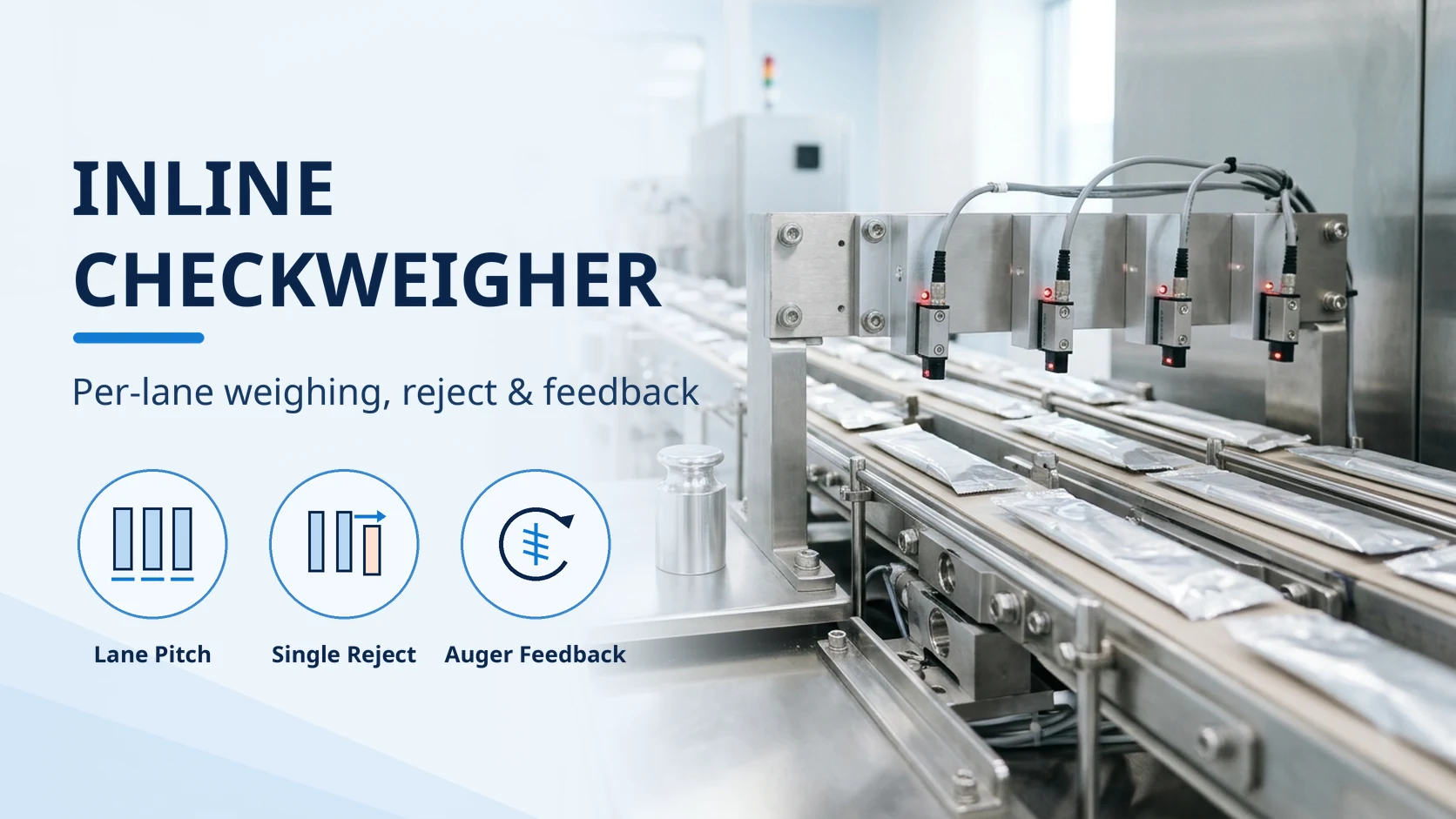
Multi-Lane Stick Pack Dosing Architecture and Per-Lane vs. Single-Lane Checkweighing
The four-lane powder stick pack machine reference configuration uses an independent servo auger for each lane. A four-lane powder stick pack machine reference range runs about 30–40 cycles per lane per minute, roughly 120–160 sticks per minute, using an independent auger for each lane. The powder stick pack reference fill weight is about 1–20 g per stick, while doses around 30 g require different auger tooling and a trial. In the StickPackMachine source facts registry for powder stick pack machines (auger, back seal), 4 lanes is the published reference configuration, while observed source configurations also mention 4 to 12 lanes and 4-16Lanes (with other lane counts quoted per project) and fill accuracy is agreed as an acceptance criterion and verified on the buyer's product during FAT rather than published as a blanket guarantee.
The powder stick pack reference configuration forms sticks with a length of about 50–180 mm and a width of about 15–30 mm set by the forming tube. The powder stick pack reference configuration uses about 3.5–4.5 kW at 220 V or 380 V and 50/60 Hz, 0.6–0.8 MPa compressed air, weighs about 650 kg, and uses an SUS304 frame with 304/316L product-contact parts. The powder stick pack reference configuration supports heat-sealable laminates (PET/PE, PET/AL/PE, NY/AL/PE, paper/PE), back seal with straight, zig-zag, or round-corner cuts and optional tear notch, plus dust extraction and nitrogen flushing options. Across the StickPackMachine lineup, liquid and gel models use a piston or servo pump with a suck-back anti-drip nozzle (about 1–30 ml sticks or four-side-seal sachets up to about 50 ml), while granule models use volumetric cups or vibratory feeding.
For equal sample counts per lane, using population variances with the observation count as divisor, total variance = average within-lane variance + variance of lane means. A combined sample can look acceptable while one lane runs high and another runs low, and a single bad pack pulled from the discharge says nothing about which lane made it unless someone labelled it when it was taken. According to Anritsu, a multi-lane checkweigher features multiple independent conveyors—typically ranging from 2 to 12 lanes—each equipped with its own load cell, operating speed, and reject mechanism that classifies products into good, underweight, and overweight. Anritsu notes that even when a single-lane checkweigher (such as the AW9 Series Ultra-Fast Type at up to 1,000 products a minute) can match a multi-lane filler's total output, running each lane of a multi-lane checkweigher at 100 feet per minute instead of pushing a single conveyor at 1,000 feet per minute allows easier product handling and significantly improved weighing accuracy. Anritsu states that when using a single-lane checkweigher in a multi-lane setup, filler feedback is limited, whereas a multi-lane checkweigher allows individual feedback control for each lane and preserves original lane positions without merging lanes. Anritsu gives an example where a six-lane checkweigher might cost $180,000 whereas purchasing six individual single-lane checkweighers for the same application could total $250,000.
Related reading: Stick Pack Machine Buying Guides; Powder Stick Pack Machine: Auger Dosing; Multi-Lane Stick Packaging Machines Compared; Single vs Multi-Lane Stick Pack Machines
Infeed Product Spacing, Narrow Lane Pitch Transfers, and EMFR vs. Strain-Gauge Weigh Cells
In dynamic inline checkweighing, the basic inspection sequence is product spacing → dynamic weighing → signal processing → tolerance comparison → acceptance or rejection; if two packages overlap, touch each other, or bounce while entering the weigh belt, the result will not represent either package correctly. For high-speed multi-lane checkweighers in pharma, Anritsu recommends models with accuracy around ±0.010 grams, scale intervals of 0.01 grams, throughput of 150-200 products per minute per lane, and center pitches as narrow as 50–80 mm for direct connection to multi-lane fillers. Wipotec HC-A multi-track checkweigher systems are designed for small package sizes (such as stick packs or 4-sided sealed bags), are available in conventional conveyor belt systems and as a push over variant, provide high-precision weight measurements with individual display for each track, and offer track-based or combined rejection. In Wipotec multilane push-over weighing systems for vials and stick packs, a pusher dog pushes products over EMFR (Electro-Magnetic Force Restoration) Weigh Cells that are completely separated mechanically from product transport, achieving lane spacings from 25 millimeters with one central servomotor for all lanes and optional AVC (Active Vibration Compensation).
The Ishida DACS Multi-Lane Checkweigher (DASC Multilane Checkweigher table) offers 2 / 3 / 4 / 5 / 6 lanes, a weighing capacity of 200 g (weighing range 2 - 200 g), ± 0.1 g weighing accuracy, 0.05 g minimum graduation, double-beam load cells, and a max weighing speed of 150 times / min per lane. The Ishida DACS Multi-Lane Checkweigher features an 80mm conveyor pitch, conveyor belt width of 50mm, 80mm or 100mm (350L x 50W mm conveyor size in spec table), product dimensions of 40 - 230 mm length × 10 - 50 mm width × 5 - 60 mm height, belt speed of 5 - 65 m / min, 12.1 inch touch screen panel, AFV (Anti Floor Vibration system), IP-30 standard construction (IP-65 waterproof model), approx 65 kg main body weight, and single phase AC100, 240 V, 50/60 Hz power. Kenwei's Model JW-C50 (Identify Code CDL650-2-1) 6-lane checkweigher for strip-packed materials such as coffee sticks and pharmaceuticals has 6 weighing lanes, a 1-50g weighing range, ±8/±15mg accuracy, 55 cuts/min max speed, 50-170(L)X25-35(W)X5-15(H) mm material size range, 10.1-inch touch screen, slide-type reject, approximate height of 350mm, 220V/600W/50/60Hz/3A power, and 100kg gross weight.
All-Fill's Model EW/8 checkweigher offers 0.5 grams resolution and utilizes a strain gauge load cell to weigh packages up to 5 lbs, while the Model PW/12 power weigh table handles containers up to 8 lbs at speeds up to 250 packages per minute with accuracies of ±0.5 grams, depending on the application. All-Fill's Model HP/14 high-precision checkweigher handles packages up to 8 lbs at speeds up to 300 containers per minute and utilizes an electromagnetic force restoration (EMFR) load cell as standard to achieve accuracy up to ±100 mg. AMS Filling Systems' EB-100 Economy Belt checkweigher uses off-the-shelf strain gauge technology and adjustable leveling rubber isolators, whereas the HB-100 High-End Belt uses electromagnetic force restoration (EMFR) weigh cells, and the AMS Embedded Checkweigher uses EMFR weigh cells to provide high-accuracy feedback and adjustments; embedding it closely with the auger filler conveyor allows the highest rate of feedback possible. Wintech's WT-500A Dynamic Checkweigher has a weighing range up to 2000 g, 1 g resolution, ±1 g dynamic accuracy (3σ Rule), 70 pcs/min max sorting speed, 120 mm conveyor belt width, 300 mm conveyor belt length, drop-through rejector, and supports Modbus RTU, RS-232C/485/422, Ethernet, and EtherCAT communication at 0 °C–40 °C and <80% humidity.
Related reading: How a Stick Pack Machine Works; Stick Pack Sizes & Dimensions Guide; Stick Pack Machine Floor Space: Multi-Lane Size, Weight, Ceiling Height & Line Layout Guide
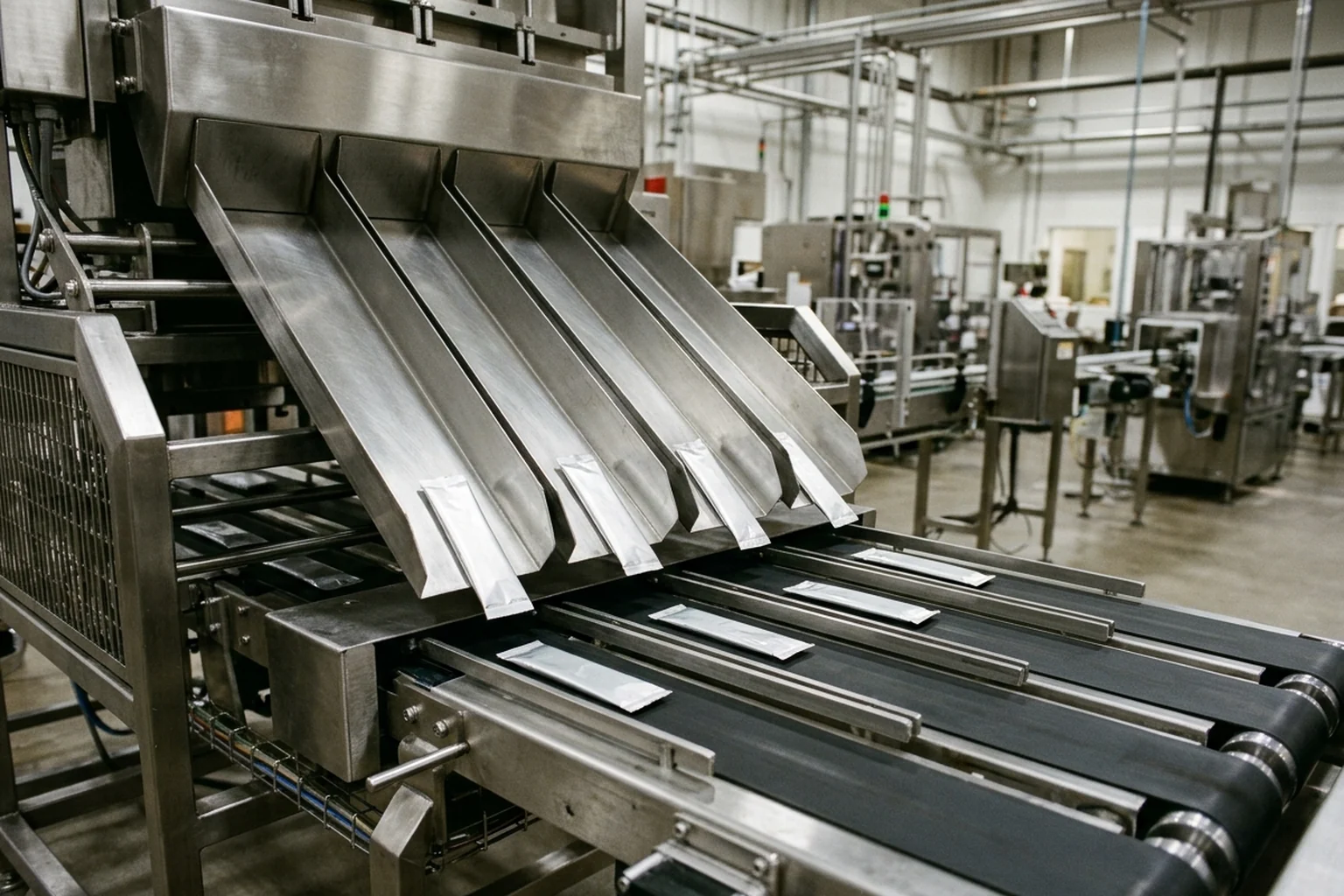
Checkweigher Reject Systems: Air Jets, Pushers, Drop Flaps, and Fail-Safe Controls
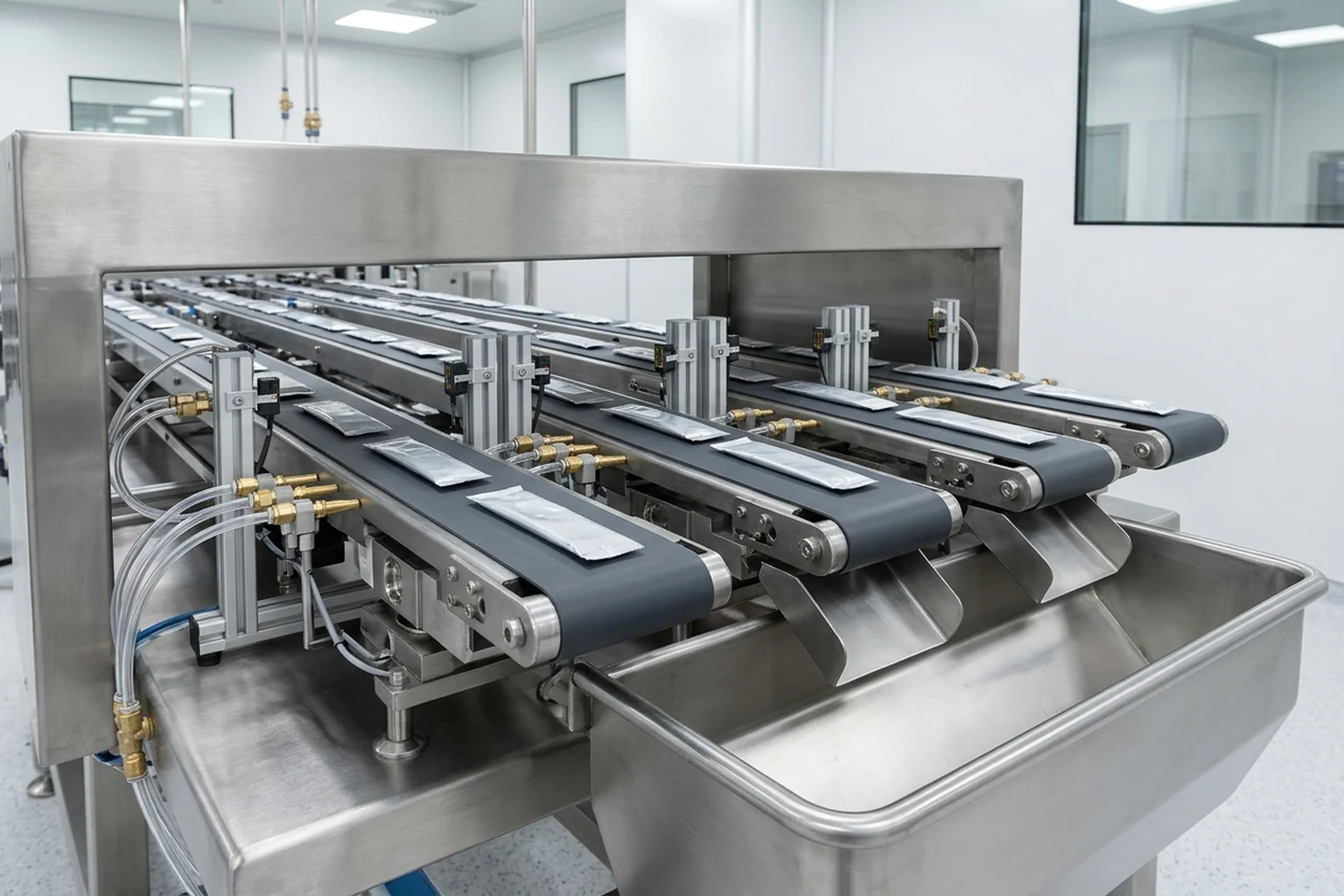
In multi-lane checkweighers for sachets and stick packs, each lane moves a single pack across its own weigh cell with photoelectric triggers, and a dedicated reject device per lane—where air jets suit light, fast packs, pushers work for heavier or less fragile items, and drop flaps fit short footprints or enclosed chutes—removes off-spec packs without disturbing adjacent lanes. A checkweigher reject system tracks a failed package to the reject point and activates an air blast, pusher, diverter, or drop mechanism, and for controlled pharmaceutical production can include a reject confirmation sensor and a lockable collection bin. Reject control should define the response to loss of compressed air or a full reject bin. Wolf-Packing's WPMC Multi Lane Weighing Belt is built in 2 to 16 lane configurations with drag chain, belt conveyor, and gravity-assisted fixed scale designs, holding 100 recipes in memory with user-set 3 or 5 zone (low reject, low pass, good, high pass, and high reject) outputs, 3-level password protection, and calibration audit trail.
Related reading: Pharmaceutical Stick Pack Machines: 316L cGMP; Stick Pack Machine Problems and Solutions: Multi-Lane Troubleshooting, Seal Leaks & Dose Drift
Scroll horizontally to see all columns. Keyboard: focus the table and use the arrow keys.
| Published System | Lane Count, Pitch & Speed | Weigh Cell, Accuracy & Reject Design |
|---|---|---|
| Wipotec multi-track & push-over weigh cell system | Multilane push-over systems achieve lane spacings from 25 millimeters with one central servomotor for all lanes | Wipotec HC-A multi-track systems offer conventional conveyor belt or push over variants with individual track display and track-based or combined rejection |
| Anritsu multi-lane checkweigher | Multiple independent conveyors typically ranging from 2 to 12 lanes with individual load cells, speeds, and reject mechanisms | For pharma, Anritsu recommends accuracy around ±0.010 grams, 0.01 grams scale intervals, 150-200 products per minute per lane, and 50–80 mm center pitches |
| Ishida multi-lane checkweigher | Ishida DACS Multi-Lane Checkweigher offers 2 / 3 / 4 / 5 / 6 lanes, 2 - 200 g weighing range, ± 0.1 g accuracy, 0.05 g minimum graduation, double-beam load cells, and 150 times / min per lane | Ishida DACS features an 80mm conveyor pitch, 50mm, 80mm or 100mm belt width, 5 - 65 m / min belt speed, 12.1 inch touch screen, AFV, and IP-30 or IP-65 construction |
| Kenwei strip-pack multi-lane checkweigher | Kenwei Model JW-C50 (Identify Code CDL650-2-1) has 6 weighing lanes for 50-170(L)X25-35(W)X5-15(H) mm strip-packed coffee sticks and pharmaceuticals at 55 cuts/min max speed | Kenwei Model JW-C50 provides a 1-50g weighing range, ±8/±15mg accuracy, 10.1-inch touch screen, slide-type reject, approximate height of 350mm, 220V/600W/50/60Hz/3A power, and 100kg gross weight |
| Wolf-Packing multi-lane weighing belt | Wolf-Packing WPMC Multi Lane Weighing Belt is built in 2 to 16 lane configurations with drag chain, belt conveyor, and gravity-assisted fixed scale designs | Wolf-Packing WPMC holds 100 recipes in memory with user-set 3 or 5 zone (low reject, low pass, good, high pass, and high reject) outputs, 3-level password protection, and calibration audit trail |
Discuss this configuration
Discuss on WhatsAppClosed-Loop Per-Lane Checkweigher Feedback to Independent Servo Auger Fillers
While older clutch-brake auger heads relied on fixed three-step pulley speeds (450, 600, and 750 RPM), our multi-lane stick pack machines use an independent servo auger drive on each lane for continuous speed and acceleration-ramp control. In multi-lane VFFS powder packaging, variations in product density or head pressure cause weight discrepancies between inner and outer lanes, requiring independent servo motors for each auger and downstream multi-lane checkweighers that weigh each lane individually and provide automatic feedback loops to the PLC to adjust dosing parameters per lane in real time. Because an auger filler is a volumetric tool that calculates weight from the number of screw rotations, compressible powder at the bottom of a hopper is denser than at the top; placing a checkweigher immediately after the packaging machine sends real-time data back to the auger filler's control system to slightly decrease or increase rotations when weight trends shift. In All-Fill's filler/checkweigher feedback control (pairing an Alpha PW-12 checkweigher with an SHA-SV-600 servo-driven automatic auger filler), the checkweigher does not make feedback corrections on a single out-of-spec weight; instead, the operator sets feedback ignore samples and a sample evaluation range so the checkweigher monitors weight trends from product density shifts and sends a correction signal that adjusts auger revolutions.
Related reading: Auger Filler for Stick Packs: Screw Pitch, Agitator Sync & Shutoff; Powder Stick Pack Machine: Auger Dosing; Instant Coffee Stick Packs: Dosing, Moisture & Nitrogen
Legal Metrology Frameworks and Pharmaceutical Equipment Calibration Controls
In OIML R 51-1: 2006 (E) clause T.1.3, an automatic catchweighing instrument (catchweigher) is an automatic weighing instrument that weighs pre-assembled discrete loads or single loads of loose material. In OIML R 51-1: 2006 (E) clause T.1.3.1, a checkweigher is a catchweigher that sub-divides prepackages of different mass into two or more sub-groups according to the value of the difference between their mass and the nominal set point. Under OIML R 51-1: 2006 (E) clause 2.1, Category X applies only to checkweighers used to check prepacked products that are subject to the requirements of OIML R 87, while Category Y applies to all other automatic catchweighing instruments. Under OIML R 51-1: 2006 (E) clause 2.1.1, Category X is further divided into four accuracy classes: XI, XII, XIII and XIIII, supplemented by a factor (x) specified by the manufacturer. In OIML R 51-1: 2006 (E) Table 1, accuracy class XII / Y(II) has verification scale interval 0.001 g ≤ e ≤ 0.05 g or 0.1 g ≤ e (up to 100 000 verification scale intervals). In OIML R 51-1: 2006 (E) Table 1, accuracy class XIII / Y(a) has verification scale interval 0.1 g ≤ e ≤ 2 g (minimum 100, maximum 10,000 verification scale intervals) or 5 g ≤ e (minimum 500, maximum 10,000 intervals).
In OIML R 51-1: 2006 (E) clause 2.5.1.1 Table 3, for Category X instruments in the lowest net load band (0 < m ≤ 500 e for Class XIII, 0 < m ≤ 5,000 e for Class XII), the maximum permissible mean error is ±0.5 e at initial verification and ±1 e at in-service inspection. In OIML R 51-1: 2006 (E) Table 4, for a net load mass m ≤ 50 g and class designation factor (x) = 1, the maximum permissible standard deviation is 0.48 % at initial verification and 0.6 % at in-service inspection. For classes XI and XII, (x) shall be less than 1; for class XIII, (x) shall be not greater than 1; and for class XIIII, (x) shall be greater than 1. Under OIML R 51-1 Edition 2006 (E) Erratum clause A.5.6.2.1 (Static tare), the tare setting accuracy is verified to be better than ± 0.25 e.
Under NIST Handbook 133 (2026) Chapter 1, in general, the average net quantity of contents of packages in a lot must at least equal the net quantity of contents declared on the label. Under NIST Handbook 133 (2026) Chapter 1, the limit of the reasonable minus variation for an under filled package is called a Maximum Allowable Variation (MAV), beyond which the deficiency is considered an unreasonable minus error. In NIST Handbook 133 (2026) Appendix A Table 2-5 (Maximum Allowable Variations for Packages Labeled by Weight), for a labeled quantity less than 36 g (0.08 lb or 1.28 oz) the MAV is 10 % of labeled quantity, and for 36 g or more to 54 g the MAV is 3.6 g. Section 2.2 requires inspection scales to have at least 100 scale divisions with a scale division no larger than MAV/6 (one-sixth of the Maximum Allowable Variation for the package size being weighed). Under NIST Handbook 44 (2024) Section 2.24 Paragraph A.1, the Automatic Weighing Systems code applies to automatic weigh-labelers, automatic checkweighers, combination automatic and non-automatic checkweighers, and automatic gravimetric filling machines. Under NIST Handbook 44 (2024) Section 2.24 Paragraph S.5.1 and Table S.6, weigh-labelers and automatic checkweighers shall be Class III devices (0.1 g to 2 g verification division e with 100 to 10,000 divisions, or ≥5 g with 500 to 10,000 divisions, and d not smaller than 0.1 e). Under NIST Handbook 44 (2024) Section 2.24 Paragraph N.3.2 and Table N.3.2, automatic checkweighers shall be tested at the highest speed in each weight range using two test loads, with 30 consecutive sample weights per test in the field (60 for type evaluation) when 20 divisions < m < 10 kg (22 lb).
Under 21 CFR § 211.68(a), automatic, mechanical, or electronic equipment used in the manufacture, processing, packing, and holding of a drug product shall be routinely calibrated, inspected, or checked according to a written program designed to assure proper performance, and written records of those calibration checks and inspections shall be maintained. Under 21 CFR § 211.68(b), appropriate controls shall be exercised over computer or related systems to assure that changes in master production and control records or other records are instituted only by authorized personnel, input/output of formulas or data shall be checked for accuracy, and a backup file of data shall be maintained.
Related reading: Pharmaceutical Stick Pack Machines: 316L cGMP; Nutraceutical Stick Pack Machine
Scroll horizontally to see all columns. Keyboard: focus the table and use the arrow keys.
| Regulatory Framework | Classification & Scope | Verification & Tolerance Requirement |
|---|---|---|
| International catchweighing metrology framework | In OIML R 51-1: 2006 (E) clause 2.5.1.1 Table 3, for Category X instruments in the lowest net load band (0 < m ≤ 500 e for Class XIII, 0 < m ≤ 5,000 e for Class XII), the maximum permissible mean error is ±0.5 e at initial verification and ±1 e at in-service inspection | In OIML R 51-1: 2006 (E) Table 4, for a net load mass m ≤ 50 g and class designation factor (x) = 1, the maximum permissible standard deviation is 0.48 % at initial verification and 0.6 % at in-service inspection |
| Net contents package inspection handbook | In NIST Handbook 133 (2026) Appendix A Table 2-5, for a labeled quantity less than 36 g (0.08 lb or 1.28 oz) the MAV is 10 % of labeled quantity, and for 36 g or more to 54 g the MAV is 3.6 g | Section 2.2 requires inspection scales to have at least 100 scale divisions with a scale division no larger than MAV/6 (one-sixth of the Maximum Allowable Variation for the package size being weighed) |
| Automatic weighing systems device code | Under NIST Handbook 44 (2024) Section 2.24 Paragraph S.5.1 and Table S.6, weigh-labelers and automatic checkweighers shall be Class III devices (0.1 g to 2 g verification division e with 100 to 10,000 divisions, or ≥5 g with 500 to 10,000 divisions, and d not smaller than 0.1 e) | Under NIST Handbook 44 (2024) Section 2.24 Paragraph N.3.2 and Table N.3.2, automatic checkweighers shall be tested at the highest speed in each weight range using two test loads, with 30 consecutive sample weights per test in the field (60 for type evaluation) when 20 divisions < m < 10 kg (22 lb) |
| Finished drug equipment & computer controls | Under 21 CFR § 211.68(a), automatic, mechanical, or electronic equipment used in the manufacture, processing, packing, and holding of a drug product shall be routinely calibrated, inspected, or checked according to a written program designed to assure proper performance, and written records maintained | Under 21 CFR § 211.68(b), appropriate controls shall be exercised over computer or related systems to assure that changes in master production and control records or other records are instituted only by authorized personnel, input/output of formulas or data checked for accuracy, and a backup file of data shall be maintained |
Factory Acceptance Testing (FAT), Process Capability (Cpk), and Stratified Lane Qualification
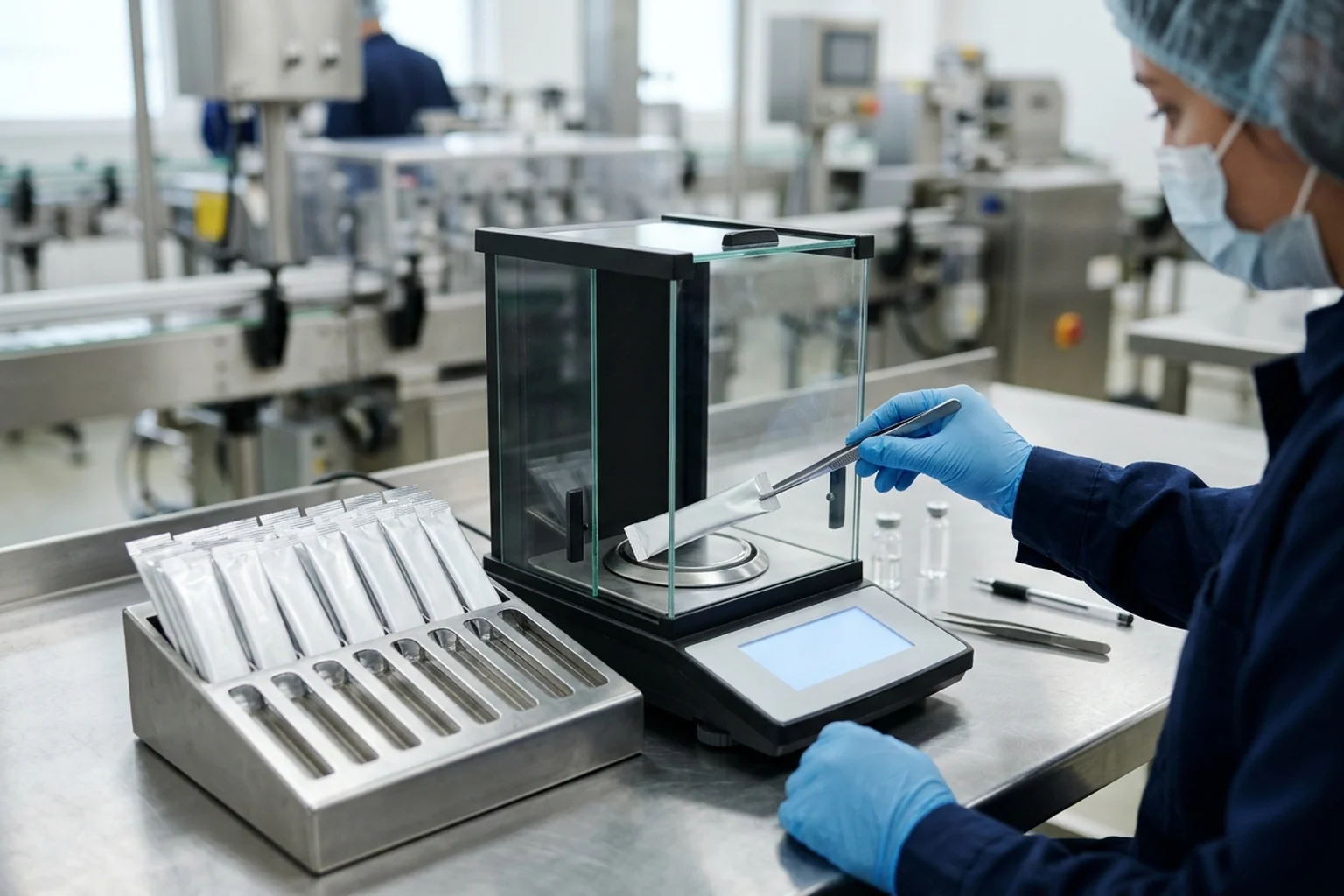
Where a stable process and an agreed statistical sampling method support capability analysis, Cpk = min[(USL − mean)/(3s), (mean − LSL)/(3s)], using the agreed dose limits and within-process standard deviation s in consistent units. For production accounting, availability = running time / planned time; performance = produced packs/(running time × agreed ideal pack rate); quality = accepted packs / produced packs, and OEE is their product. Product for the running portion of a FAT test in kg = active lanes × cycles/min × running minutes × dose in g / 1,000, and running film length in meters = machine cycles × cut pitch in mm / 1,000. StickPackMachine has its manufacturing base in Foshan, Guangdong Province, China, has been building packaging machinery since 2013, and builds single machines to order (MOQ = 1 Unit).
Related reading: Stick Pack Machine FAT Checklist; Stick Pack Production Capacity: Lanes, Cycles per Minute (CPM), Film Splicing & Real OEE Output; How to Choose a Stick Pack Machine
Sources
- Our StickPackMachine Engineering Library — Powder, Liquid, and Granule Stick Pack Machine Specifications, Auger Filler Guide, Troubleshooting Guide, and Factory Acceptance Test Checklist
- International Organization of Legal Metrology — Automatic Catchweighing Instruments Metrological and Technical Requirements
- National Institute of Standards and Technology — Checking the Net Contents of Packaged Goods and Specifications, Tolerances, and Other Technical Requirements for Weighing and Measuring Devices
- Code of Federal Regulations — Automatic, Mechanical, and Electronic Equipment in Current Good Manufacturing Practice for Finished Pharmaceuticals
- Wipotec, Anritsu, Ishida, All-Fill, AMS Filling Systems, Kenwei, Wintech, Wolf-Packing, and Multi-Lane Checkweigher Technical Literature