
Which liquids and gels can a stick pack machine fill?
Thin liquids, concentrates and viscous gels such as energy gels and liquid supplements can all be packed in sticks, but each poses a different filling problem. A liquid stick pack machine has to deliver a measured dose and leave the sealing area clean enough to close. Describe the formulation, the dose and the temperature at the machine inlet, plus any particles, foaming, settling in storage or thickening after standing. A room-temperature sample may not behave like product arriving warm from your process.
Pump type, contact parts and nozzle arrangement follow from the actual formulation, not from the product category. Explain how the product is prepared, held and transferred before packing, and whether it arrives continuously or in batches. That fixes the boundary between the packaging machine and your upstream process, and shows which connections and operating conditions both sides have to support.
Pump, hopper and product circuit
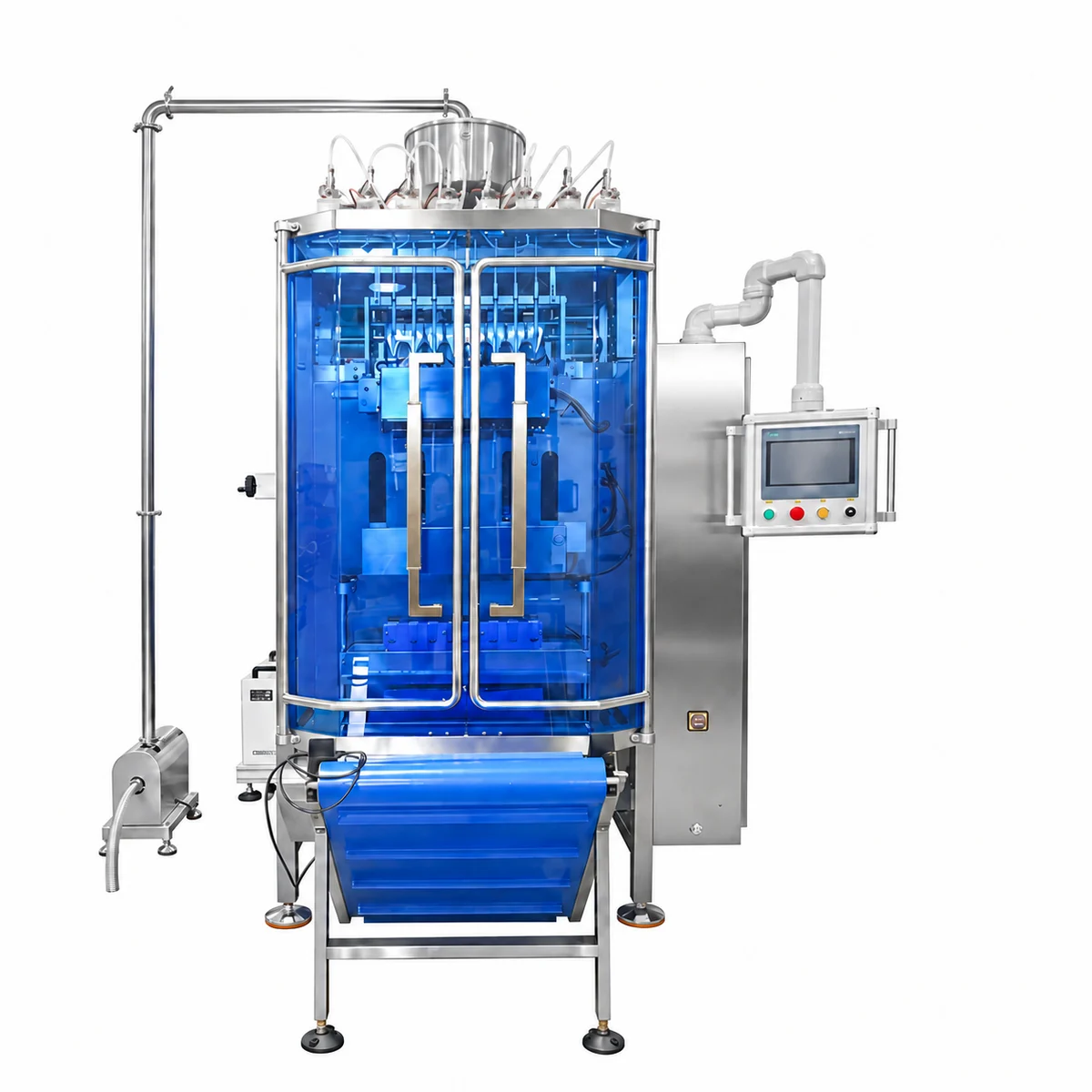
The quotation should name every part of the liquid path from the supply connection to the nozzles: hopper or inlet, pumps, distribution connections, hoses, valves and filling outlets. In the reference configuration each lane has its own piston or servo pump. Ask how that pump covers your portion range and how the operator switches between approved settings. Liquid moving through a hose on a bench says little about a complete multi-lane filling sequence.
Heating, insulation or agitation should be specified for a reason your product team can state, such as keeping a thick gel pumpable. A jacketed, heated and agitated hopper is listed as an option for viscous products; if it is proposed, define which parts of the circuit it covers and how temperature is monitored during a run, and have it written into the equipment scope. The trial should follow the product through refills and waiting periods as well as steady running.
| Item | Review before ordering |
|---|---|
| Product contact parts | Material compatibility and access for cleaning |
| Dosing system | Dose range, viscosity and particulate tolerance |
| Temperature control | Whether heating, insulation or agitation is required |
| Cleaning | Disassembly, flushing and any proposed cleaning-in-place scope |
| Sealing | Film compatibility and product residue at the seal |
How do anti-drip nozzles keep liquid out of the seal?
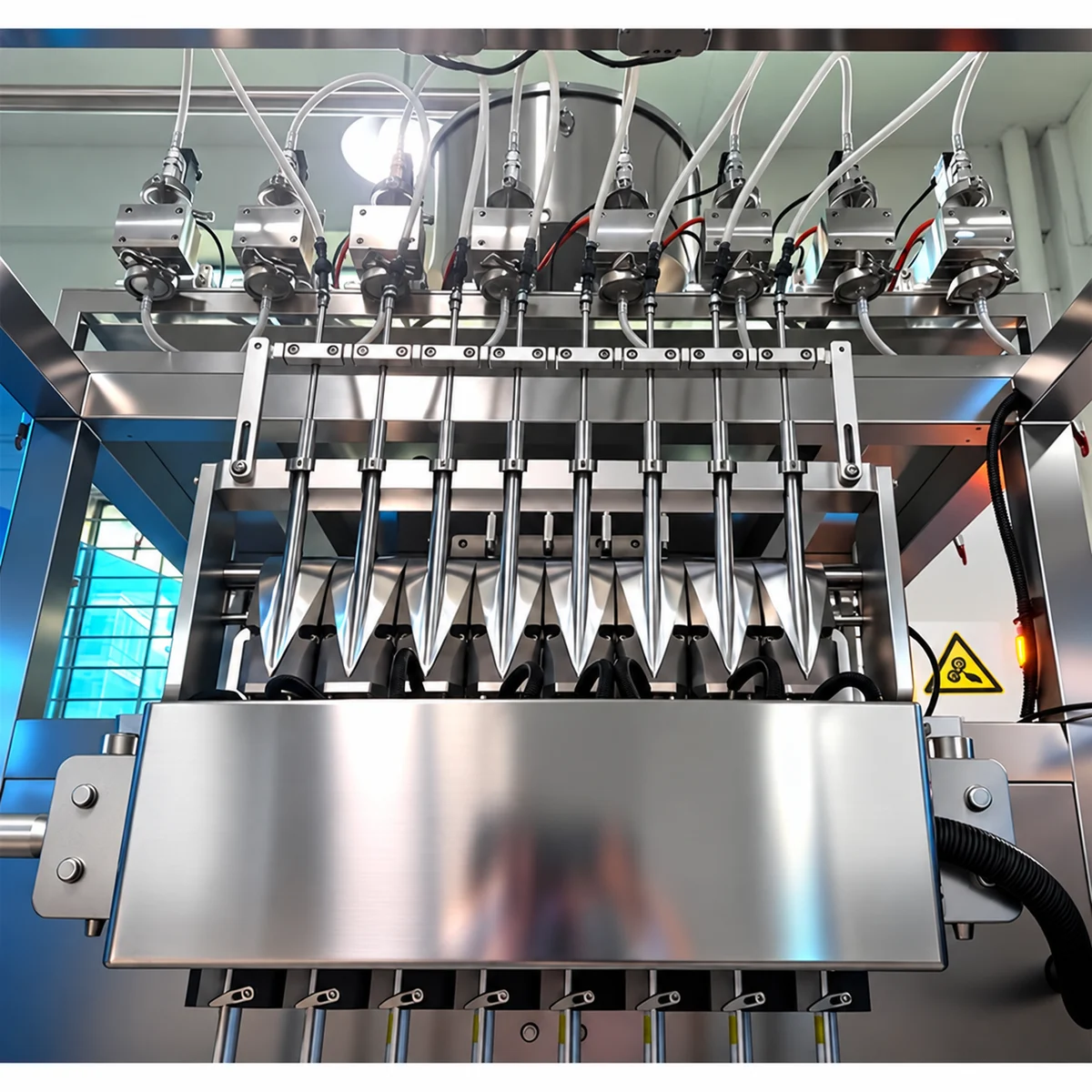
Suck-back nozzles draw a small amount of product back into the outlet at the end of each dose, so a drop does not land on the film where the end seal will form. That only works when nozzle position, dose timing and the interval before sealing are set together for your formulation. Watch for product hanging at the outlet, strings between nozzle and dose, and residue near the end seal, and record the settings with each observation so contamination in a finished pack can be traced.
Build deliberate pauses and restarts into the trial, because the first packs after a wait often differ from those in an uninterrupted run. Collect samples by lane and by stage, then compare fill and seal appearance before changing settings. A close-up video of a clean nozzle cut-off is useful, but the finished pack still has to pass your inspection and opening checks after it has been formed, filled and cut.
Stick or sachet: pack geometry and film path
Choose between a slim stick and a wider four-side-seal sachet from a finished-pack drawing showing width, length, seals, cut and opening feature. The two formats use different forming, sealing and cutting hardware even for the same gel; in the reference configuration a stick holds about 1–30 ml and a sachet up to about 50 ml. Confirm the included format and tooling before ordering printed film or treating a sample from another platform as the production design.
Provide the film structure, thickness, roll dimensions and supplier material code; the reference film reel width is about 400–480 mm. Check the registration mark and artwork against the coding and cutting positions. During the trial, look at how much headspace the filled volume leaves for closing, and test grip, tearing and emptying on filled packs. If several pack sizes are planned, ask for a changeover description that separates operator settings from the parts that must be swapped.
Cleaning and service access for the liquid path
List every part that touches product, from the supply connection and hopper through pumps, hoses and valves to the nozzles, and how each is reached for cleaning. Ask which parts come off and which stay assembled. If a cleaning-in-place interface is offered, document what it reaches and what still needs manual work or extra equipment. A connection described as cleaning-ready is not yet a procedure your plant can follow.
Your product and quality teams decide the checks required before the next batch is released. Review material compatibility, reassembly instructions and the pump seals or contact parts that wear in routine service. Measure changeover from the last accepted pack of one product to the first accepted pack of the next, including draining, cleaning, inspection and setup. That figure is far more useful to production planning than the time for a single flush.
How fast is a four-lane liquid stick pack machine?
As a reference range, a four-lane liquid stick pack machine reaches about 120–200 packs per minute, with a piston or servo pump per lane and suck-back nozzles to limit drips on the seal area. Viscosity and fill volume decide where a project falls in that range: thick or heated products and products with particles run slower than thin liquids.
Figures are typical reference ranges for four-lane configurations. Output, fill range and dose accuracy depend on the product, film and pack size; they are confirmed in the quotation and verified during factory acceptance testing, not guaranteed for every product.
| Parameter | Typical reference range |
|---|---|
| Lanes | 4 in the reference configuration; other lane counts are quoted per project |
| Output | About 120–200 packs per minute, depending on viscosity and fill volume |
| Fill volume | About 1–30 ml per stick pack; up to about 50 ml in four-side-seal sachets |
| Pack length | About 50–180 mm |
| Pack width | About 15–80 mm per lane, depending on pack format |
| Film reel width | About 400–480 mm |
| Dosing | Piston or servo pump per lane with suck-back anti-drip nozzles |
| Options | Jacketed, heated and agitated hopper for viscous products |
| Power supply | About 3.5–4.5 kW; 220 V or 380 V, 50/60 Hz, matched to the destination grid |
| Machine weight | About 750–850 kg |
| Footprint | About 1.6 × 1.2 m and about 2.1 m high, excluding feed tanks and platforms |
Matching machine output to the rest of the line
Line capacity is set by accepted packs per minute over your daily operating pattern, not by the filler alone. Check that product supply, refills and finished-pack handling can keep pace with that target. Coding, conveyors, counting and cartoning may be supplied separately; agree who owns each mechanical and control interface, and what the packer does when a downstream station stops accepting packs.
In evaluation, keep mechanical cycle rate apart from finished output that passes the agreed checks. Record the run time, active lanes, sample results and rejects together with the product and film used, including stops, restarts and supply changes. If the line will run several formulations, note which were tested and which still need assessment, so one good demonstration is not applied to every product in the schedule.
What to send for a liquid machine quotation
Send the formulation description, viscosity information if you have it, dose range, filling temperature and the sample quantity you can supply. Add the pack drawing, proposed film and target output, then the upstream transfer arrangement, cleaning requirements, available utilities and installation space. Flag particles or handling restrictions that affect pumps, hoses or nozzles. With these inputs the discussion covers the whole filling task and shows which details are still open before equipment is selected.
Agree in advance what the sample trial will establish: dose results by lane, finished-pack checks, restart behavior and how cleaning or changeover went. Keep the results tied to the tested material, format and settings. The quotation should then list supplied components, optional items, documentation and service scope, so the equipment proposal can be traced back to your application and acceptance criteria.
Documents to request for a liquid filler
Ask for the documents you need by name, because anything left unnamed is easy to leave out of scope. For a liquid machine that means a configuration list covering the pumps, nozzles, hopper options and product-contact materials, plus the agreed factory acceptance criteria and the results recorded for your machine.
Operating instructions, a spare-parts list for pump seals, hoses and nozzles, and control-cabinet wiring diagrams are further common requests; check which ones the quotation includes. Any compliance documentation your market requires is a separate topic to raise directly. Keep the set with the trial results so installation and service teams work from one reference.
Common Questions
What fill volume can a liquid stick pack machine handle?
The four-lane reference configuration fills about 1–30 ml per stick pack, or up to about 50 ml in four-side-seal sachets, with pack widths of about 15–80 mm per lane depending on format. Send your target volume and pack drawing so the pump and forming parts are matched to them.
Can a liquid stick pack machine fill products with particles?
It can be assessed, but particles affect pump and nozzle selection, and products with particles generally run slower than thin liquids within the reference output of about 120–200 packs per minute across four lanes. Describe the particle size and share, and send a real sample for the trial.
What causes a liquid stick pack to leak at the seal?
A leak usually means product reached the seal area or the film and seal settings do not suit the product. Check nozzle cut-off and timing first, then the film. Inspect end seals on packs from every lane after pauses and restarts, not only in a steady run, and keep the settings with each sample.
How much floor space does a liquid stick pack machine need?
The four-lane reference machine occupies about 1.6 × 1.2 m, stands about 2.1 m high and weighs about 750–850 kg, excluding feed tanks and platforms. Add room for operator access, product supply, film loading and downstream conveyors when you lay out the area.