
Prepare a quotation discussion
Use the What to send us table to prepare your request. Partial answers are enough to start. The team reviews the filling method and pack, identifies which decisions affect the configuration and discusses the next useful step with you.
What happens when you request a quote on WhatsApp?
We handle all quotation requests on WhatsApp. The button opens a draft RFQ with six editable requirement fields, this page and a Reference ID. Fill in what you know, edit anything you like and send it. The button sends nothing by itself.
Keep the Reference ID so the team can find the page your request came from. After you send the message, the team follows up on WhatsApp about any missing details. Our team reviews your product, pack and output requirements. A quotation and any order are agreed separately.
Discuss this configuration
Discuss on WhatsAppHow ordering works
Ordering a stick pack machine runs from your request to installation in six steps. There is no separate order form: the WhatsApp RFQ starts the request, and the order itself is the agreed quotation and contract. A sample trial is usually arranged when your product, dose or pack has not yet been run on the proposed configuration, so not every project goes through every step at the same depth.
Dates, fees and responsibilities for each step are set in the quotation for your project. Ask for them in writing at the quotation stage rather than after production has started, and keep the trial, acceptance and installation records under the same machine reference.
Related reading: Stick Pack Machine Sample Testing; Stick Pack Machine FAT Checklist; Stick Pack Machine Installation & Training
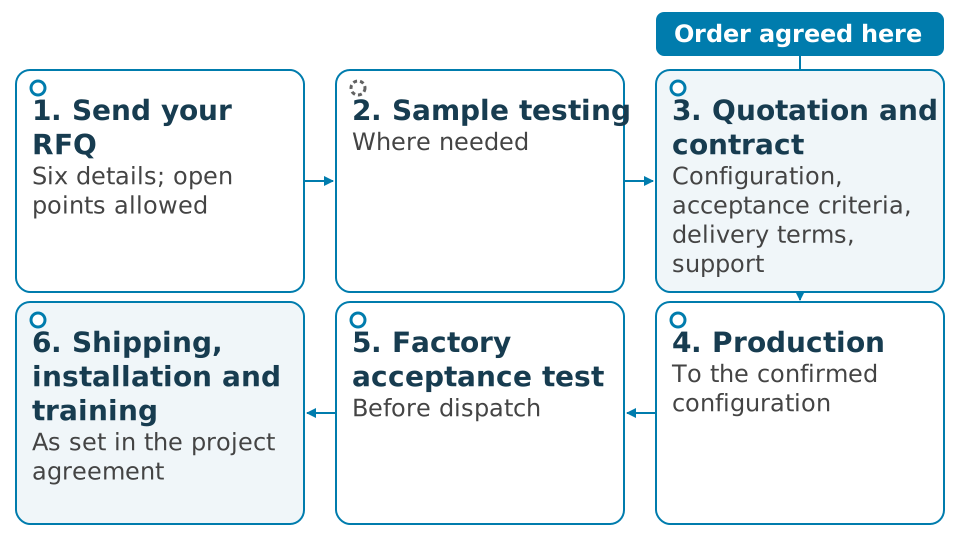
- Send your requirements: the six RFQ details on this page, with undecided points marked as open
- Sample testing where needed, with scope, sample quantity and fees agreed before you ship material
- Quotation and confirmation: configuration, acceptance criteria, delivery terms and support responsibilities, then the contract
- Production of the machine to the confirmed configuration
- Factory acceptance test against the agreed criteria before dispatch
- Shipping, installation and operator training as set in the project agreement
How to fill in the RFQ when details are uncertain
If you have an estimate, label it as provisional. You can give a dose or output range, approximate pack dimensions and expected shifts per day. Leave blank anything you do not know. The team can help you work out what to decide before the machine is quoted.
Use the scope line for anything beyond the machine itself: feeding, coding, sample testing, installation and training, or spare parts. Listing these at the start lets the team ask the right questions and lets you compare quotations on the same scope.
State output as accepted packs per minute rather than machine cycles so offers from different suppliers can be compared on the same basis.
Sharing samples and drawings
Agree with the team how to provide a product sample, film specification or drawing. Leave confidential recipes and unnecessary personal information out of your first message.
The quotation defines the selected equipment, acceptance criteria, delivery terms and support responsibilities so manufacture and site preparation follow the same configuration.
If you need sample testing, installation and training or spare parts, ask for each to appear as a separate line so its scope and fees can be read on their own.
Common Questions
Do I need a complete specification to start?
No. Fill in the RFQ lines you know and leave the rest blank. The team will ask on WhatsApp for the information needed for the next step.
Does clicking WhatsApp place an order?
No. It opens an editable message. Orders and commitments require a separate agreed quotation and contract.
Can I attach samples or drawings to my first message?
Mention that they exist, but agree how to share them first. Keep confidential recipes and unnecessary personal information out of the initial message. Once the conversation has started, the team will discuss how to provide a product sample, film specification or drawing.