
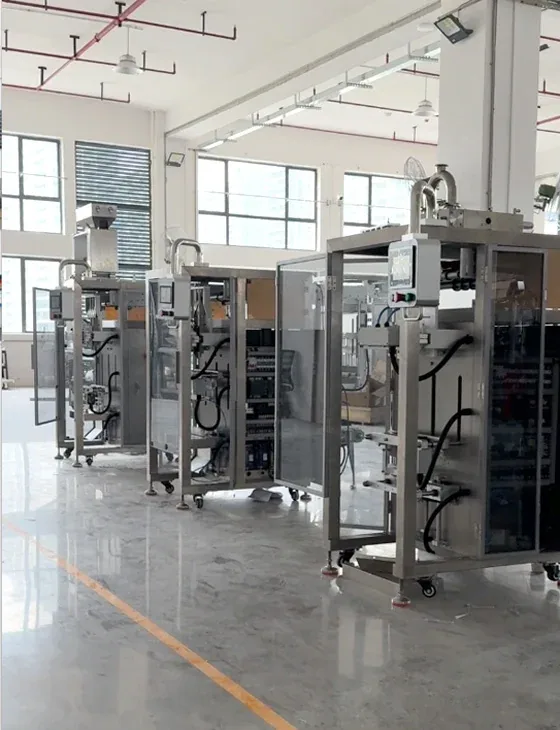
What does the site need before the machine arrives?
The receiving site needs a clear access and unloading route, a floor position with room for cleaning, service access and change parts, and the utilities your machine specification calls for. Check the items below against the layout and utility requirements in the quotation before dispatch.
Plan how product reaches the machine and how finished packs leave it, whether by hand, from a hopper or onto a downstream conveyor. Mark the electrical supply and grounding point, and the compressed-air connection where one is specified, on your own floor plan.
Share the floor plan before agreeing installation support so both teams can check access and the connections shown on it.
- Floor layout, access route and unloading arrangements
- Electrical supply and grounding requirements
- Compressed-air supply where specified
- Product feeding and finished-pack handling
- Space for cleaning, service access and change parts
How does stick pack machine installation work?
Installation follows the order below, and each step depends on the one before it. The quotation and project agreement should name who does each step, so use the list to check that no step is left without an owner.
Treat commissioning as complete only when the site checks with your own material and film pass, or when every difference from the factory test has been recorded, explained and resolved. Keep the result with the factory acceptance records so both can be compared later.
Related reading: Stick Pack Machine FAT Checklist
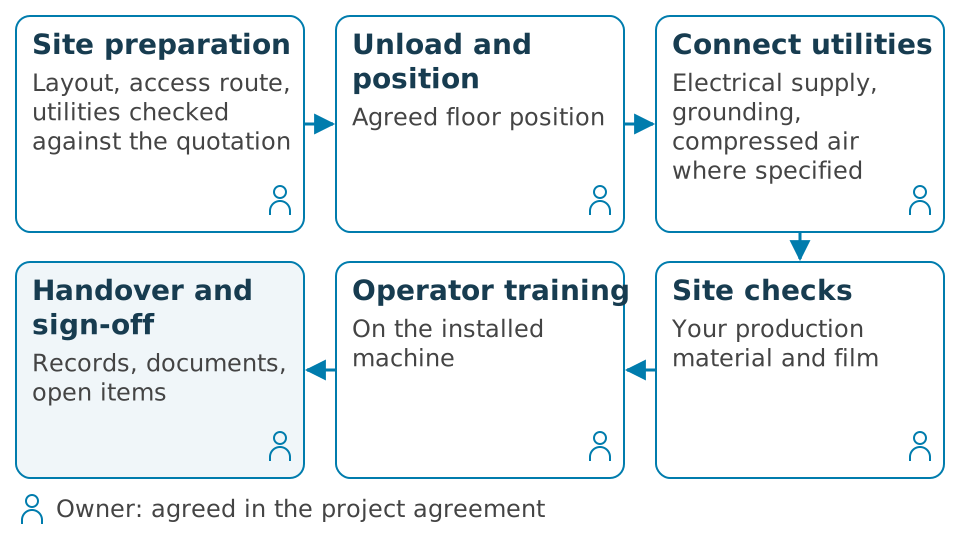
- Site preparation: layout, access route and utilities checked against the quotation before dispatch
- Unloading the machine and placing it in its agreed floor position
- Connecting the electrical supply, grounding and compressed air where specified
- Site checks with your own production material and film
- Operator training on the installed machine
- Handover records and sign-off of commissioning
Is installation support remote or on site?
Support can be remote, on site or a combination, and the arrangement for your project is set in the project agreement. Location, travel, working language, schedule and fees must be stated there rather than assumed.
Ask what support is available for your destination and who will handle it on each side. Have any response-time commitment written into the agreement. Define the contact route, remote support and any site attendance in the service scope.
Write down who unloads and positions the machine, who connects utilities, who supplies product and film for the site checks, and who signs off commissioning. A short responsibility list agreed in advance is easier to check against than a general description of support.
How do you use a stick pack machine day to day?
Daily operation comes down to four jobs: loading film, loading product, starting up on an approved recipe and changing over to another product or size. The outline below shows what each job involves so you can plan staffing and training. The manual for your configuration sets the actual steps, guards and settings, and it takes precedence over any general description, including this one.
Loading film: the roll is mounted on the unwind stand in the correct winding direction and threaded along the film path to the forming parts, where each lane's strip is folded into a tube. On printed film, a registration sensor reads a printed mark to keep the artwork and the cut position aligned, so registration is checked after every roll change on packs from every lane.
Loading product: product reaches the hopper by hand or from upstream feeding equipment, depending on the configuration. Keep the hopper level and supply steady, because fill weight can drift with hopper level, refills and pauses, especially with powders that settle and blends that separate. On a liquid machine the product supply feeds a pump for each lane, and the nozzles are checked for drips before packs are accepted.
Startup: select the approved recipe settings, run the first packs and check fill weight by lane, seals, cut position and print before counting output. Packs made just after a stop and restart can differ from steady running, so check them the same way. A multi-lane machine needs these checks on every lane, not on one combined sample.
Changeover: a new flavor at the same dose and pack size may need only a settings change and cleaning, while a new width, seal layout or much larger dose needs change parts such as a forming set, sealing or cutting parts, another auger or another nozzle. Each changeover ends with first-pack checks before production restarts. Ask the supplier to go through the changeovers you plan and say which are settings changes and which are parts changes.
Related reading: How a Stick Pack Machine Works; Stick Pack Machine Spare & Change Parts
What should stick pack machine operator training cover?
Operator training should cover safe startup and shutdown using the machine manual, recipe setup, changeover, cleaning and routine inspections. Agree the topics, format and trainees in the project agreement, and identify who is responsible for training records and ongoing operator competence.
Use your own production material and film for the agreed site checks. Record differences from the factory test and resolve them before treating commissioning as complete.
Choose trainees who will actually run and clean the line, plus whoever handles maintenance. If shifts rotate, decide how later operators will be trained from the manual and the handover records.
Use the topic list below to agree what the training covers on your machine. Each topic should end with the trainee doing the task on the installed machine, not watching it.
- Safe startup, shutdown and stopping procedures from the machine manual
- Loading film, threading the film path and setting print registration
- Loading product and keeping the supply steady
- Selecting recipes and running first-pack checks by lane
- Changeover between the planned products and pack sizes
- Removing product-contact parts for cleaning and reassembling them
- Routine inspections and recording stop reasons
Which manuals and handover records should you ask for?
Ask for the handover records in the quotation rather than after installation. Useful records include the site checks performed, the training topics and trainees, and any difference noted between the factory test and the site run, with the action taken.
Record any spare or change parts used or recommended during commissioning. Keep their identification with the manual and site-check report. Operators and maintenance staff can use this record for later changeovers and parts requests.
Put the document list in the quotation as well: operating instructions (the machine manual), electrical and pneumatic drawings, the parts list with change parts and wear items, and maintenance information. These documents are written for the configuration you receive, so a manual found online for another multi-lane stick pack machine may not match your lane count, dosing unit or controls. Check the documents at the factory acceptance test and again at handover.
Compare installation proposals
When comparing quotations, check the support location and format, travel, working language, schedule, fees, handover records and the document list. Ask each supplier to name the installation tasks and training topics it includes. A general line reading 'installation support' leaves too much undecided before delivery.
Common Questions
Do you provide on-site installation for a stick pack machine?
Tell us the site location and whether you need remote help, on-site attendance or both. We will discuss availability and record the agreed travel, language, schedule, fees and responsibilities in the project agreement. Confirm these arrangements before dispatch.
What utilities does a stick pack machine need?
The electrical supply, grounding and, where specified, compressed air depend on the configuration you order. Take the requirements from your quotation and machine documentation rather than a general web page, and check them against your site before the machine is dispatched.
Who should attend operator training?
The people who will run, clean and maintain the line day to day, plus whoever keeps training records. Agree the trainees and topics in advance, and plan how operators who join later will be trained from the machine manual and the handover records.
What happens if the site run differs from the factory test?
Record the difference, agree its cause and the fix, and resolve it before commissioning is treated as complete. Running site checks with your own production material and film makes such differences visible while both sides are still working through the handover.
How do you clean a stick pack machine between products?
Operator training should cover removing the product-contact parts named in the cleaning procedure, cleaning them and reassembling them, along with the cleaning steps at each product changeover. Your production and quality teams set the cleaning method and the checks required before the next batch; make sure it suits the stainless grades used, since the powder reference configuration combines a SUS304 frame with 304/316L product-contact parts. Training teaches the procedure; cleaning validation remains a separate task for your quality team.
Is there a manual for a multi-lane stick pack machine?
Ask for the operating manual written for your supplied configuration, together with the drawings and parts list, and have them listed in the quotation. Check them at the factory acceptance test and at handover. A manual for a different machine may not match your lane count, dosing unit or controls.