
How does a stick pack machine work?
Two material streams meet inside a stick pack machine. Film comes off the unwind stand and is shaped into narrow tubes, one per lane; product comes down from the hopper and is dosed into those tubes; sealing jaws close each pack and a cutter separates it. The exact arrangement varies with the machine platform and finished format, which is why the table below lists what to check at each stage rather than a fixed hardware list. Knowing the sequence helps a buyer ask sharper questions during a quotation, a demonstration or a troubleshooting call.
Coordination matters more than the speed of any single station. A doser that fills quickly is useful only when film feed, sealing and discharge keep pace with it, and product supply upstream or pack handling downstream can cap useful output while the machine keeps cycling. During a demonstration, follow both streams: where product enters, how it reaches each lane, where the film travels and what happens to the finished packs. That tells you more about real performance than watching the sealing jaws.
| Stage | Purpose | What to check |
|---|---|---|
| Film supply | Unwind and guide the roll film | Tracking and print registration |
| Forming | Present film in the required lane and pack geometry | Compatibility with the pack drawing |
| Dosing | Deliver the product into each pack | Material-specific filling method |
| Sealing | Close the longitudinal and end seal areas | Film conditions and clean seal zones |
| Cutting and discharge | Separate packs and transfer them onward | Cut registration and product handling |
Film unwinding and print registration
The film path starts at the unwind stand, where a roll of compatible film is mounted and guided toward the forming area, with tension and tracking controlled along the way. On printed film, the artwork has to line up with pack length and cut position. A registration sensor reads a printed mark on the web to hold that timing, provided the mark and print layout match what the machine expects, so check both against the machine's requirements before ordering printed rolls.
Inspect the roll path during a trial from outside the guarded areas. Ask the operator to show how rolls are loaded, how the correct winding direction is identified and how registration is set. Then look at packs from every lane for print that drifts or film that wrinkles. A fault that appears after a roll change points to a different cause than one that affects a single lane all the time, so log roll numbers and artwork revisions in the production record to separate material differences from setup differences.
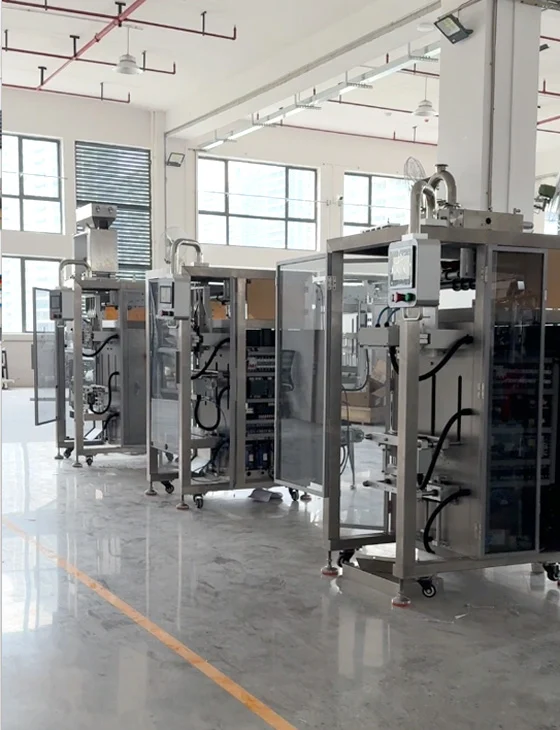
How is film formed into multiple lanes?
The wide web is slit into narrower strips, and forming parts fold each strip around the filling path into the pack shape. How web width, lane spacing, seal layout and finished pack relate to one another is specific to each platform, so check it against a dimensioned drawing before ordering printed film or change parts.
Our powder range includes multi-lane forming configurations, and our liquid machines pull and slit the web in a coordinated way. That describes the process family, not identical hardware in every configuration. Ask which forming components are included in the quoted machine and how a different pack width would be introduced. Also check access for threading and routine adjustment, because a machine that is awkward to set up can burn through film before the first acceptable packs appear.
Dosing powders, liquids and granules in each lane
Each lane receives a measured dose from a system chosen for the product. Powder configurations use an auger, and the auger and feed arrangement must suit the formulation, dose and flow behavior: a cohesive powder, an aerated one and a free-flowing blend can react differently to the same settings. In a trial, judge consistency lane by lane and over time, not from one combined sample.
Liquids and gels use a pump and nozzle matched to viscosity, temperature, particles and how the product behaves at the end of each dose. Test any anti-drip or shutoff feature with the real product instead of assuming it keeps every seal clean. Granules may use a volumetric or vibrating dosing option, which has to be confirmed against your sample, including how particle size and blend separation are handled. What matters is how the offered system performs with your material, not whether a brochure lists the product category.
Longitudinal and end sealing
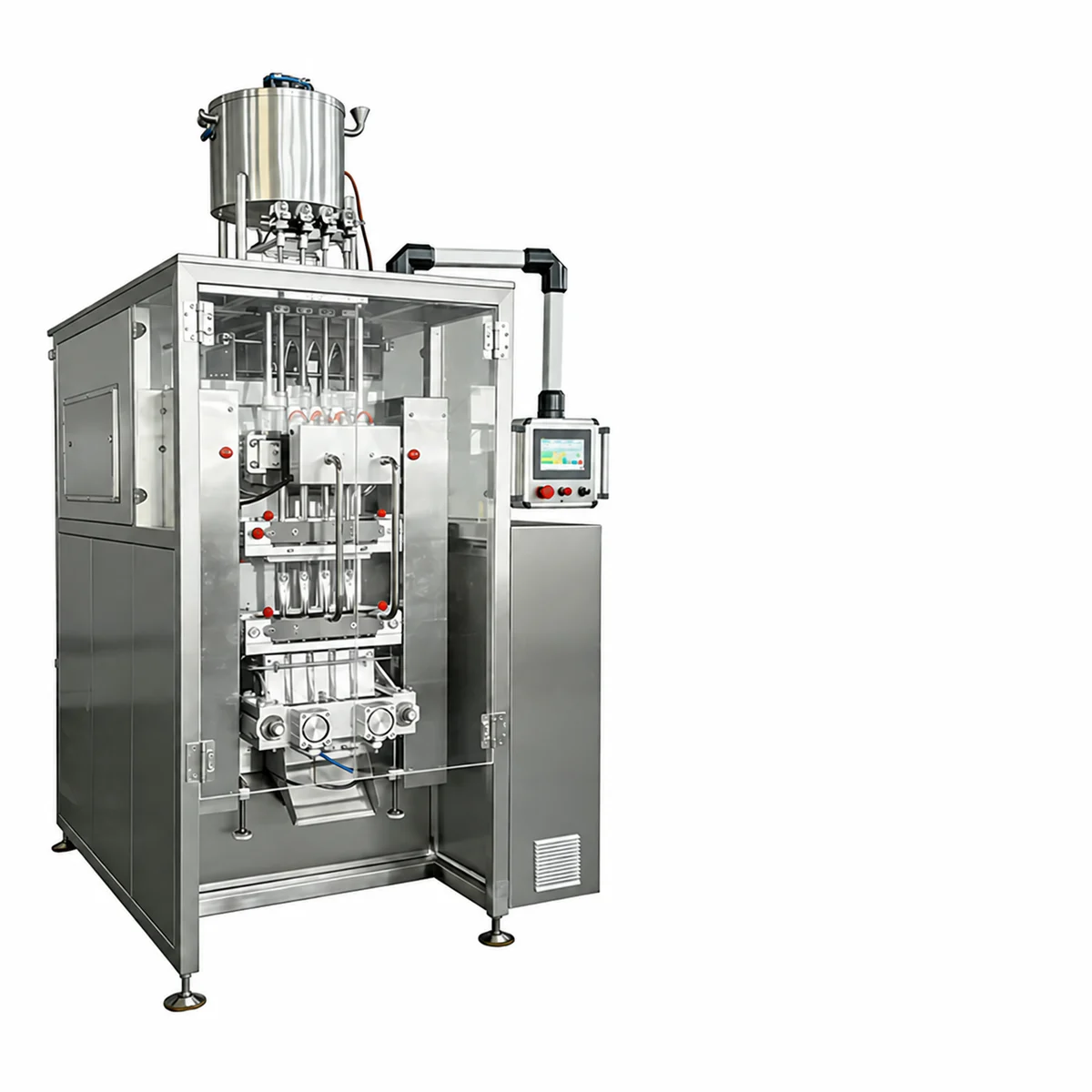
Each pack gets a longitudinal seal along its length and an end seal at each end, and both depend on film structure, machine setup and operating settings. Product that reaches the seal area interferes with closure, so powder handling, nozzle timing and film alignment belong in the same conversation as jaw temperature and timing. A defect that looks like a sealing problem can start upstream at the filler.
Watch the first packs after a stop and restart, since they can differ from steady-running output. Agree how finished seals will be evaluated and keep samples labeled by lane and operating conditions. A good-looking seal is useful evidence, but it does not replace an agreed integrity check; a machine running smoothly on a demonstration floor has not shown that the package suits your product and distribution chain.
Cutting, coding and discharging finished packs
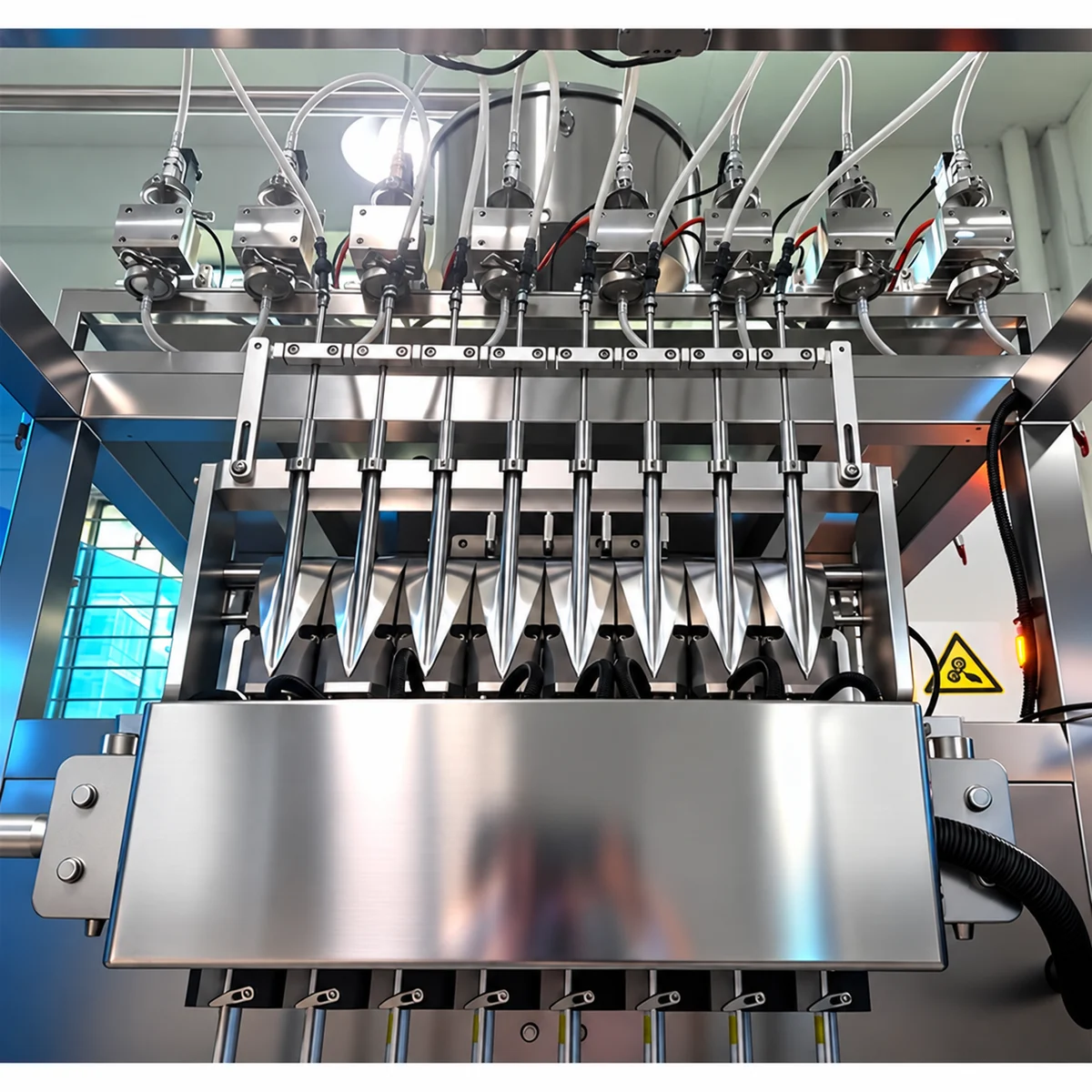
The cutter separates the sealed web into individual packs. Depending on the configuration, a project may add a particular cut style, a tear feature, a code printer or a counting station; each should appear as a line in the quotation rather than being assumed standard. Coordinate cutter position, artwork and the code area so the printed information stays readable and the pack tears open where intended.
At discharge, several lanes release packs at the same moment. Manual collection, counting, conveying or secondary packing all have to absorb that output without pileups or crushed packs. Ask who supplies and integrates the equipment between the stick pack machine and the next process; a clearly defined transfer point prevents two machines that each meet their own specification from failing to work as a line.
Further reading: Packaging World: stick pack collation and cartoning at PACK EXPO
Is cycle speed the same as accepted output?
No. A machine cycle and a finished pack are different units: nominal output is cycle rate multiplied by active lanes, while accepted output also subtracts stops and rejects. As an arithmetic example only, four active lanes at twenty cycles per minute create eighty pack positions per minute before losses. That figure illustrates the calculation; it is not a stated capability of any machine we offer and should not be read as a production promise.
When comparing projects, define accepted packs and the measurement period together. Record the material, dose, film, active lanes and the reason for each stop or reject, and state whether the timing includes roll changes, replenishment and changeover. A rate measured over a short uninterrupted demonstration cannot be compared with a full-shift result. With shared definitions, both sides can talk about practical capacity and find the real bottleneck instead of trading headline speeds.
Stick pack machine buying checklist by stage
Ask the supplier to walk through the proposed sequence using your pack drawing and material brief. Name the product inlet, film specification, dosing method, seal layout, cutter and discharge boundary, then add utilities, cleaning and maintenance access, change parts and operator tasks. Mark which options are included and which need a separate decision; that turns a process explanation into a configuration you can quote and review.
Before acceptance, agree on a representative run and the records it should produce: filling results by lane, seal observations, registration checks, stop reasons and accepted output. Ask for the manuals, drawings and parts information for the supplied configuration. To start, send StickPackMachine your product and film samples with the pack drawing. A sound purchase rests on verifying the whole process under defined conditions, not on lane count or a moving demonstration.
Common Questions
What are the main parts of a stick pack machine?
The main parts are the film unwind stand with a registration sensor, the slitting and forming section, the dosing system (an auger, a pump and nozzle, or a granule doser), the sealing jaws, and the cutter with its discharge. Coding, counting and conveying equipment are options and should be listed separately in a quotation.
What does the registration mark on stick pack film do?
The registration mark is a printed mark that a sensor on the machine reads to keep the artwork aligned with pack length and cut position. If the mark is missing, faint or placed where the machine does not expect it, the print drifts from pack to pack, so confirm its position before ordering printed rolls.
Why do stick pack seals fail?
Seal failures trace back to the film structure, the jaw settings or product reaching the seal area. Powder dust and liquid dripping from the nozzle are typical upstream causes, so a seal defect should be investigated at the filler as well as at the jaws. Judge seals with an agreed integrity check, not appearance alone.
What should I watch during a stick pack machine demonstration?
Follow both the film and the product: how rolls load and register, how each lane is dosed, how packs look after a restart, and how the discharge copes when every lane releases at once. Ask for results by lane and for accepted output over a defined period rather than a short burst of cycling.