
What should you send before a sample trial?
Identify the question the sample needs to answer before shipping material. Describe the behavior to observe, such as dusting at the seal, caking after a pause, stringing at cutoff or settling in the supply path. Include handling precautions so the team can plan the setup and sample procedure safely.
The team uses the brief to assess whether a trial is needed and to discuss sample quantity and film. Identify the question you want the run to answer, such as fill-weight variation or product in the seal. Some equipment questions can be answered from the drawing and specification alone.
Include the pack format you plan to sell and any dosing method already under discussion. If you are changing an existing pack's size or film, describe the current setup and what you want to change. You can leave machine selection open for the team to assess.
How does product formulation affect stick pack packaging?
Formulation decides three things in a stick pack project: how the product is dosed, how cleanly the seal closes and which film it needs. A product name does not tell you which of these will be the difficult one. Two collagen powders, or two energy gels, can flow, settle or drip differently, so the table below links each property to the part of the machine it affects and to what the trial should check.
Powders are judged on flow and bulk density. Bulk density turns a dose in grams into a volume, and that volume decides whether the serving fits the stick width and length you have in mind. A cohesive or aerated powder can bridge in the hopper, fill unevenly across lanes and lift as dust when each dose drops, which puts product in the end seal. Auger dosing is the usual starting point, and dust extraction is an option on the powder reference configuration, but the trial has to show how your powder behaves at start-up, in steady running and after a pause.
Liquids and gels are judged on viscosity, filling temperature and whether they carry particles. These properties choose the pump and nozzle, and they decide whether each dose breaks off cleanly or strings onto the seal area. Thick, heated or particulate gels generally run slower than thin liquids. Granulated mixes add particle size and blend separation: a volumetric cup measures volume, so a blend that separates or changes density in the hopper changes the fill weight with it.
Moisture and oxygen sensitivity are mostly film and handling questions. A hygroscopic powder can cake in the hopper or pick up moisture between storage and the forming tube, and an oxidation-sensitive product needs barrier layers chosen with your film supplier. Nitrogen flushing is an option on the powder reference configuration; if you want it, define what it should achieve and how the result will be measured before it goes into the trial scope.
That is why the trial should run your real production material, stored and shipped the way it will be in production, together with your intended film where it is available. A substitute powder, a lab batch or a sample that has picked up moisture in transit can pass or fail for reasons that will not repeat on your line. The trial records how your formulation behaved on the tested setup; changing the formulation itself remains a decision for your product team.
Related reading: Powder Stick Pack Machine: Auger Dosing; Liquid Stick Pack Machine for Gels; Granule Stick Pack Machine: Drink Mixes; Stick Pack Film & Machine Compatibility; Energy Gel Stick Pack Machine
Scroll horizontally to see all columns. Keyboard: focus the table and use the arrow keys.
| Product property | What it affects | What to send and check |
|---|---|---|
| Powder flow and bulk density | Auger and feed arrangement; dose volume against stick size | Bulk density and how it was measured; fill weight by lane over time |
| Fine or dusty powder | Product in the end seal; need for dust extraction | Seal area on packs from every lane |
| Liquid viscosity and filling temperature | Pump and nozzle choice; drips or strings at the nozzle | Viscosity data if available and filling temperature; seal area after each dose |
| Particles in a liquid or gel | Pump, hose and nozzle selection; achievable output | Particle size and share; dose consistency by lane |
| Granule size and blend separation | Volumetric cup or vibratory dosing; fill-weight drift | Fill weight at different hopper levels and after refills |
| Moisture or oxygen sensitivity | Film barrier, hopper exposure, optional nitrogen flushing | Storage conditions and intended film; product condition in the hopper |
What should you agree before shipping a sample?
Agree sample quantity, fees, freight, handling and return or disposal before anything leaves your site, because each of these depends on the project. Do not send confidential formulations or physical samples until the handling scope is agreed.
Request the planned trial date and fees in writing before shipping. Booking, timing and charges are agreed for each project, along with the results you will receive.
Tell the team how the material is normally stored and transported, for example sealed against moisture or kept cool, and whether the sample may be consumed in the trial. A sample that has picked up moisture or separated in transit may not behave like your production material.
Defining the scope of a stick pack trial
Write down the product, pack width and length, film, dosing method and target fill weight. Agree the checks that will answer your open questions, and have both sides accept that scope before the run.
Ask which machine arrangement will be used and how it differs from the configuration being proposed to you, for instance in lane count, dosing unit or sealing tooling. Also ask whether you can attend the run or receive photographs or video of it. Settle these points as part of the scope, not afterwards.
What should a sample trial record?
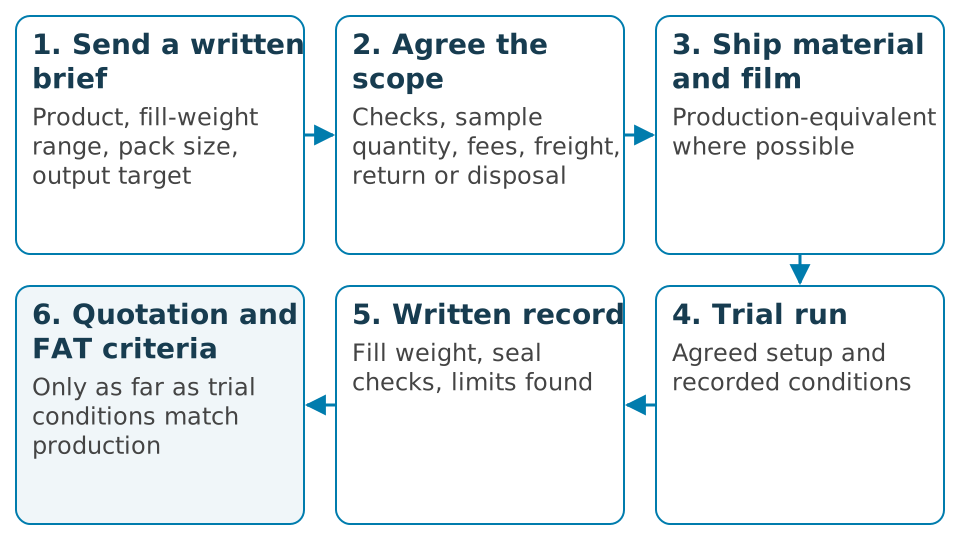
Agree in advance what the trial should record and ask for the record in writing, so the result can be compared with later tests. The list below is a practical minimum; add product-specific checks, such as powder in the seal area or drips at the nozzle, where they matter.
- Material identification and trial conditions
- Material condition on arrival and storage before the run
- Dosing and pack configuration
- Film used and finished pack appearance
- Fill-weight observations and seal checks
- Limits encountered and proposed follow-up work
How do trial results shape the machine configuration?
Trial results carry into the configuration only as far as the trial conditions match production. Check whether the material and film were production-equivalent, and note every difference before setting acceptance targets or finalizing the machine specification.
Where the fill-weight and seal observations are sound, you can propose the same checks as criteria for the factory acceptance test and reference them in the quotation. Where the trial exposed a limit, agree the follow-up work, such as a second run with another film or dosing arrangement, before relying on the result.
Common Questions
How much sample material should I send for a stick pack trial?
Send the quantity agreed with the team rather than a guess. The amount depends on the fill weight, the pack size and how many settings need to be tried, so share the brief first and ask for the figure together with packaging, freight and return or disposal instructions.
Should the trial use my own film?
Use production-equivalent film wherever you can. Film structure and thickness affect forming and sealing, so a substitute can hide problems that only appear with your finished pack material. If your film is not yet available, record that the trial used a different film and plan a later check.
Is stick pack sample testing free?
Fees, freight and sample handling are agreed for each project. Ask the team for the charges and planned trial date in writing before sending material.
Does a successful trial confirm the final machine specification?
No. A trial shows how your product behaved under the recorded conditions. The final specification, acceptance criteria and commercial terms are set in the quotation and contract, and differences between trial and production material should be resolved before you rely on the result.
Can you adjust my formulation so it runs better on a stick pack machine?
Formulation development stays with your product team. The trial records how your formulation behaved and which machine-side settings were tried, such as the dosing arrangement, timing, pack length or film. If you change the product afterwards, run the revised batch in a repeat trial rather than assuming the earlier result still applies.