
Which stick pack machine fits your material?
Pick the machine by what flows into the pack. Dry powders and powder blends go to the powder machine, pumpable liquids and gels go to the liquid and gel machine, and free-flowing granulated mixes go to the granule machine. Finished packs can look almost identical across all three, but the feeding and dosing hardware behind them is not interchangeable.
Products that sit between categories, such as instant coffee that is partly agglomerated or a drink mix with coarse and fine particles, are settled with a sample rather than a product name. Note any dust, foaming, sticking, settling or segregation you already see in production, list every recipe that will share the line and mark the one that runs most often. That tells the engineers which product should set the configuration and which ones may need extra tooling.
| Route | Typical application to discuss | Information to prepare |
|---|---|---|
| Powder | Coffee, collagen and powdered drink mixes | Bulk density, dose range, dust and moisture behavior |
| Liquid & gel | Energy gels and liquid supplements | Viscosity, fill temperature, particulates and dose |
| Granules | Granulated solid beverage mixes | Particle size, flow, segregation and pack format |
How do the three stick pack machine types compare?
The three machines follow the same film-to-pack sequence of forming, filling, sealing and cutting; what changes most is the dosing unit and, with it, the reference output and fill range. The table lists the four-lane reference range published on each machine page. Read every figure as a typical range for that reference configuration, not a guaranteed rate for your product.
Where your product sits inside a range depends on how it behaves. Fine, sticky or dusty powders run toward the lower end of the powder range; thick, heated or particulate gels run slower than thin liquids; and uniform, free-flowing granules sit higher than blends that segregate or bridge. Other lane counts are quoted per project, and the rate for your line is confirmed by a sample trial and stated in the quotation.
| Machine type | Dosing per lane | Output (four-lane reference range, not guaranteed) | Fill range (reference) | Pack format (reference) |
|---|---|---|---|---|
| Powder | Independent auger for each lane | About 30–40 cycles per lane per minute, roughly 120–160 sticks per minute | About 1–20 g per stick; around 30 g needs different auger tooling and a trial | Back-seal stick, about 15–30 mm wide (set by the forming tube) and about 50–180 mm long |
| Liquid & gel | Piston or servo pump per lane with suck-back anti-drip nozzles | About 120–200 packs per minute, depending on viscosity and fill volume | About 1–30 ml per stick pack; up to about 50 ml in four-side-seal sachets | Stick or four-side-seal sachet, about 15–80 mm wide per lane and about 50–180 mm long |
| Granule | Volumetric cups or vibratory feeding, selected with the product sample | About 30–50 packs per lane per minute, up to roughly 120–200 packs per minute | About 1–30 g per stick pack | Back-seal stick about 20–60 mm wide per lane, or four-side-seal sachet about 30–80 mm wide; about 50–180 mm long |
How does dosing differ between powder, liquid and granule machines?
Each machine meters the product in a different way. On the powder machine the auger meters each dose by its rotation, so the hopper has to present powder to the screw at a steady density; aeration after a refill or compaction after a pause shows up directly as weight variation. On the liquid machine a piston or servo pump pushes a fixed volume through tubing and a nozzle, and the suck-back action at the end of each stroke keeps product off the seal. Heating or agitation is added only when the product needs it and is written into the supply scope.
Granules bring particle size, bulk volume and blend separation into the decision, so the choice between volumetric cups and vibratory feeding is made after the sample has been run. On every machine, check how product travels from the hopper to each active lane, not just how one filler performs on a bench. A trial that links supply, dosing and sealing shows the problem where it matters, on the finished pack.
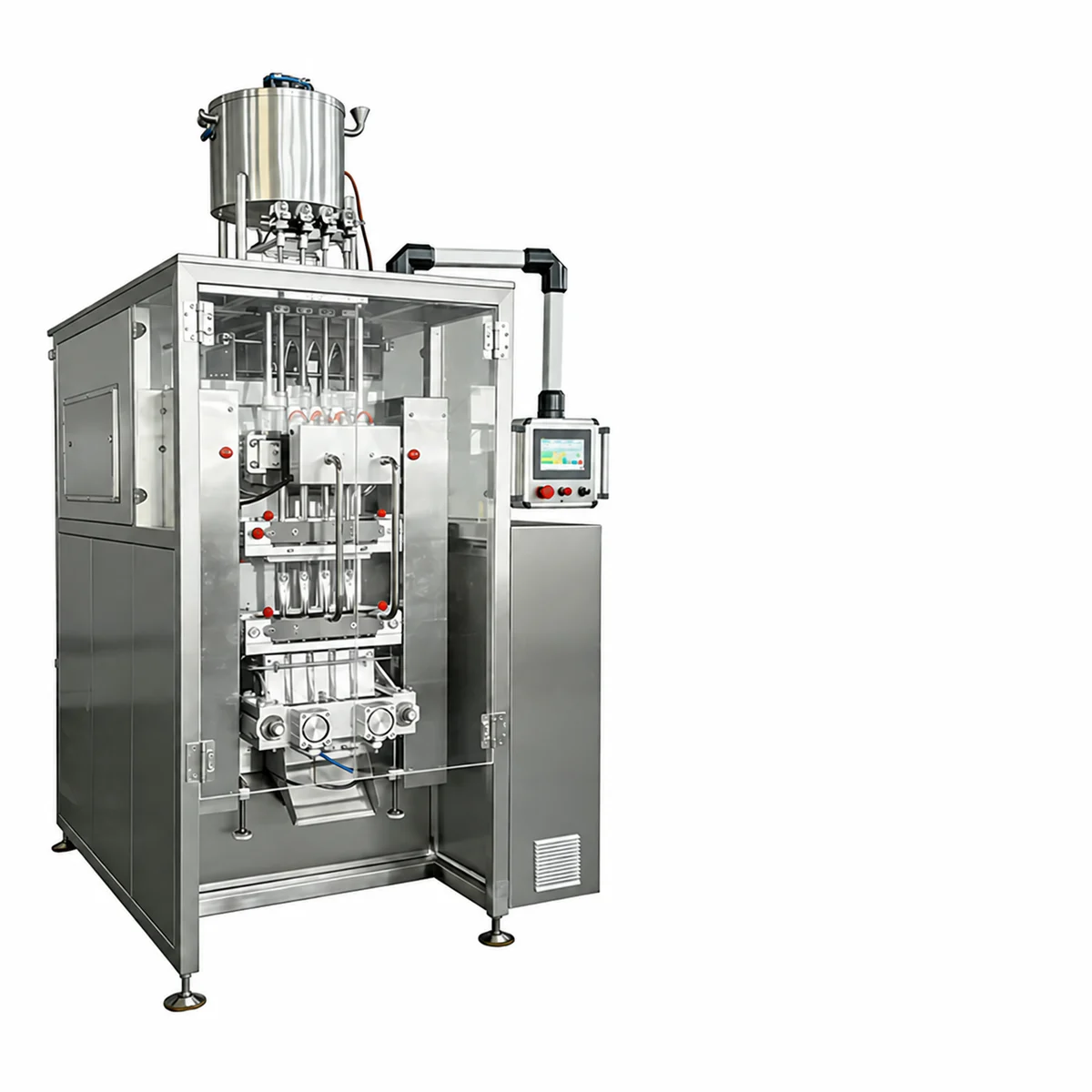
Four-lane reference configuration and lane count
The four-lane machine is the reference point across the range: one film reel is slit and formed into four sticks that are filled, sealed and cut in the same cycle. More lanes raise the output ceiling, but each lane still needs enough time to dose and seal cleanly, so lane count is reviewed together with portion size, pack length and the product's behavior rather than chosen from a target number alone. The single-lane versus multi-lane guide walks through that sizing.
Ask the engineers to show how film registration, dosing and sealing stay in step, which adjustments an operator makes day to day, and how a recipe is stored and recalled after a format change. During a trial, pull samples from every lane, not only the lane nearest the operator. Lane-by-lane results make it easy to trace a fault back to one auger, pump or sealing station.
Pack and film specification for a stick pack machine
Start the pack specification with a drawing that shows finished width, length, seal layout, tear notch or opening feature and code position, and say whether the dimensions describe the finished pack or the flat film. A slim stick and a wider four-side-seal sachet use different forming and sealing parts, and a shaped pouch may belong on another platform entirely, so confirm which formats the quotation covers before ordering printed rolls.
For the film, list the supplier material code, laminate structure, thickness and roll dimensions. The powder machine page lists the heat-sealable laminates used in the reference configuration, such as PET/PE, PET/AL/PE, NY/AL/PE and paper/PE. Run filled samples on the proposed machine and check forming, print registration, seal strength and opening, not just appearance. Shelf life and barrier performance come from the product and film together, so plan that testing alongside the machine trial.
What does a complete stick pack machine line include?
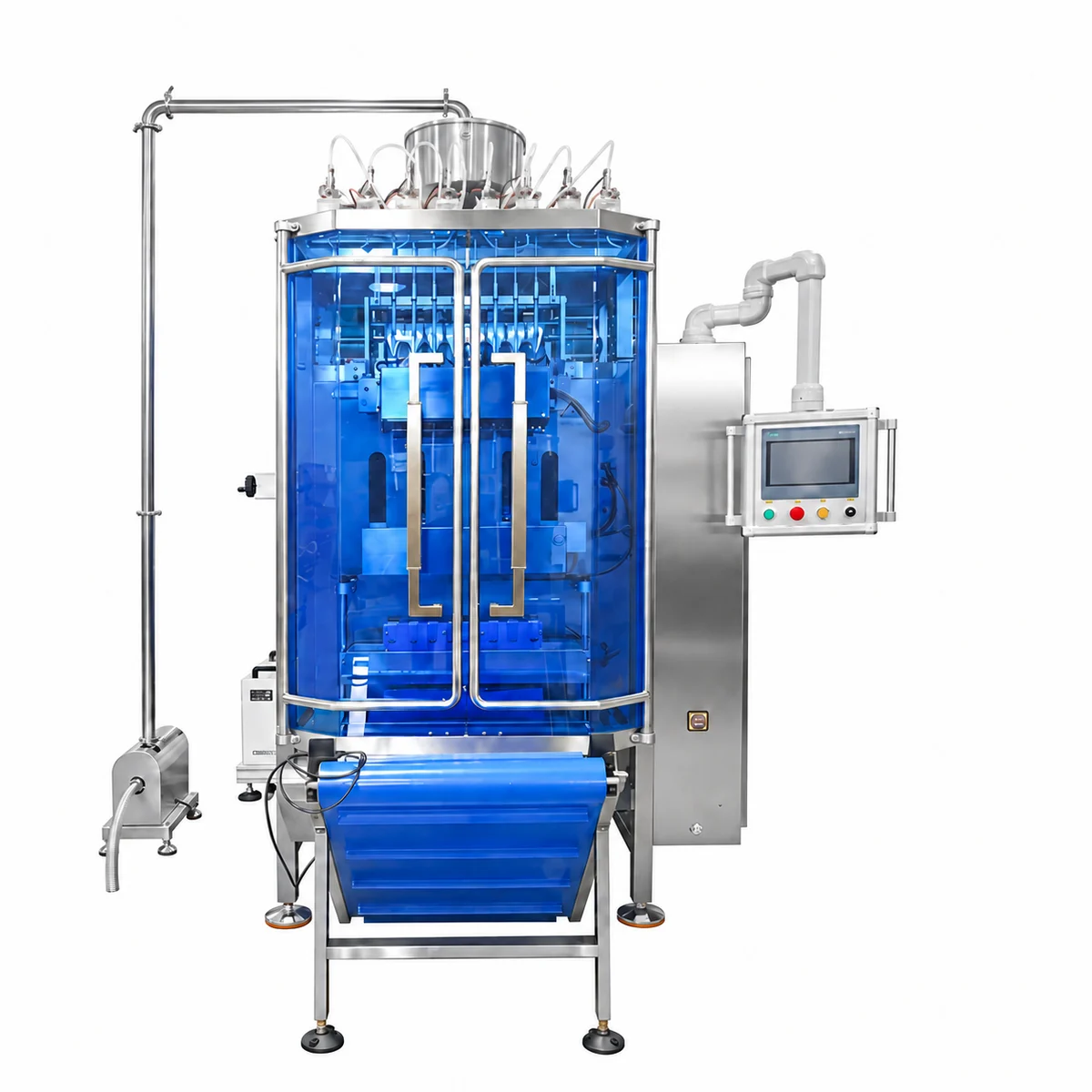
A complete line is usually more than the packing machine: it can include product feeding, a coding unit, a discharge conveyor, counting and secondary packing. Mark which items belong in the quotation and which your team or another vendor supplies, and check connection heights, transfer points, floor space and installation access early enough to change the layout if needed.
Match site utilities to the selected configuration. The reference machines list their electrical supply, and the powder machine also lists its compressed-air pressure. Agree what the machine does when upstream product runs out or a downstream conveyor stops, who owns mechanical connections, control signals and commissioning checks, and list change parts, spare parts, documentation and training as named items. Quotations built on the same list are far easier to compare.
- Product and dosing-system assessment
- Pack and film compatibility review
- Changeover and cleaning requirements
- Factory acceptance, installation and spare-parts scope
How much output can a stick pack machine deliver?
Usable output is the number of accepted packs the line delivers over a shift, which is always lower than the mechanical cycle rate shown in the reference table. Hopper refills, film reel changes, startup checks, recipe changes and cleaning all take time out of the shift, so compare proposals on the same product, dose, pack and operating pattern, and ask what trial evidence supports each figure.
A representative trial settles the question better than a short demonstration. Agree how samples are taken from each lane, how fill weight or volume is checked, what a rejected pack looks like and what limits apply. Include a pause, a restart and, where relevant, a recipe change. Keep the trial conditions and rejected packs with the results, and record every adjustment before the next sample set, so a setting that needs tuning can be told apart from a product that needs a different configuration.
From application brief to stick pack machine quotation
A quotation can only be as specific as the brief behind it. Send the product description, whether a sample is available, the dose range, a pack drawing, film details and the accepted output you need, plus installation space, site utilities, cleaning expectations and what happens to the packs downstream. If a decision is still open, such as stick or sachet, list both options so the engineers can say which one needs a trial.
Compare offers against one scope list rather than the headline machine price: dosing and format parts, optional peripherals, change parts, acceptance criteria and support. The price guide explains which of these items move the cost. Keep the approved product and film references with the order, because they are the baseline for any later change of recipe, portion or pack size.
Common Questions
Which type of stick pack machine do I need?
Choose by how the product flows. Dry powders and blends use the powder machine with auger dosing, pumpable liquids and gels use the liquid and gel machine, and free-flowing granulated mixes use the granule machine. If your product sits between two types, send a sample and let the trial decide the dosing method.
Are the output figures on the machines page guaranteed?
No. They are four-lane reference ranges copied from each machine page, for example roughly 120–160 sticks per minute for powder. Your actual rate depends on how the product behaves, the dose, the film and the pack length, and it is confirmed by a sample trial and stated in the quotation for your configuration.
What does four-lane reference configuration mean?
It is the standard layout used to publish the ranges on this site: four sticks formed, filled, sealed and cut in each machine cycle, with one dosing unit per lane. It is a common starting point, not a fixed model. Other lane counts are quoted per project once the output target and pack size are known.
My drink mix is part powder, part granule. Which machine applies?
The flow of the sample decides it, not the product name. A mix that behaves like powder is usually assessed on auger dosing, while a free-flowing, coarser mix points to volumetric cups or vibratory feeding. Describe the particle size and any segregation you see, and send a representative sample so both routes can be compared.