
What stick pack size do I need for my serving?
The right stick pack size starts from the serving and a representative product sample, because no dependable chart turns a dose in grams into one correct width and length. Weight describes the amount of product, while a package must accommodate its volume, filling behavior and sealing needs. Two powders with the same serving weight can occupy different spaces, and even one formulation may settle differently after transport, hopper replenishment or time in the package.
Define the smallest and largest dose in the planned range, and identify which serving will be launched first. Include whether the consumer pours the contents into water, sprinkles them onto food or squeezes them directly from the pack. Those actions influence the opening and shape. A package that is large enough to contain the dose can still be inconvenient to empty. Combining serving, handling and use requirements gives the equipment team a better starting point than a photograph of a competitor's package.
How do you estimate stick pack volume from fill weight?
Divide the dose mass by a measured bulk density to get an approximate product volume for early powder planning. Treat the result as a starting estimate, not a finished pouch calculation: it ignores the seal bands, forming geometry, air carried with the powder and the space needed to keep product clear of the closing jaws. Document how the density was measured and whether the sample represents the production formulation.
Granules introduce additional questions about particle size and segregation. Liquids and gels need consideration of viscosity, temperature and any tendency to foam or leave a dosing tail. The filling system must place the dose within the package during the available cycle. Use a trial to observe the material in motion and after settling. A static sample cup alone cannot reveal what happens when the same product moves through a hopper, auger, pump or nozzle at the proposed operating conditions.
Stick pack dimensions vs usable capacity
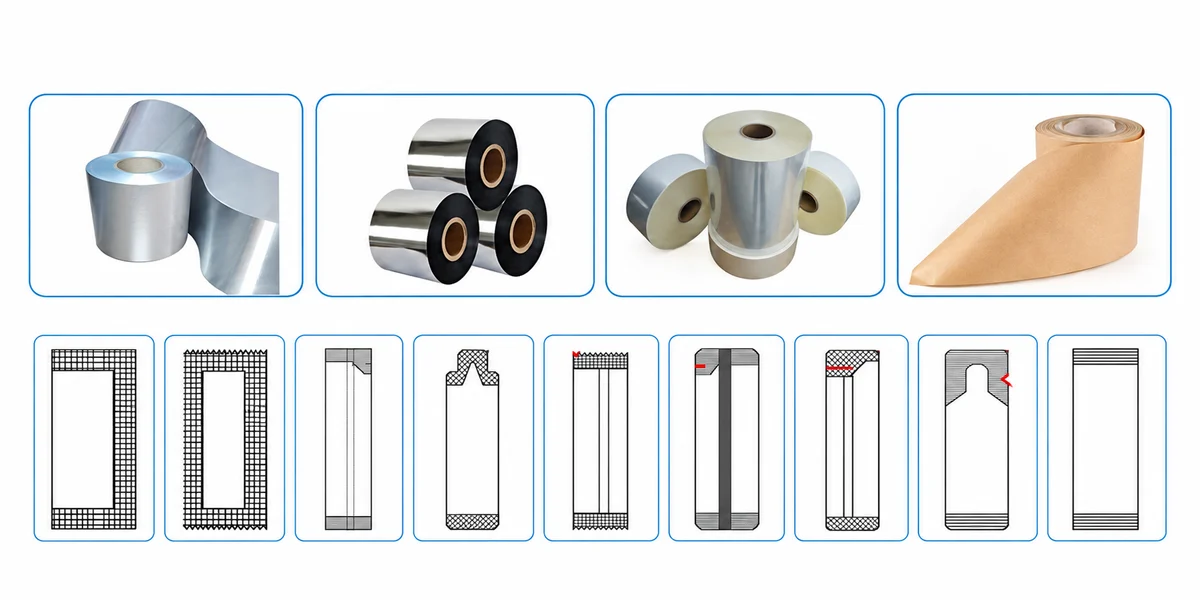
Finished pack dimensions describe the outside of the package, including its seals; usable capacity is the smaller space inside those boundaries. Longitudinal seal construction, end-seal depth and the selected forming arrangement all affect that space. A narrow stick and a wider sachet with similar external area should not be treated as interchangeable containers, because their filling openings and formed cross-sections may be very different.
Ask for a dimensioned drawing that identifies the overall width and length, seal locations, cut line and opening feature. Show any maximum size imposed by a carton, display tray or customer specification. Where a dimension is provisional, mark it as such so that trial findings can guide a sensible adjustment. This is particularly helpful when a product needs more filling clearance than expected. A drawing with fixed and adjustable fields makes development decisions visible instead of leaving them buried in email comments.
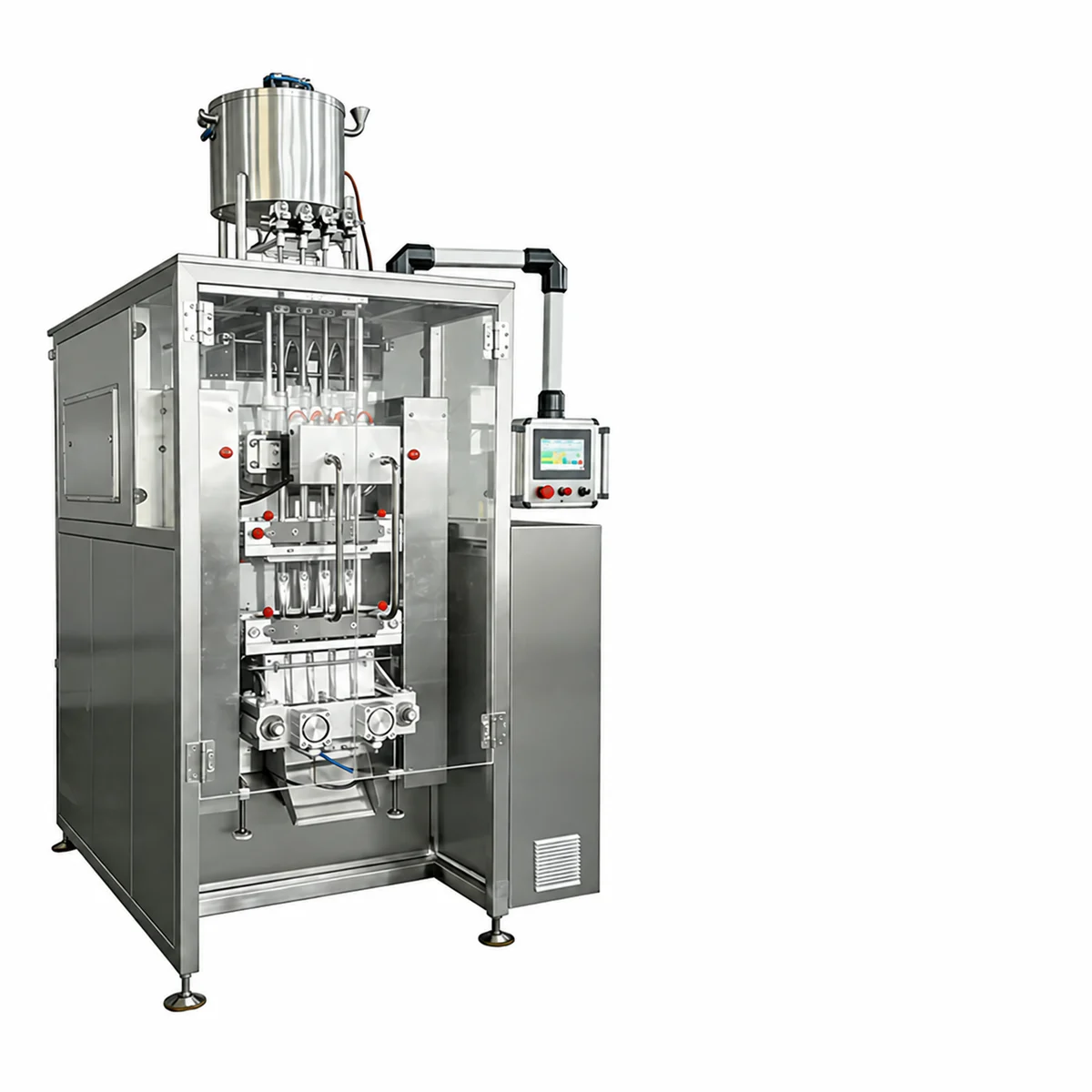
For orientation, the four-lane reference configurations on our machine pages form powder sticks of about 50–180 mm in length and about 15–30 mm in width, with granule and liquid formats reaching wider lanes. These are equipment ranges, not a recommended size; the right pack is the one that holds your tested serving with clean seals.
| Field | What to define |
|---|---|
| Width and length | Finished external dimensions, with an agreed drawing |
| Seal layout | Longitudinal and end seals for the selected format |
| Opening | Tear notch, cut style and intended dispensing behavior |
| Artwork | Print repeat, registration and readable information |
| Usable volume | Space available after seal allowances and filling needs |
Allow space for filling and clean sealing
A pack should have enough practical space for the dose to enter and for the seal area to close without contamination. Powder can create dust near the end seal, while a viscous liquid may string between the nozzle and the product already in the pack. These behaviors influence the useful filling interval and the package geometry. Increasing length may help some applications, but it should not replace reviewing the dosing arrangement and timing.
Observe the pack immediately after filling as well as after it has settled. Look for product trapped near the seal, excessive bulging, difficult opening or incomplete emptying. Agree with the supplier which adjustments belong to the package and which belong to the filler. A successful design balances material handling, forming and closure. It is not simply the smallest external rectangle into which a sample can be pushed by hand.
Connect the pack drawing to film and tooling
Once a candidate size is selected, the machine team needs to translate it into forming parts, sealing tools, cutting arrangements and a roll-film layout. Multi-lane equipment may slit a wide film web into several narrow strips. The roll width and print layout therefore depend on the actual lane and seal configuration. Do not calculate a production roll order by multiplying a finished width without an approved layout drawing.
Confirm the required registration marks, artwork orientation and any reserved code area at the same time. An apparently small dimensional change can move a cut or seal relative to printed information. Keep the package drawing, tooling reference and artwork revision linked in the project record. When one changes, review the others before ordering material. This coordination prevents a machine that is mechanically capable of producing a new size from receiving film printed for an earlier geometry.
How many stick pack sizes can one machine run?
One machine can run a range of sizes, but every change of dose or geometry is either a settings change or a parts change, and the quotation should say which. Some dose changes are possible through settings within the selected filling configuration. Others need a different auger, forming component, nozzle or cutting part. Ask the supplier to describe the change procedure for each planned product and size, including the parts, tools, setup checks and material needed to confirm the first acceptable packs.
Review the smallest and largest planned package rather than testing only the easiest middle size. If the project includes several recipes, identify which combinations are essential at launch and which are future possibilities. This distinction helps keep the initial configuration practical while exposing future limitations. A broad advertised size range should never be interpreted as proof that every material, dose and width within that range can run with one set of parts or at the same output.

Evaluate the package beyond the machine discharge
Stick pack dimensions also shape counting, boxing, handling and the customer's experience. Test filled samples inside the intended carton or shipping arrangement, including any inserts. Check whether packs fit comfortably without being forced against edges or folded across seals. If the product will be carried in a pocket or dispensed through a bottle opening, include that use in the review. Small geometric details can matter more in use than they do on a flat drawing.
Opening and emptying should also be evaluated with the actual material. A tear notch can be correctly positioned while the resulting opening remains inconvenient for the product. Compare the retained product after emptying and the ease of handling with dry or wet hands where relevant to the intended use. Record the preferred sample and any rejected alternatives. These observations make later size changes easier to assess because the team knows why the original dimensions were chosen.
Further reading: Packaging World: stick packaging experience and consumer use
Send a size brief that supports a useful trial
A strong brief includes the formulation description, dose range, representative samples, candidate external dimensions and seal layout. Add film details, artwork status, intended opening and downstream packaging. State the required accepted output and the sizes that must be demonstrated. If dimensions are still flexible, describe the user's needs and any hard limits rather than presenting an untested number as a final specification.
Keep the trial report with the approved drawing. Record the material batch, machine configuration, operating conditions and the actual dimensions of accepted samples. If a later formulation or film change affects filling behavior, the report provides a baseline for comparison. Send the brief and any earlier trial records with your enquiry, and we will match them to a powder, liquid or granule configuration and a sample trial. The aim is a size that works through filling, sealing, packing and use, with a clear record of how it was chosen.
Common Questions
How do I convert grams into stick pack dimensions?
You cannot convert them directly. Start with an approximate volume from dose mass and measured bulk density, add room for seal bands and clean closing, then draw a candidate pack. A filled sample from a trial confirms the width and length, because settling and dosing behavior do not show up in the weight.
Is there a standard stick pack size?
No. Retail cartons, dispensing habits and product density vary too much for one standard. The length and width ranges quoted for our four-lane machines describe what the forming parts can produce, not a size to copy. Fix the dimensions from your tested serving and your carton or shelf limits.
Do I need new tooling for every stick pack size?
Not always. A dose change inside the same pack can sometimes be handled by settings, while a new finished width usually means a different forming tube or cutting part. Ask for a written list of which planned sizes share parts and which need their own set before you order film.
How much empty space should a stick pack leave above the product?
Enough to keep product out of the end seal while the jaws close, which varies with dust, settling and nozzle tail. There is no single figure. Judge it from trial packs checked straight after filling and again after settling, looking for trapped product in the seal or excessive bulging.