
cGMP Regulatory Scope and Pharmaceutical vs. Nutraceutical Stick Pack Boundaries
Defining the regulatory boundary between human drug manufacturing and nutritional supplement packaging is the primary engineering step when writing a user requirement specification for a single-dose stick pack line. Under 21 CFR 211.63, equipment used in the manufacture, processing, packing, or holding of a drug product must be of appropriate design, adequate size, and suitably located for its intended use and cleaning. Under 21 CFR 211.65(a), equipment surfaces that contact components, in-process materials, or drug products must not be reactive, additive, or absorptive so as to alter the safety, identity, strength, quality, or purity of the drug product beyond the official or other established requirements. Under 21 CFR 211.65(b), any substances required for operation, such as lubricants or coolants, must not come into contact with components, drug product containers, closures, in-process materials, or drug products so as to alter the safety, identity, strength, quality, or purity of the drug product beyond the official or other established requirements. Under 21 CFR 211.42(b), any drug manufacturing building must have adequate space for the orderly placement of equipment and materials to prevent mixups and contamination.
Separating finished pharmaceutical operations from dietary supplement blending also clarifies how quality units evaluate equipment suitability and portion accuracy. Dietary supplement equipment and utensils are regulated under 21 CFR Part 111 Subpart D (§§ 111.25–111.35), including § 111.27 requirements for equipment and utensils. FDA does not maintain a list of CDER-approved drug manufacturing equipment; CGMP regulations neither approve nor prohibit specific equipment for use in manufacturing pharmaceutical products except under 21 CFR 211.72. In our nutraceutical stick pack configurations, we check portion weight and active-ingredient content separately, and our four-lane reference configuration fills about 1–20 g per stick at roughly 120–160 sticks per minute with 304/316L stainless steel product-contact parts. Establishing whether a formulation is governed as a human drug or a dietary supplement before requesting vendor quotations ensures that material traceability, line-clearance hardware, and qualification deliverables match the facility's regulatory scope.
Related reading: Stick Pack Machine Applications; Nutraceutical Stick Pack Machine
Scroll horizontally to see all columns. Keyboard: focus the table and use the arrow keys.
| Specification Area | Pharmaceutical Stick Pack Line | Dietary Supplement Stick Pack Line |
|---|---|---|
| Governing quality framework | 21 CFR Part 211 finished drug cGMP with DQ/IQ/OQ/PQ validation | 21 CFR Part 111 Subpart D (§§ 111.25–111.35) utensil & hygiene controls |
| Electronic records and recipes | 21 CFR Part 11 (§ 11.10) role-based HMI access & time-stamped audit trails | Password-protected PLC recipe storage & batch equipment usage logs |
| Changeover and cleaning proof | 21 CFR 211.67/211.130 line clearance with direct swab & USP <643> TOC rinse checks | Tool-free hopper/auger strip-down with visual and allergen/lot clearance logs |
Product-Contact Metallurgy, Surface Roughness, and Material Verification
Selecting the appropriate stainless steel alloy and surface finish for hoppers, dosing screws, liquid manifolds, and forming tubes prevents metallic contamination and simplifies cleaning between batches. On our cGMP pharmaceutical powder VFFS stick pack machines, the product-contact path from the hopper to the forming tubes is constructed from medical-grade SUS316L stainless steel with a mirror-polished finish (Ra < 0.4μm) to eliminate microbial attachment points. Our powder stick pack machine reference configuration uses an SUS304 frame with 304/316L product-contact parts, a power supply of about 3.5–4.5 kW at 220 V or 380 V (50/60 Hz), 0.6–0.8 MPa compressed air, and a machine weight of about 650 kg.
Alloy composition and analytical incoming inspection methods allow engineering teams to confirm product-contact materials during factory acceptance testing. In pharmaceutical packaging machinery, 316/316L stainless steel contains molybdenum (Mo) to distinguish it from 304, and the 'L' indicates lower carbon content, which is relevant for welded components because lower carbon content can reduce the risk of corrosion associated with welding. Beyond material certificates, pharmaceutical packaging machine materials can be verified using a molybdenum test reagent for preliminary 316 screening, XRF analysis for Chromium (Cr), Nickel (Ni), and Molybdenum (Mo), OES analysis to distinguish 316 from 316L by carbon content, and FTIR to verify PTFE. Documenting mill test reports alongside shop-floor spectroscopic verification records provides traceable material evidence for installation qualification.
Related reading: How a Stick Pack Machine Works; How to Choose a Stick Pack Machine
Pharma Powder Auger Dosing vs. Oral Liquid Pump Systems and Reference Specifications
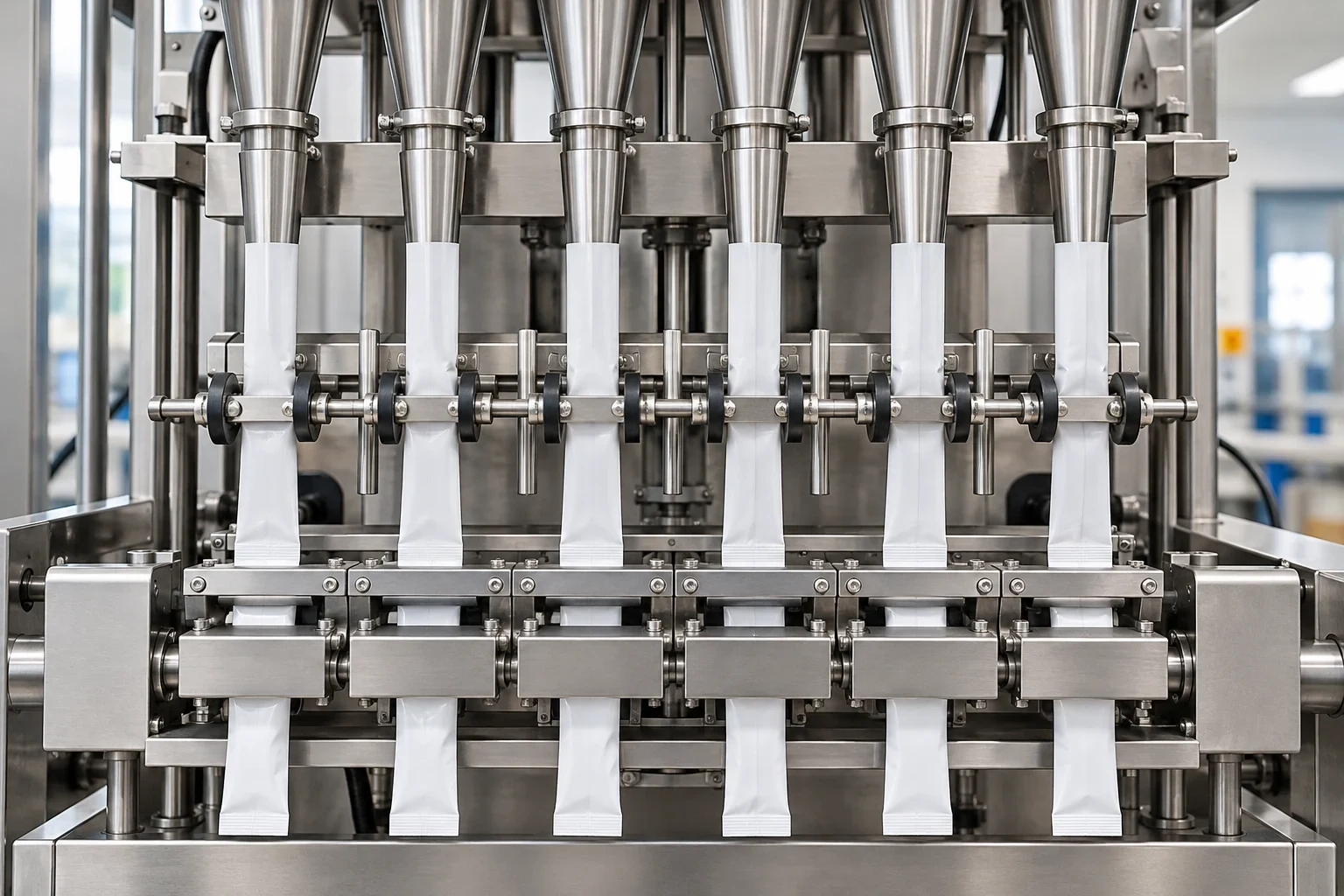
Matching the dosing head to the physical rheology of the formulation determines whether the machine uses servo-driven vertical augers with dust extraction or sanitary positive-displacement liquid pumps. In FDA's Container Closure Systems Guidance, oral powders and granules for reconstitution are grouped with solid oral dosage forms, where a pouch typically consists of film or laminate sealed at the edges by heat or adhesive and leak testing is usually performed on flexible packages as part of in-process controls. Our cGMP pharmaceutical powder VFFS configuration includes integrated vacuum extraction points at the dosing nozzle and sealing jaws to capture airborne micro-particles. Our 8-lane pharmaceutical powder stick pack machine features independent 8-lane pharmaceutical-grade auger filling screws, dual servo-driven film pulling mechanisms, constant-temperature PID heating bars, and SUS304/316L stainless steel construction. In our 4-lane powder stick pack machine reference configuration, 4 lanes run about 30–40 cycles per lane per minute, or roughly 120–160 sticks per minute. Our powder stick pack machine reference configuration covers fill weights of about 1–20 g per stick (with around 30 g needing different auger tooling and a trial), stick lengths of about 50–180 mm, and stick widths of about 15–30 mm. On our powder stick pack machine (Model DS-400Y), independent servo motors achieve filling accuracy within ≤ ±1% and run laminated films including PET/AL/PE, PET/PE, NY/AL/PE, and Paper/PE with air consumption of 0.6-0.8 Mpa and 0.35m³/min.
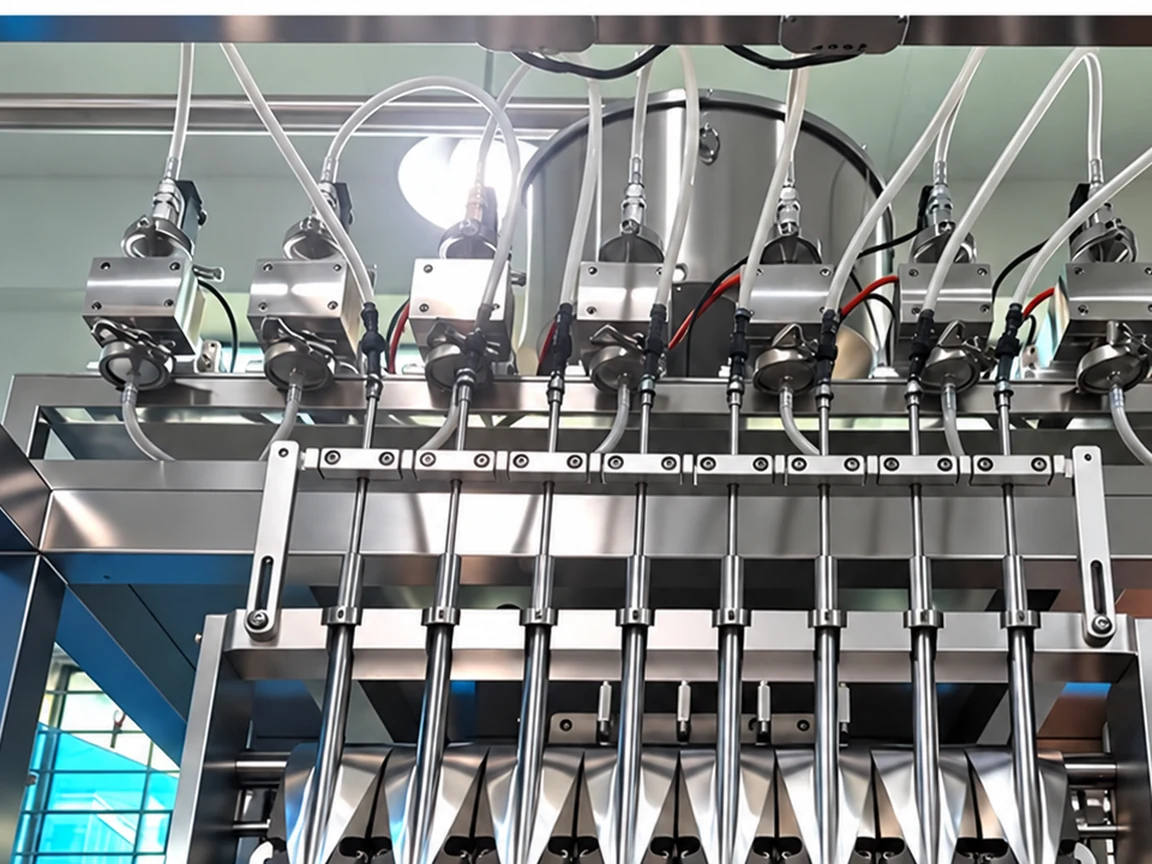
Our liquid and gel stick pack reference configurations use a piston or servo pump per lane with suck-back anti-drip nozzles. In FDA's Container Closure Systems Guidance, liquid-based oral dosage forms (such as solutions, gels, syrups, and suspensions) are generally marketed in multiple-unit bottles or in unit-dose or single-use pouches and typically need to be protected from solvent loss and microbial contamination. In our 4-lane liquid and gel stick pack machine reference configuration, 4 lanes use a piston or servo pump per lane with suck-back anti-drip nozzles to fill about 1–30 ml per stick pack (or up to about 50 ml in four-side-seal sachets) at about 120–200 packs per minute. Our liquid stick pack machine reference configuration accommodates stick widths of about 15–60 mm (or 30–80 mm for four-side-seal sachets), pack lengths of about 50–180 mm, film reel widths of about 400–480 mm, a footprint of about 1.6 × 1.2 m by about 2.1 m high, and a machine weight of about 750–850 kg. On our 4-lane liquid sachet and stick pack machine (Model DS-450X), 4 lanes run 30–45 cuts/min per lane (up to 120–180 sachets/min total) with a 1–30 ml filling range, 50–160 mm length, 15–60 mm single-lane width, and up to 480 mm max film width. Aligning lane count, dosing mechanism, and web width with the target unit dose during sample trials prevents throughput bottlenecks when scaling to production.
Related reading: Powder Stick Pack Machine: Auger Dosing; Liquid Stick Pack Machine for Gels; Granule Stick Pack Machine: Drink Mixes; Auger Filler for Stick Packs: Screw Pitch, Agitator Sync & Shutoff
Scroll horizontally to see all columns. Keyboard: focus the table and use the arrow keys.
| Dosage Form | Primary Dosing Mechanism | Seal-Zone Protection Hardware | Qualification Trial Verification |
|---|---|---|---|
| Micronized or cohesive drug powders | Independent servo vertical auger per lane (DS-400Y / 8-lane) | Nozzle & cross-seal jaw vacuum dust extraction ports | ≤ ±1% per-lane mass accuracy & dust-free cross-seal peel strength |
| Free-flowing pharmaceutical granules | Parallel-flight auger with cut-off disc or volumetric cups (0.1–100 g) | Timed charge drop sync & static-dissipative forming chutes | Particle friability check & lane-to-lane net weight RSD |
| Oral solutions and pediatric syrups | Sanitary 316L piston or servo pump per lane (1–30 ml, DS-450X) | Suck-back anti-drip filling lances above cross-seal zone | Zero stringing into hot jaws & ASTM D3078 bubble leak check |
| Shear-sensitive suspensions and gels | Agitated manifold feeding servo positive-displacement pumps | Positive shut-off nozzle tips with timed suck-back retraction | Active-ingredient suspension uniformity across all active lanes |
Discuss this configuration
Discuss on WhatsAppTool-Free Disassembly, Line Clearance, and Cleaning Validation Protocols
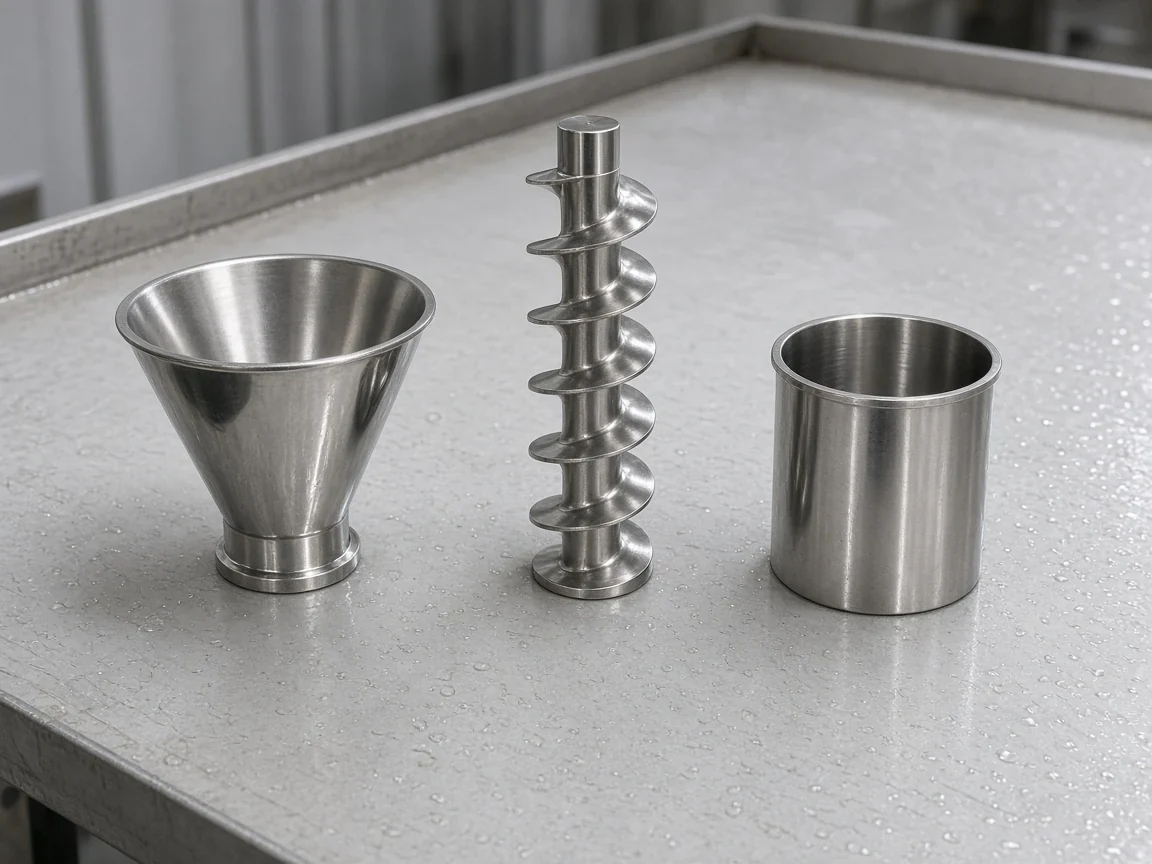
Designing the product contact path for rapid tool-free disassembly and unobstructed visual access directly supports batch changeover and line clearance. Under 21 CFR 211.67(a), equipment and utensils must be cleaned, maintained, and, as appropriate for the nature of the drug, sanitized and/or sterilized at appropriate intervals to prevent malfunctions or contamination that would alter the safety, identity, strength, quality, or purity of the drug product beyond the official or other established requirements. Under 21 CFR 211.67(b)(3), written cleaning procedures must describe in sufficient detail the methods, equipment, and materials used in cleaning and maintenance, and the methods of disassembling and reassembling equipment. Under 21 CFR 211.67(b)(4) and (6), written equipment cleaning procedures must include removal or obliteration of previous batch identification and inspection of equipment for cleanliness immediately before use. Under 21 CFR 211.130(a) and (e), written packaging procedures must include prevention of mixups and cross-contamination, and inspection of the packaging and labeling facilities immediately before use to assure that all drug products have been removed from previous operations. Under 21 CFR 211.182, a written record of major equipment cleaning, maintenance, and use must be included in individual equipment logs that show the date, time, product, and lot number of each batch processed. Our cGMP pharmaceutical powder VFFS configuration is engineered with split, swing-open hoppers and tool-free quick-release auger shafts, allowing operators to perform full-line sanitization and formula changeovers in under 15 minutes without structural blind spots.
Analytical residue sampling after disassembly confirms that cleaning procedures remove active drug traces from every wetted surface before the next campaign begins. In FDA's Cleaning Validation Guide, limits mentioned in the literature include analytical detection levels such as 10 PPM, biological activity levels such as 1/1000 of the normal therapeutic dose, and organoleptic levels such as no visible residue. For cleaning validation, FDA states that rinse samples alone would not be acceptable; firms should also measure the residue or contaminant on the equipment surface using a direct method (if feasible), and some firms use both swab and rinse samples. Total Organic Carbon (TOC) under USP General Chapter <643> can be an acceptable method for monitoring residues routinely and for cleaning validation. Mapping swab locations across auger shafts, hopper seams, and forming tubes before factory trials ensures that operators can access and verify every product-contact surface.
Related reading: Single vs Multi-Lane Stick Pack Machines; Stick Pack Machine Problems and Solutions: Multi-Lane Troubleshooting, Seal Leaks & Dose Drift
Container Closure Barriers, In-Process Controls, and Electronic Record Security
Primary laminate selection, inline coding inspection, and computerized recipe security protect product stability and batch record integrity across multi-lane runs. Under 21 CFR 211.68(a), automatic, mechanical, or electronic equipment must be routinely calibrated, inspected, or checked according to a written program designed to assure proper performance. Under 21 CFR 211.68(b), appropriate controls must be exercised over computer or related systems to assure that changes in master production and control records or other records are instituted only by authorized personnel. Under 21 CFR 211.94(a), drug product containers and closures must not be reactive, additive, or absorptive so as to alter the safety, identity, strength, quality, or purity of the drug beyond the official or established requirements. Under 21 CFR 211.105(b), major equipment must be identified by a distinctive identification number or code recorded in the batch production record to show the specific equipment used. Under 21 CFR 211.110(a), written procedures must be established and followed that describe the in-process controls, and tests, or examinations conducted on appropriate samples of in-process materials of each batch. Under 21 CFR 211.122(h), printing devices on or associated with manufacturing lines used to imprint labeling upon the drug product unit label or case must be monitored to assure that all imprinting conforms to the batch production record. Under 21 CFR 211.132(b)(1), each manufacturer and packer who packages an over-the-counter (OTC) human drug product (except a dermatological, dentifrice, insulin, or lozenge product) for retail sale must package the product in a tamper-evident package if this product is accessible to the public while held for sale. Under 21 CFR 211.188(b), batch production and control records must document the identity of individual major equipment and lines used (item 2), in-process and laboratory control results (item 5), and inspection of the packaging and labeling area before and after use (item 6). Under 21 CFR Part 11 (§ 11.10), closed electronic record systems require limiting system access to authorized individuals and using secure, computer-generated, time-stamped audit trails to independently record the date and time of operator entries and actions.
Barrier permeation procedures and our multi-lane pharmaceutical equipment options help engineering teams specify lane-level inspection and rejection requirements. FDA's Container Closure Systems Guidance references USP <661> for polyethylene container evaluations and USP <671> for water vapor permeation testing of single-unit and unit-dose container closure systems. In our multi-lane 316L pharmaceutical stick pack platform specifications, configurations scale from 2 to 20 lanes on web widths up to 800 mm at speeds up to 80 cycles per minute, forming stick sizes from 17 × 40 mm to 80 × 200 mm and dosing 0.1 to 100 g of powders or granules. We equip these pharmaceutical stick pack lines with OCR/OCV optical code controls, 21 CFR Part 11 access and electronic record controls, OPC UA protocol, load-cell checkweighing with feedback, individual discharge chutes, empty-stick detection, automatic rejection of noncompliant sticks, and DQ/IQ/OQ/PQ plus FDS/HDS/SDS documentation. Listing optical code verification, checkweigher feedback, audit-trail software, and individual lane reject chutes in the user requirements specification ensures the quotation covers all required controls.
Related reading: Stick Pack Film & Machine Compatibility; Fin Seal vs Lap Seal on Stick Packs: Film Width, Seal Layers & Dust Tolerance; Nitrogen Flushing for Stick Packs: Residual Oxygen Control
Qualification Lifecycle, FAT Material Budgeting, and Seal Integrity Testing
Qualifying a pharmaceutical stick pack machine follows a structured lifecycle that links design specifications to documented installation and operational challenge tests. In FDA's Process Validation Guidance, Stage 2 Process Qualification has two elements: (1) design of the facility and qualification of the equipment and utilities and (2) process performance qualification (PPQ). Equipment qualification under FDA's Process Validation Guidance includes verifying that utility systems and equipment are built and installed in compliance with design specifications and challenging equipment under load, including interventions, stoppage, and start-up. Under FDA's Process Validation Guidance, qualification activities should be documented and summarized in a report with conclusions, and the quality control unit must review and approve the qualification plan and report (§ 211.22). Our cGMP pharmaceutical powder VFFS configuration integrates Siemens PLC/HMI and SICK registration sensors (MOQ = 1) and provides 3Q (IQ/OQ/PQ) validation documentation support. Our pharmaceutical validation package defines FDS (Functional Design Specifics), HDS (Hardware Design Specifics), and SDS (Software Design Specifics) alongside Design Qualification (DQ), Installation Qualification (IQ), Operational Qualification (OQ), and Performance Qualification (PQ).
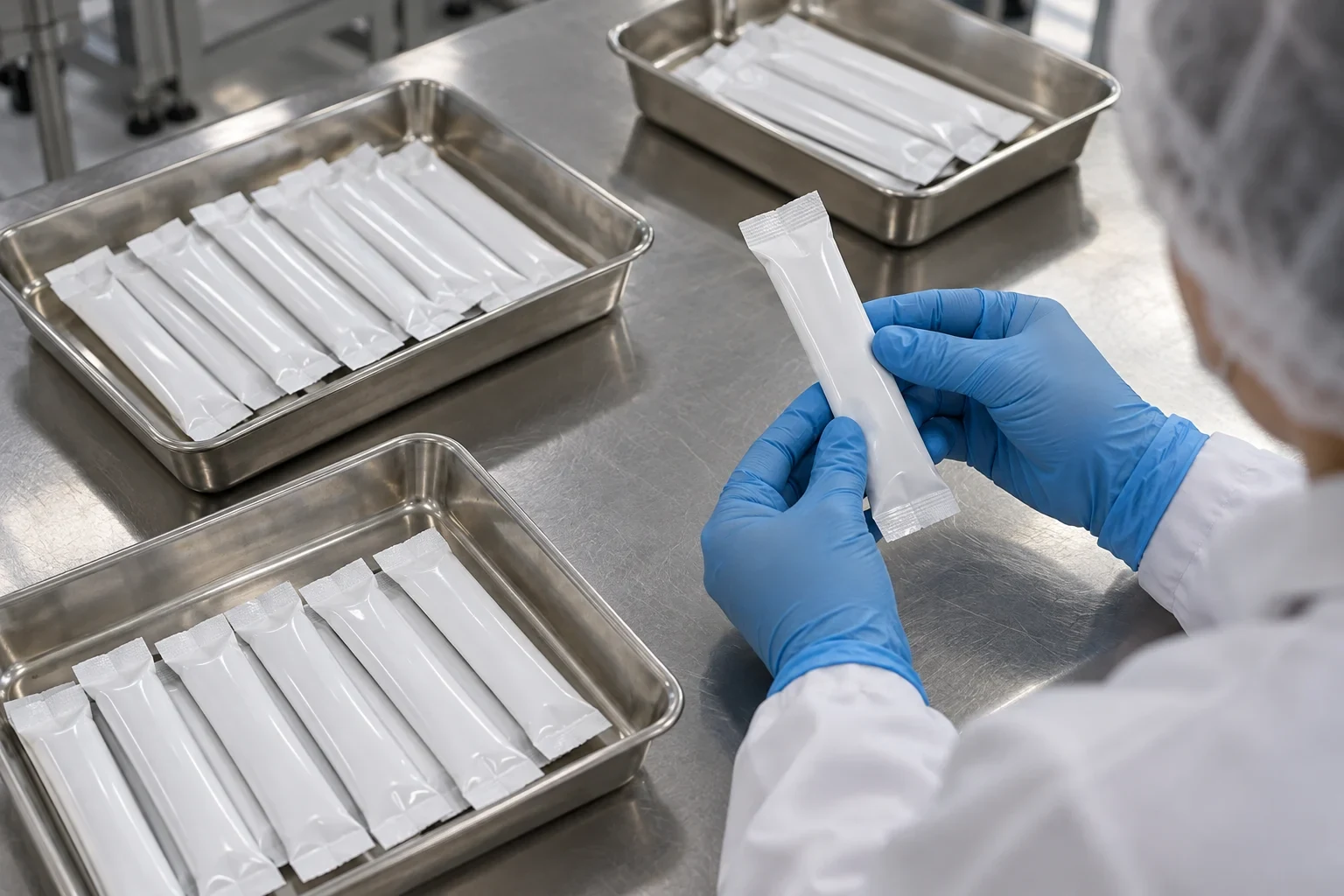
Factory acceptance testing combines leak integrity verification with lane-by-lane material budgeting before the equipment ships to the packaging suite. In our FAT checklist protocol, ASTM D3078 describes bubble-emission detection of gross leaks in flexible packages containing headspace gas, which is different from a vacuum-decay measurement and does not establish that no microchannels exist. Under our FAT material budgeting formula, product for the running portion of a test in kg equals active lanes × cycles/min × running minutes × dose in g / 1,000, and running film length in meters equals machine cycles × cut pitch in mm / 1,000. We build our stick pack machines to order at our manufacturing base in Foshan, Guangdong, China, where we have engineered packaging machinery since 2013, supporting sample trials and factory acceptance tests against criteria agreed in the quotation. Executing factory trials with representative laminate rolls and lane-indexed sampling trays allows engineering and quality teams to close open items prior to site installation.
Related reading: Stick Pack Machine FAT Checklist; Stick Pack Sizes & Dimensions Guide
Scroll horizontally to see all columns. Keyboard: focus the table and use the arrow keys.
| Lifecycle Stage | Primary Engineering Deliverable | Acceptance Verification Focus |
|---|---|---|
| User requirements and design qualification | URS, FDS, HDS, SDS & DQ engineering binder | Approve SUS316L contact list (Ra < 0.4μm), lane count, and Part 11 PLC architecture |
| Factory acceptance trial | FAT protocol, film/product budget & lane weight log | Verify cycle speed, per-lane dose RSD (≤ ±1%), and reject chute isolation |
| Installation qualification | IQ checklist, XRF/OES mill certs, FTIR logs & P&ID drawings | Confirm 316L/PTFE material traceability, sensor calibration, and 220/380 V & 0.6–0.8 MPa utilities |
| Operational and performance qualification | OQ/PQ challenge reports, seal window matrix & batch audit trails | Validate PID temperature/pressure limits, ASTM D3078 leak checks, and 3-lot PPQ uniformity |
Sources
- Our StickPackMachine Engineering Library — Multi-Lane Powder, Liquid, and Granule Stick Pack Machine Specifications
- United States Food and Drug Administration — Current Good Manufacturing Practice for Finished Pharmaceuticals and Electronic Records
- United States Food and Drug Administration — Process Validation, Cleaning Validation, and Container Closure Systems Guidance
- United States Pharmacopeia — Total Organic Carbon and Container Permeation Chapters
- Pharmaceutical Multi-Lane Stick Pack Qualification and Material Verification Literature