
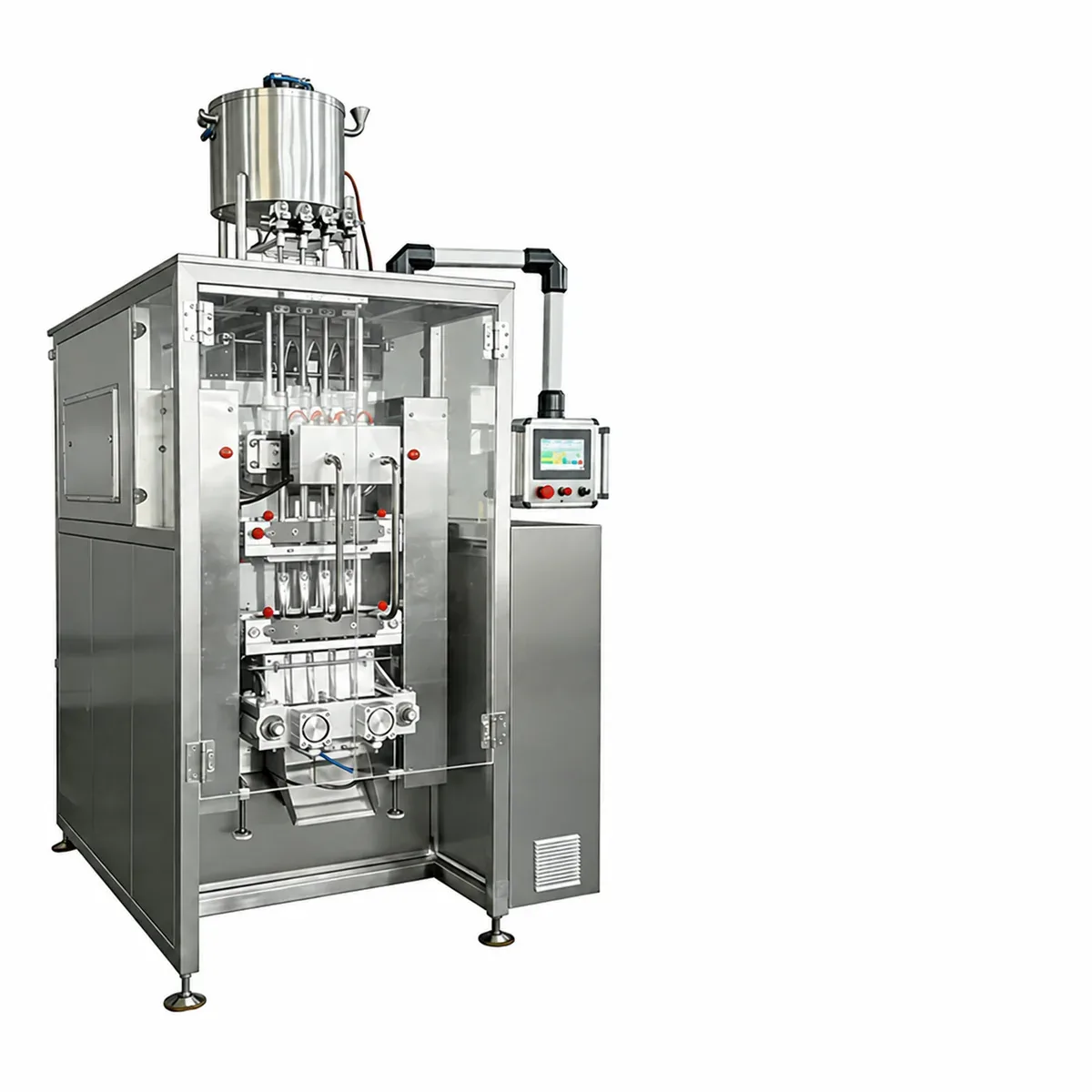
Step 1 — Describe the product at the machine inlet
Begin with the actual formulation and its condition when it reaches the filler. Record the product, batch, dose range and handling notes before choosing a machine family. A product name such as coffee, collagen or energy gel does not establish flow behavior, usable pack volume or a suitable dosing arrangement.
For a powder, provide measured bulk density with the method and handling state, then describe dust, caking, settling and uneven discharge already observed. Density connects mass to approximate volume: an aerated sample and a settled sample can occupy different spaces at the same dose. Explain how the product is stored, transferred and held before packing so the sample represents the material the machine will receive.
For a liquid or gel, record the filling temperature, viscosity data with its unit and measurement conditions, and any particles. Add notes on foaming, separation, thickening while standing or strings at discharge. The temperature at the machine inlet matters more to this review than an unrelated room-temperature reading. For granules, describe particle size, shape and whether coarse and fine fractions separate during handling.
List every recipe that will share the equipment and identify the main production product. Keep a separate row for a recipe whose flow or dose differs materially. Mark unknown measurements as open and assign someone to obtain them; a blank with an owner is more useful than a guessed value. Use the profile below as the first page of the brief that follows the project into trial planning and quotation.
Scroll horizontally to see all columns. Keyboard: focus the table and use the arrow keys.
| Product profile field | Record | Question to resolve |
|---|---|---|
| Formulation / batch | Product ID: ___; batch: ___ | Does this represent production material? |
| Powder or granule behavior | Density / method / state: ___; flow notes: ___ | What changes during storage and replenishment? |
| Liquid or gel behavior | Temperature: ___; viscosity / unit / conditions: ___ | Are particles, tails or separation present? |
| Shared recipes | Main product: ___; other recipes: ___ | Which differences require another trial or tooling? |
Step 2 — Match a dosing candidate to the sample
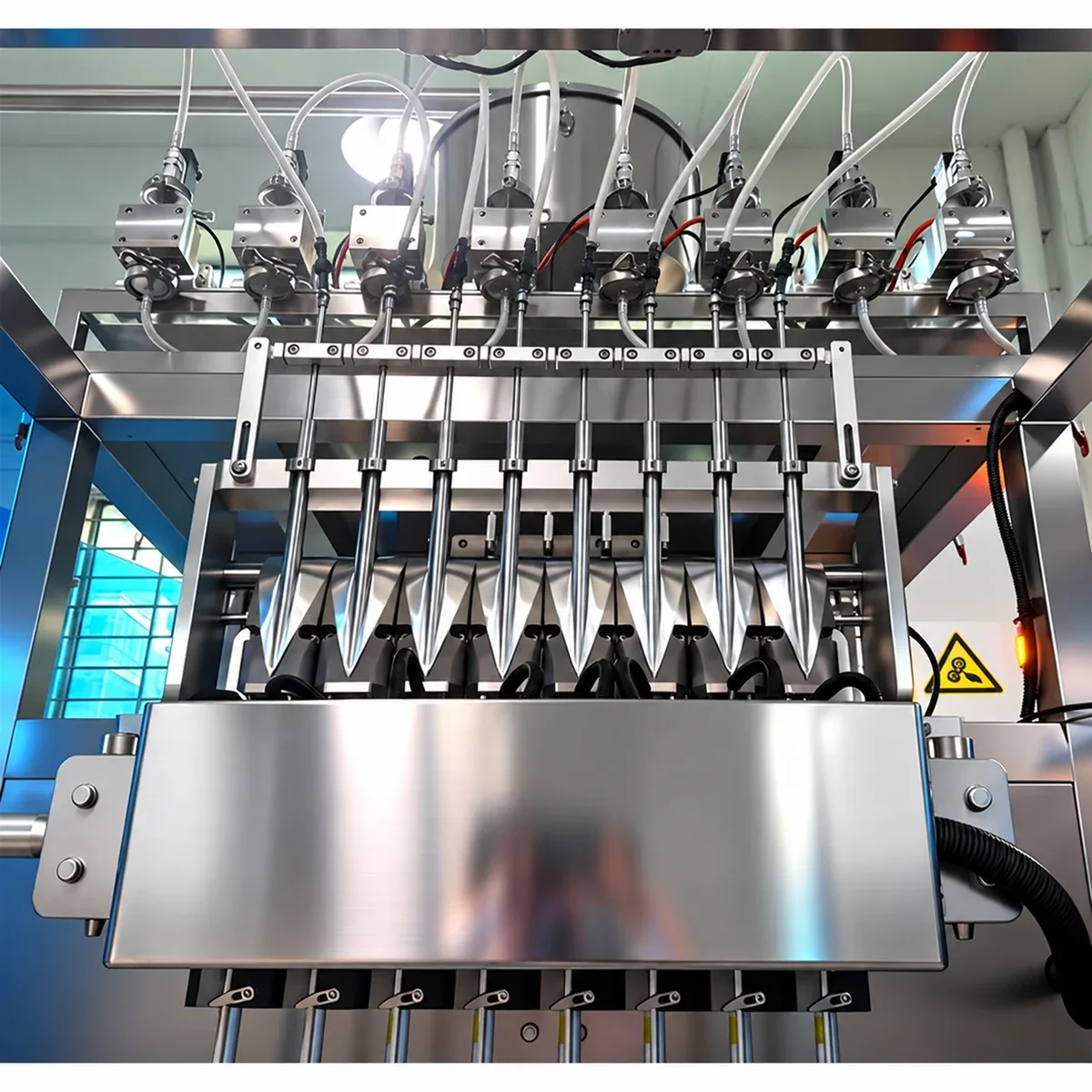
Use auger dosing as a candidate for powder, a pump and nozzle arrangement for pumpable liquids or gels, and volumetric cups or vibratory feeding for free-flowing granules. Select the route with the sample and dose range in view. These are starting points for evaluation, not an accuracy ranking or a promise that every formulation fits.
Ask how the proposed filler receives material, adjusts the portion and delivers it to each active lane. For a powder-rich blend, the auger and feed arrangement need review together: a good portion setting does not resolve interrupted supply or powder reaching the seal. For a granular blend, a cup meters volume, so a density change can alter weight even when its volume setting stays the same.
For liquids, follow the proposed product path from the supply connection through the pump to the outlet. Review temperature control or agitation if the product team identifies a need, and ask which parts of that path the option covers. Assess shutoff with the formulation and inspect finished packs for residue near the seal. A clean outlet in a short video does not establish the result for a different gel or dose.
Keep the output of this step simple: one candidate route and the questions it must answer. The linked powder, liquid and granule equipment pages explain their respective feeding and dosing inputs. Use them to prepare the route-specific review rather than adding every available machine type to the shortlist. A mixed or borderline material should stay a sample-assessment question until its behavior is understood.
Related reading: Powder Stick Pack Machine: Auger Dosing; Liquid Stick Pack Machine for Gels; Granule Stick Pack Machine: Drink Mixes
Scroll horizontally to see all columns. Keyboard: focus the table and use the arrow keys.
| Material condition | Dosing candidate | Evidence question |
|---|---|---|
| Powder / powder-rich blend | Auger with reviewed feed arrangement | Does supply remain consistent, and is product kept out of the seal? |
| Pumpable liquid / gel | Pump and nozzle circuit | How do temperature, particles and pauses affect dose and cutoff? |
| Free-flowing granules | Volumetric cups or vibratory feeding | Does fill weight change with hopper level, refills or separation? |
Step 3 — Connect the dose to a pack drawing
Specify the smallest and largest dose alongside a dimensioned finished-pack drawing. Review usable space, seals, opening and print or code positions together. Dose weight alone cannot settle pack width and length, and an external outline does not tell the equipment team how much room remains for the product and clean closure.
For early powder planning, a measured density helps estimate the product volume. That estimate still leaves forming geometry, air carried with the powder, seal bands and clearance at closure to be checked. The dimensions guide explains this distinction and the measurement boundaries. Use it when preparing the drawing; avoid treating an early volume estimate as a finished size ready for a film order.
Separate fixed constraints from candidate dimensions. An existing carton, opening feature or approved artwork may set a boundary that the equipment proposal must respect. Where a size remains adjustable, identify it as provisional and state what the filled sample needs to do. Review opening and emptying with the product team, especially when a gel can remain against the film after squeezing.
If the pack format is unsettled, use the stick-pack-versus-sachet guide to compare the neighboring choices before requesting tooling. For each intended format, ask which forming, sealing, cutting and dosing parts it requires. A proposal covering several sizes should identify those sizes and their parts explicitly, including whether they are needed at launch or later. Keep the approved drawing revision with the dose range and tooling response so a later quotation change can be traced.
Related reading: Stick Pack Sizes & Dimensions Guide; Stick Pack vs Sachet: Which Format to Use
- Dose: minimum ___; maximum ___; unit g or ml; product ID ___.
- Finished drawing: width ___ mm; length ___ mm; revision ___.
- Seal, opening and code positions: shown on drawing ___; fixed constraints ___.
- Format list: launch ___; later ___; required change parts to confirm ___.
Step 4 — Size lanes from accepted output
Start with accepted packs over a stated production schedule, then ask which lane arrangement can meet that requirement with your product and pack. Include cleaning, changeovers, replenishment and downstream handling in the discussion. A highest mechanical speed multiplied by an entire shift does not describe the quantity of usable packs you will receive.
Nominal packs/min equals active lanes multiplied by cycles/min. This is a counting relationship, not measured accepted output. Ask which product, dose, film, pack drawing and active-lane arrangement support a proposed rate. Keep the counting interval and reject treatment with the evidence, so a machine-cycle figure cannot be mistaken for finished accepted packs or a short demonstration for a shift result.
Write down the batch pattern as well as the total requirement. A long run of one format and several short recipe runs place different demands on the same arrangement. Identify the planned cleaning and format changes, how material reaches the hopper or inlet, and how packs are collected or transferred. If downstream packing limits useful output, make its responsibility and capacity review part of the line brief.
Use the single-lane-versus-multi-lane guide for the detailed arrangement comparison. Here, the decision is whether the supplier has answered the production basis you supplied. Ask for accepted-output evidence with its conditions and state which operating tasks are inside that counting window. Where the trial and proposed arrangement differ, retain the difference as an open verification item rather than extrapolating a shift result.
Related reading: Single vs Multi-Lane Stick Pack Machines
Scroll horizontally to see all columns. Keyboard: focus the table and use the arrow keys.
| Production basis | Buyer entry | Supplier evidence to attach |
|---|---|---|
| Accepted output | ___ packs/min or ___ packs/shift | Counting interval and accepted/rejected definitions |
| Available schedule | Shift time ___; planned stops ___ | Tasks included in the stated output basis |
| Batch / format pattern | Products ___; changeovers ___ | Proposed cleaning and tooling sequence |
| Feeding / downstream | Supply method ___; discharge ___ | Included transfer equipment and open site work |
Step 5 — Approve film and sealing inputs
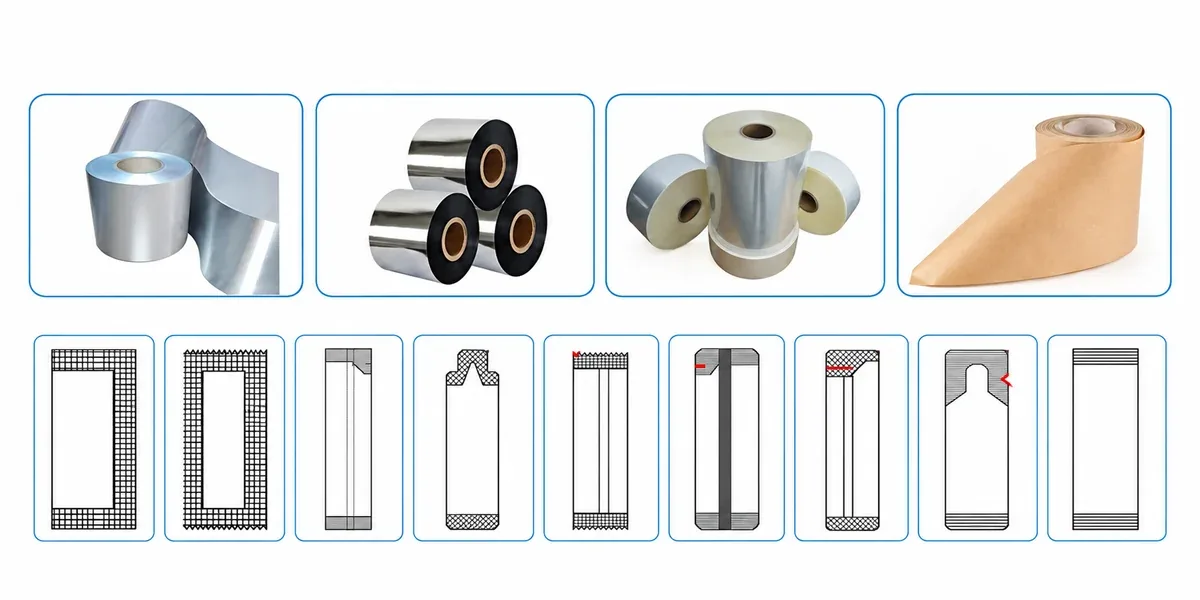
Give the equipment team and film supplier the exact film specification, physical roll details and approved pack drawing. Identify the grade and revision rather than relying on a laminate name. The review must cover forming, print registration, seal and cut behavior with the product, as well as the material information used by your packaging team.
Collect the material code, full structure, layer or total thickness information, coatings and sealant specification. Request grade-specific evidence for product-protection needs. Two films described with the same layer names can behave differently because their grades, thicknesses or surfaces differ. The film guide explains which specification fields to collect and why a shorthand structure name cannot settle the decision.
The roll must also match the proposed unwind and web arrangement. Record width, core dimensions, maximum roll diameter, winding direction, print repeat, registration-mark location and artwork orientation. Distinguish the unfolded strip width for each lane from the finished external pack width. The strip supplies tube material and the back seal; the complete roll layout includes the specified trim and slitting allowances. Release the roll order against the approved web drawing.
Arrange checks with production-equivalent film where available. Inspect filled packs for product near the closing seal, wrinkles, cut or artwork alignment and opening behavior, using the agreed inspection scope. Keep film and product IDs with the record. If a substitute roll is necessary, list which checks remain open for the intended grade so the production-film approval cannot disappear between a successful demonstration and purchasing.
Related reading: Stick Pack Film & Machine Compatibility
Step 6 — Separate options from change parts
Ask for a scope list that separates included equipment, optional items, exclusions and change parts. Review each planned product and format against that list. A photograph, touchscreen recipe or broad statement about flexibility does not establish which hardware will be supplied or which changes the delivered arrangement can make.
Begin at the supply boundary: who provides product feeding, the liquid connection or hopper replenishment, and who handles finished packs? Then list requested coding, inspection and product-handling functions individually. If heating, agitation, dust handling, checkweighing or film splicing is being discussed, ask whether it is offered for this configuration and what work it covers. Do not let an accessory shown during a demonstration become an assumed line in the order.
Keep format tooling separate from wear items. Each active lane has its own forming arrangement, so a width change can require a matched forming set across the lanes. Changes in seal layout, cut style or dose range may also involve parts. Ask for a per-format answer showing settings changes, parts changes and first-pack checks. Saved settings can be useful, but they cannot replace an incompatible forming tube, auger or nozzle.
Add cleaning access and the planned recipe sequence to the scope discussion. Ask which product-contact components and tools are involved and which instructions accompany them; your production and quality teams retain responsibility for the required cleaning method and verification. The price guide covers cost factors and quotation boundaries in more detail. This step supplies the scope to compare before a price difference is interpreted.
Related reading: Stick Pack Machine Price: Budget & Quote Guide
Scroll horizontally to see all columns. Keyboard: focus the table and use the arrow keys.
| Scope item | Response to request | Keep with the quotation |
|---|---|---|
| Feeding and discharge | Included / optional / excluded; interface owner | Layout and connection boundary |
| Requested functions | Availability and exact coverage for each option | Option line and configuration reference |
| Additional formats | Settings, forming, seal, cut and dose parts | Drawing revision; quantities and lanes covered |
| Cleaning / maintenance | Access, tools and instructions to be supplied | Contact-part and wear-item list |
Step 7 — Agree a representative sample trial
Request a trial that answers the open question in your brief, with identified materials, a stated setup and agreed records. Discuss the quantity, fees, freight, handling, date and return or disposal before sending anything. A useful trial links an observation to the product, film and configuration that produced it, so its relevance to the proposed machine can be reviewed.
Specify whether the unresolved issue is dosing consistency, supply after a refill, liquid cutoff, product in the seal or another documented concern. Some questions can be answered from a drawing and specification; others require the material to run. Ask which machine arrangement will be used and how its lane count, filler or tooling differs from the one being proposed. Record those differences alongside the agreed observation list.
Use the production formulation, stored and shipped under the agreed handling conditions, and intended film where practical. A substitute material or film may answer a narrower question, but its identity and the later production-material check must remain visible. Ask what written results, samples, photos or video you will receive and which conditions they will identify. For multi-lane observations, retain the lane identity rather than accepting a combined result without its basis.
The sample-testing page details the brief and arrangements to agree before shipping. Bring the resulting record back to the configuration review: identify questions answered, changes proposed and checks still needed. Where the conditions match, trial observations can help define later acceptance checks; where they differ, ask for follow-up work. Keep the trial record with the revised specification instead of relying on a summary message saying that the product ran.
Related reading: Stick Pack Machine Sample Testing
Scroll horizontally to see all columns. Keyboard: focus the table and use the arrow keys.
| Trial request | Entry to agree | Record to receive |
|---|---|---|
| Open question | Issue ___; proposed observation ___ | Finding and remaining question |
| Materials | Product / batch ___; film / revision ___ | Actual material IDs and condition |
| Setup | Tested arrangement ___; proposed arrangement ___ | Configuration differences and settings |
| Practical terms | Quantity / date / fees / handling ___ | Written scope and agreed deliverables |
How do you evaluate the supplier behind the machine?
Evaluate a stick pack machine supplier by the evidence and responsibilities behind the proposed configuration. Confirm who contracts, builds, integrates and supports it, then review the trial, acceptance, site, parts and document scope. A manufacturing or distribution label is only the start of that review; it does not answer which party will resolve an open project item.
Ask the seller to explain its role and name the configuration manufacturer, engineering contact and support contact. If the proposal passes through a reseller or integrator, ask who owns specification changes, trial records and later parts identification. Judge the arrangement by the actual responsibilities and documents. Avoid assuming that a factory relationship automatically covers installation, or that a distributor cannot provide an engineering or support role.
Use this site's about page to check its published equipment focus and to request contracting-entity and current company documentation. StickPackMachine publishes multi-lane equipment for powders, granules, liquids and gels; the proposed configuration and destination-specific terms belong in the quotation. Apply the same evidence questions to every response, including ours, rather than treating a supplier's public description as the final contract scope.
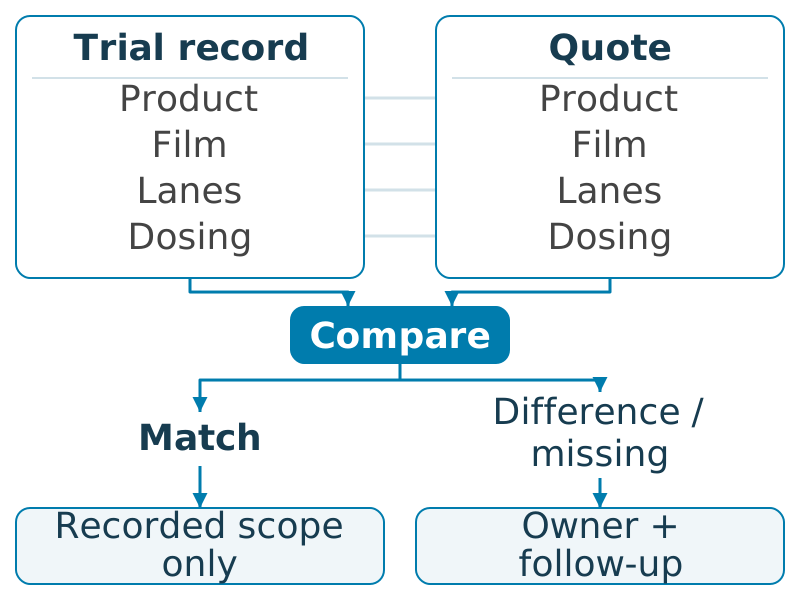
Separate an exploratory sample trial from the factory acceptance test associated with an order. Before choosing a supplier, ask how FAT would be arranged, whether attendance or remote review is available for the project, who supplies materials and which records address the order. Compare the trial record with the quoted configuration: match product and batch identity, film grade and revision, lane count and dosing arrangement. A difference or missing record remains an open item with an owner and agreed follow-up; matching inputs support only the recorded conditions. The FAT checklist provides the detailed execution questions; this guide uses the arrangement to assess the completeness of the proposal.
Treat receiving-site support as a separate scope decision when comparing suppliers. Use the installation-and-training page to review site preparation and handover, then retain a named owner for each agreed task. The US installation FAQ below collects the destination-specific questions to settle before treating attendance as included.
Agree training for the people who will run, clean and maintain the delivered equipment, and keep its scope tied to that configuration. Make document completeness and revision ownership a handover decision; the food-product FAQ below lists the records to request. Track factory-to-site differences with the person responsible for resolving them.
Ask for recommended wear items, critical spares and each required format set by identifier and quantity. Have availability and quoted lead time confirmed for the request, and distinguish parts supplied with the machine from later purchases. The spare-and-change-parts page explains the identification needed to check fit. Keep parts and document references with the configuration, so future requests can identify the machine revision and station rather than depend on a similar-looking photograph.
Related reading: Stick Pack Machine FAT Checklist; Stick Pack Machine Installation & Training; Stick Pack Machine Spare & Change Parts; About Us: Stick Pack Machine Manufacturer
Scroll horizontally to see all columns. Keyboard: focus the table and use the arrow keys.
| Question to ask | Evidence to request | Decision or open item |
|---|---|---|
| Who builds, quotes and supports it? | Contracting entity; manufacturer; engineering and support contacts | Named responsibility for each task |
| What supports the stated performance? | Product, pack, film, setup and counting conditions | Equivalent to the proposal or differences still open |
| What trial answers our question? | Scope, quantities, fees, handling and deliverables | Answered question or follow-up trial |
| How would FAT be arranged? | Attendance/remote scope; order checks; material and record owners | Agreed arrangement and open deviations |
| What is available at our site? | Agreed site-support scope and responsibility record | Project-specific support scope |
| Who will be trained, and on what? | Topics, trainees, configuration and training-record owner | Operating and maintenance handover |
| Which spare and change parts are covered? | Identifiers, quantities, formats, compatibility and availability | Supplied kit versus separate purchases |
| Which documents and communication are agreed? | Configuration-specific document schedule and revision owner | Missing document or reply owner and next action |
Step 8 — Shortlist on evidence and send one RFQ
Shortlist configurations against one written brief, using confirmed, open and excluded status for each requirement. The best fit is the proposal that meets the documented product, pack and production needs with an agreed evidence and support scope. It is a project decision, not a universal brand ranking or a numerical score assigned to missing information.
Ask every supplier to return the same requirement table with its proposed configuration and document references. Put a substantive mismatch next to the requirement it affects: an untested film grade, an omitted format set or an unassigned site task should not be buried in an email thread. A supplier can explain the alternatives; the buyer can then decide whether the requirement changes or the proposal needs revision.
Use the blank comparison row below repeatedly for each requirement and each response. Confirmed should have supporting scope or evidence; open needs a named action and owner; excluded means the buyer must decide who supplies it or whether it is necessary. Where a requirement affects basic product or pack fit, resolve it before relying on the proposal. Update the brief revision when a decision changes and ask the shortlisted suppliers to respond to that same revision.
Send the resulting product profile, dose range, pack drawing, film information and accepted-output basis with the options, destination and requested service scope. Partial information is enough to start a configuration discussion if unresolved fields are marked. The quote-request page explains the initial enquiry process and missing-detail follow-up. Keep the inquiry reference with the brief; submitting an enquiry begins that discussion, while a quotation and any order are agreed separately.
Related reading: Request a Stick Pack Machine Quote
Scroll horizontally to see all columns. Keyboard: focus the table and use the arrow keys.
| Requirement / brief revision | Offered configuration / evidence | Status / next action |
|---|---|---|
| Requirement ___; revision ___ | Configuration ___; document or trial reference ___ | Confirmed / open / excluded; owner ___; action ___ |
Discuss this configuration
Send the details below to discuss the configuration and any missing information. Leave undecided fields blank; agree how to share samples and documents on WhatsApp.
- Product and handling profile
- Dose range
- Density or viscosity conditions
- Pack drawing and format list
- Film specification and artwork
- Accepted output and schedule
- Options, cleaning and line boundaries
- Destination, layout and utilities
- Trial, FAT, training, spares and documents
We reply within 24 hours.
Discuss on WhatsAppWhen this does not apply
Use this checklist to prepare an equipment purchase, not to infer formulation development, contract filling or printed-film supply. Those are different supply questions. Establish the product specification with your product team and confirm each purchasing responsibility explicitly. A requirement for another format, a used machine or a different dosing arrangement needs its own scope and compatibility review.
Neither a family photo nor a demonstration proves the ordered machine's configuration or performance. Trial conclusions depend on the identified product, film, setup and recorded conditions. Changes to the formulation, film grade, dose or tooling can leave checks open. Nominal output and an early product-volume estimate are planning information, not a guaranteed shift quantity or a final pouch drawing.
Film-machine compatibility does not establish shelf life, and a material or equipment description does not establish destination approval. Ask for the project documents your product, quality and site teams need to review. Installation availability, technical response commitments, certification evidence, delivery and commercial terms must be confirmed for the selected equipment and destination rather than inferred from this general guide.
This is a procurement checklist rather than an operating instruction. The manual for the supplied configuration and qualified personnel govern operation, cleaning and testing. Keep unresolved factory-to-site conditions in the handover record and agree their follow-up. The enquiry response sentence used on this page concerns a reply to your enquiry; it does not set a trial, repair, quotation-completion or delivery deadline.
Method and sources
Compiled on 10 October 2026 from StickPackMachine's published equipment, dimensions, film, lane-count, sample-testing, installation, spare-parts and quotation pages. The linked pages provide the detailed inputs behind each decision. The worksheets reorganize those purchasing inputs into one brief; they are not completed tests, new model specifications or a supplier ranking.
Accepted output here means usable packs counted over a stated interval under the agreed inspection basis. Nominal output is the lane-and-cycle count. Open means a requirement still needs evidence or a scope decision, not that it has passed. The buying-guides hub links the specialist references when you need to work through one input in more detail. Keep the completed brief and its revisions with the actual project records.
Related reading: Stick Pack Machine Buying Guides
Common Questions
What should a US buyer confirm about installation and training?
Confirm availability for the actual US site before treating on-site work as included. State the location and request the remote/on-site split, responsible people, working language, travel, dates and fees in the agreement. Name who unloads and positions the machine, connects utilities, supplies product and film for site checks, and signs off commissioning. A US destination alone does not establish a local service center or an engineer visit.
What should I check before considering a used stick pack machine?
Establish the machine identity, supplied configuration, documents and support availability first. Obtain the plate, parts list and format information, then request a product-and-film suitability review. This checklist does not establish condition or a used-machine offering; ask the seller and proposed support provider what evidence and work they can supply.
Can I get replacement parts for a machine from another supplier?
Support and compatibility need confirmation for the identified equipment. Send its identification plate, the component location, any document part number and assembly photos. Ask whether the team can support that machine, then confirm fit, quantity, availability and quoted lead time; similar appearance alone does not establish interchangeability.
Does buying a stick pack machine include formulation development?
No; formulation development stays with your product team. A sample trial records how the supplied formulation behaves with the tested machine-side settings. If the formulation changes, identify the revised batch and agree which checks need repeating rather than assuming the earlier dosing or sealing observations still apply.
Does the machine supplier also supply the printed film?
Confirm film purchasing responsibility separately; machine compatibility does not establish film supply. Name the film supplier, specification, artwork and web-drawing owners in the brief. Ask what material is required for the trial and which work is included or excluded in the quotation before placing a production-roll order.
Which documents should I ask for when packaging a food product?
Ask for configuration-specific documents against the requirements your quality and destination teams identify for the food product. Request operating instructions, electrical and pneumatic drawings, parts lists including wear and change parts, maintenance information, and agreed trial and handover records. Check the document revision against the configuration you will receive. Request any required project-specific certification evidence separately; a generic brochure or another machine's manual does not establish it.