
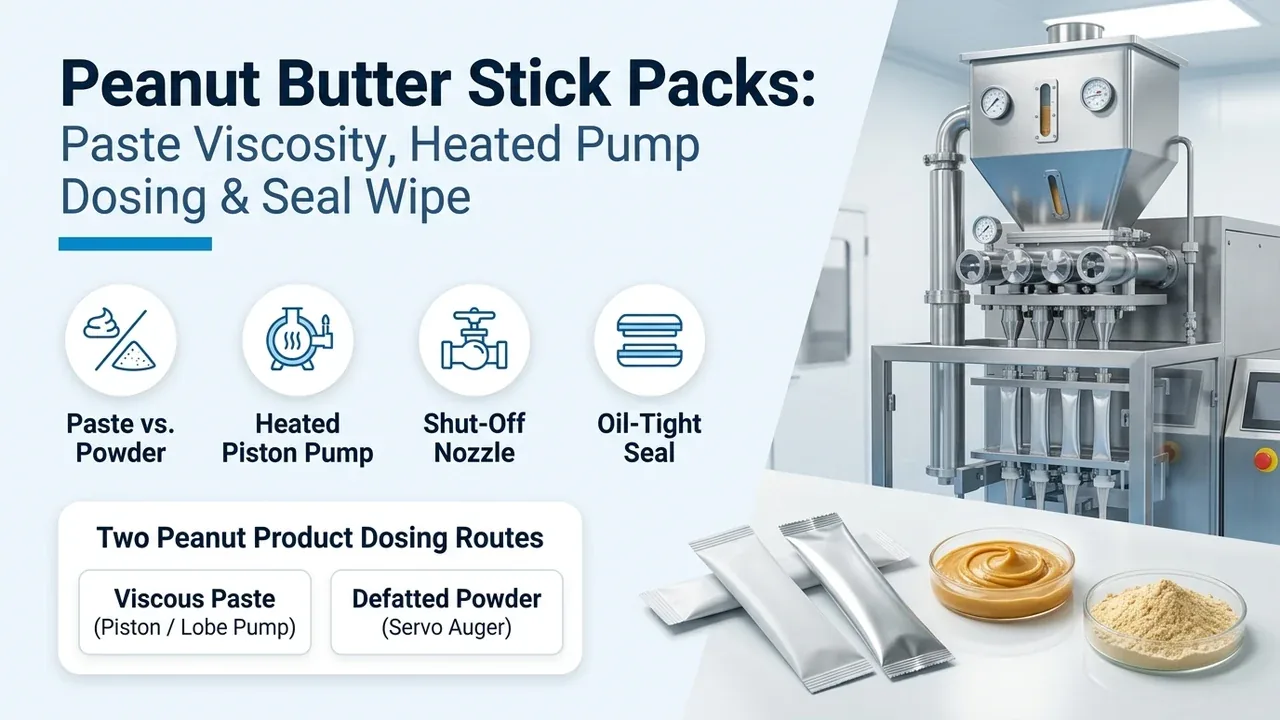
Separate peanut paste from defatted peanut powder
| Project input | Engineering review | Record to retain |
|---|---|---|
| Paste or defatted powder | Pump and nozzle route for paste; auger route for powder | Identified formulation and sample condition |
| Oil separation and particles | Supply, agitation, valve passage and cutoff | Observed changes during holding and restart |
| Pack format and film | Usable volume, opening, seal contamination and emptying | Dimensioned drawing, exact film grade and filled samples |
| Cleaning and allergens | Accessible product path, disassembly and plant cleaning requirements | Contact-parts list and agreed cleaning procedure |
| Accepted output | Complete run with feeding and discharge | Lane-indexed counts, stops, rejects and test conditions |
Roasted peanut paste contains an oil-rich continuous phase and suspended solids. It must reach the metering chamber without interrupted supply, pass through the valve and nozzle, and stop without leaving a tail across the closing seal. Start the feasibility review on the liquid and paste route, with a positive-displacement dosing candidate assessed against the formulation. The pump name alone does not settle passage through a long narrow filling tube or performance after a pause.
Defatted peanut powder is a dry material. Its bulk density, flow, dust and tendency to cake govern the auger and feed arrangement. A product sold as powdered peanut butter may contain other ingredients, so identify the full blend rather than sending only a marketing name. Keep paste and powder trials separate. They use different feeding equipment and cleaning procedures even if both finished packs are described as peanut butter sticks.
Scroll horizontally to see all columns. Keyboard: focus the table and use the arrow keys.
| Item | Engineering question | Record |
|---|---|---|
| Roasted paste | Can supply, metering and cutoff handle the actual paste? | Batch, temperature, holding history and particles |
| Defatted powder | Does the blend feed and dose consistently? | Density method, dust, caking and refill observations |
Review flow, free oil and inclusions at the filling condition
Record temperature where the product enters the machine, how it has been mixed and how long it has been held. Describe whether free oil appears on the surface, solids settle, or the paste becomes difficult to move after standing. Repeat the observation after a representative pause. These changes affect what reaches the dosing chamber, so a smooth sample immediately after mixing may not represent the production material at restart.
Describe the largest particles, their shape and the frequency of pieces in the formulation. Review the complete passage through the inlet, valve ports, metering chamber, manifold and nozzle. A particle can pass one opening yet lodge at a moving seat or an abrupt transition. Compare the actual proposed geometry with representative material rather than deriving a universal nozzle-bore multiplier from a texture grade. For powder, distinguish agglomerates that break during handling from hard inclusions that remain intact.
Product identity and texture descriptions help organize the sample brief; they are not pump-sizing specifications. The linked FDA and USDA references describe peanut-butter products and grades. Use the actual formulation sheet and measured handling behavior for engineering, with the product team responsible for the identity and market requirements of the food.
Further reading: 21 CFR § 164.150 — Peanut butter Standard of Identity (U.S. Government Publishing Office); United States Standards for Grades of Peanut Butter, 7 CFR Part 52 §§ 52.3061–52.3074 (USDA AMS); FDA 21 CFR § 177.1520 — Olefin polymers for food contact surfaces; NIST Handbook 133, 2026: Checking the Net Contents of Packaged Goods; USDA Agricultural Marketing Service — Peanut Butter Grades and Standards
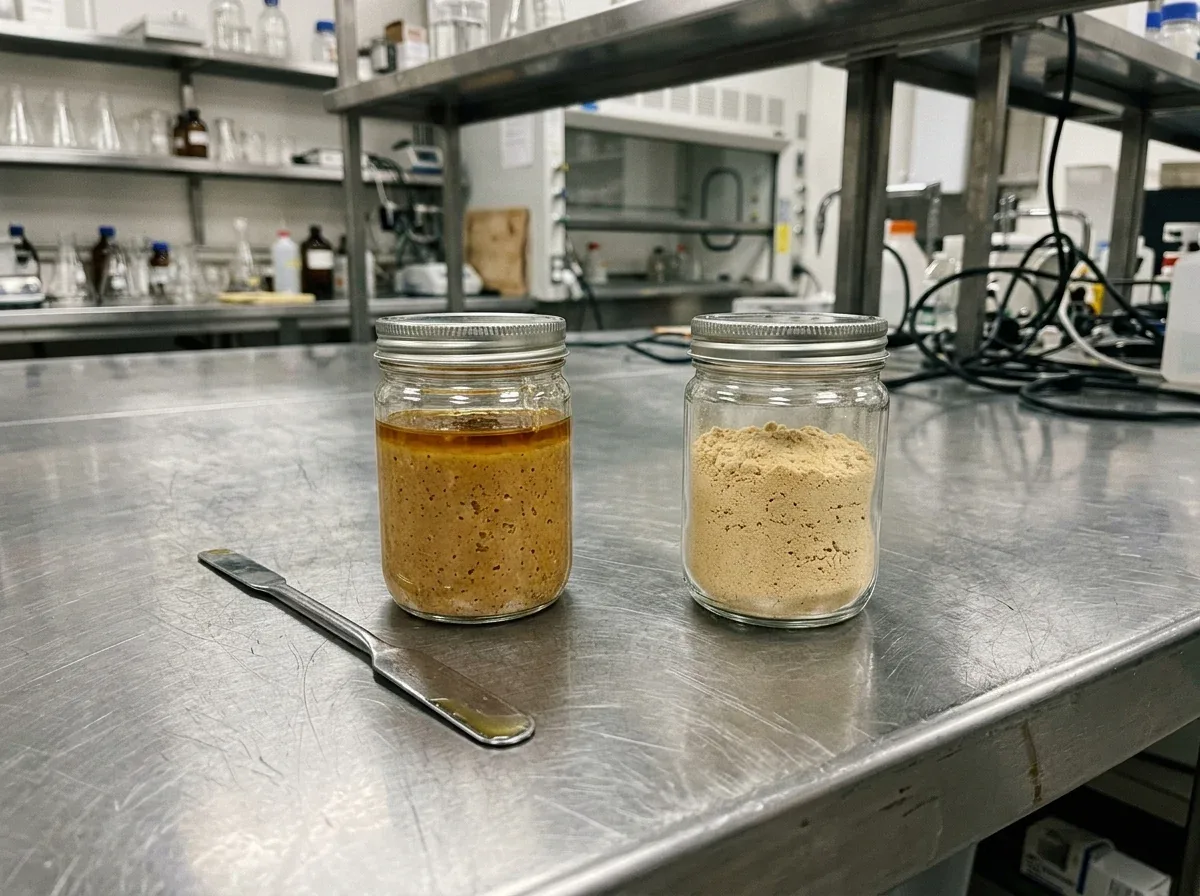
Connect hopper supply, metering and nozzle cutoff
Trace the wetted path from the holding vessel to every filling outlet. The configuration review should identify the hopper or supply connection, pump or piston chamber, valve arrangement, manifold, hoses and nozzle. Review drain-down and access at each part. An apparently short filling time can conceal a slow refill stroke or an inlet that loses supply as the hopper level changes; include replenishment and pauses when observing the proposed cycle.
Heating or agitation may be useful when the product team has defined a need, but they require review with the formulation. Agree which surfaces are conditioned, how temperature is monitored, and how the product is held before and during filling. Avoid selecting a fixed warming temperature from another peanut product. Excessive mixing or a changed temperature can alter the product after packing as well as its immediate flow through the pump.
At cutoff, inspect both the outlet and the next pack. A nozzle can stop bulk flow while a fine tail still reaches the end-seal area. Assess the proposed shutoff and withdrawal motion with the actual product, including the first doses after a hold. Record the changed setting or hardware when repeating a check. The practical objective is repeatable dosing and clean closure over the agreed run, not a clean-looking outlet in one photograph.
For steady, fully developed laminar flow of an incompressible Newtonian liquid in a round tube, the Poiseuille relationship is Delta P_nozzle = (8 · mu_app · L_tube · Q) / (pi · R_id^4), with constant viscosity and SI units. The fourth-power radius relationship explains a geometric sensitivity in that model. Peanut paste can have yield stress and shear-dependent viscosity, so substituting one apparent viscosity does not make this a reliable peanut-paste pressure prediction; use measured rheology and an appropriate model or trial for pump and nozzle selection.
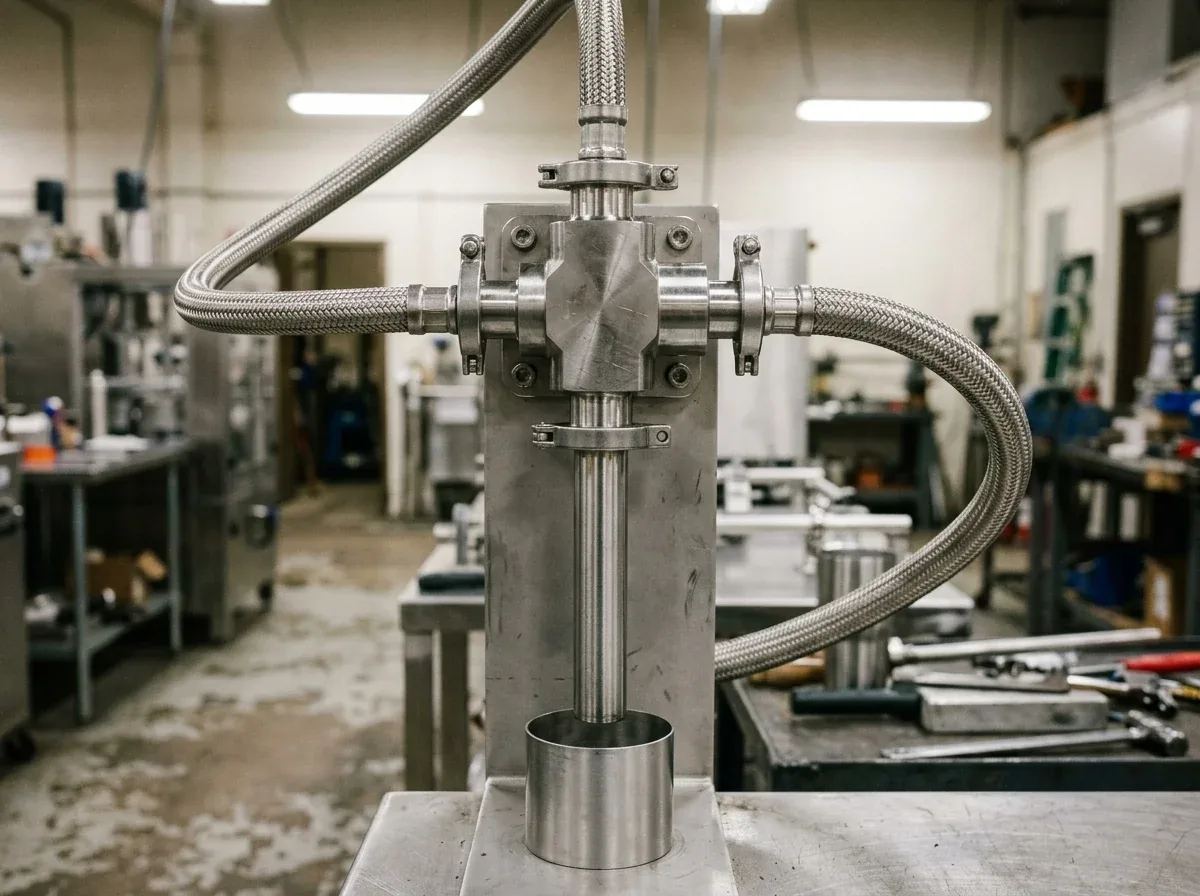
Choose the format from filling and consumer emptying
Start the drawing from the intended portion and measured product volume. The sourced four-lane liquid reference covers approximately 1–30 ml per stick, with a separate four-side-seal reference up to about 50 ml. These are equipment configuration ranges, not a peanut-butter portion chart. Paste density, the filling path, usable cavity and opening behavior must be assessed before converting a serving mass into finished width and length.
Compare a tubular stick and a wider sachet with the same formulation and serving. Review how the user opens the pack, squeezes it and handles any separated oil. A wider face can change the handling action, but does not guarantee less residue. Weigh the product remaining in opened packs under a consistent emptying procedure, and retain samples showing the preferred opening and acceptable finished shape. Include the intended retail carton or dispenser in the comparison.
Residual fraction after emptying = residual product mass / initial net fill mass × 100%. Measure both masses on packs of the same formulation and serving, using one defined opening and emptying procedure. Compare the distribution of remaining product across samples and inspect where it collects. Keep consumer-emptying measurements separate from the net-content check on unopened packs.
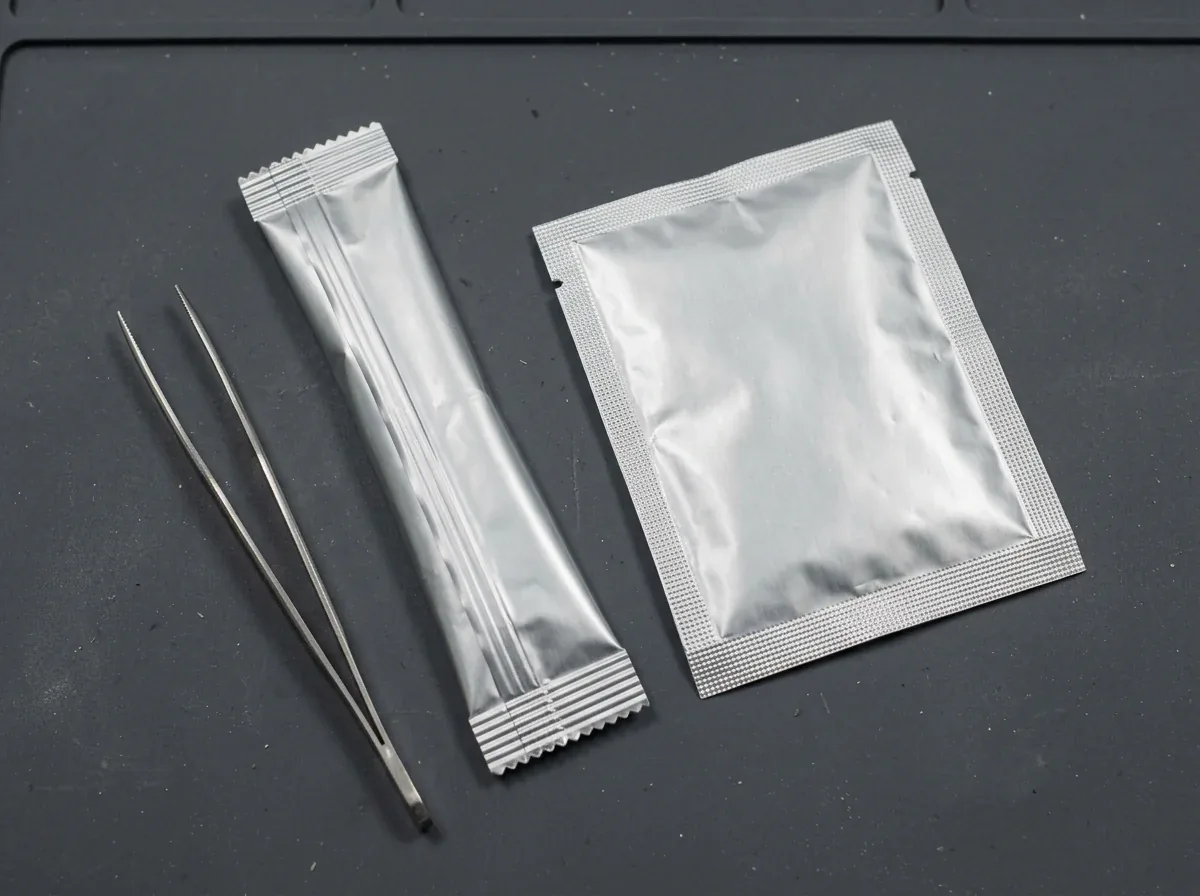
Define cleaning access and the recipe-change procedure
List every product-contact component that retains paste, including valve cavities, seal grooves, pump chambers and manifold ends. Review how each is drained, removed, inspected and reassembled under the equipment instructions. Match contact materials and seals to the food and the plant cleaning method. A stainless material designation by itself does not establish cleanability, chemical compatibility or removal of peanut residues from the assembled path.
The plant quality team should define allergen control, cleaning verification and release between products. Engineering can support that procedure through accessible parts, identified wear seals, handling tools and an agreed disassembly sequence. A spare contact-parts set may change the mechanical work, but it does not establish an allergen clearance time. Record the actual activities and their order before estimating the stopped production window.
Keep wear parts distinct from format parts. A replacement gasket must match its component and material specification; a new nozzle or forming set belongs to a configuration change. Store the approved part identifiers with the machine revision and cleaning instructions. When a formulation or cleaning agent changes, review the affected materials and repeat the relevant checks rather than assuming the previous contact-parts decision remains suitable.
Plan the product-and-film trial before dispatch
Select a production-representative sample and preserve its handling and temperature instructions through dispatch and testing. Define the question the run must answer: interrupted refill, oil separation, nozzle tail, product in the seal, emptying or another observed problem. Agree enough material for setup, the planned run, pauses and repeat checks; the quantity follows that sequence and the product held in the equipment.
During the agreed guarded test, label samples by lane and operating event. Retain startup, sustained running, refill and restart observations where they belong in the plan. Record accepted and rejected packs with the counting window, and keep dose measurements separate from seal appearance and the selected integrity check. ASTM D3078 is a bubble-emission method for gross leaks in flexible packs containing headspace gas; it is not vacuum-decay testing or proof of zero microchannels.
If product, film or tooling changes during the trial, record the change before repeating the affected check. Keep original and repeat results together. The configuration review can then distinguish a dosing correction from a film or pack-drawing change and carry the resulting setup into the order, FAT and operator handover. Assign any site integration check to the receiving installation record.
Discuss this configuration
Discuss on WhatsAppCarry the selected configuration into manufacture and handover
The selected paste route should identify its dosing device, supply arrangement, nozzle and film configuration. The powder route should identify the auger and feed arrangement for the actual blend. Keep the pack drawing and format parts with that specification. The established powder reference is four lanes, approximately 1–20 g, 15–30 mm width and 50–180 mm length; around 30 g needs tooling and sample assessment. Other combinations belong to the configuration review.
Before manufacturing release, connect the accepted-output requirement to the supply and discharge tasks included in the order. Prepare the FAT checks, drawing revisions, contact-parts list and operating information for the delivered machine. Keep the paste condition and the specific dosing or cutoff concern with the trial plan. The resulting records support installation, training, maintenance and later part identification.
Common Questions
Can peanut paste and peanut powder use the same filler?
They need separate dosing assessments. Paste starts with a pump or piston and nozzle path; defatted powder starts with an auger and dry-feed arrangement. Identify the complete formulation before selecting the route.
What nozzle bore does peanut butter need?
Review actual particles, valve ports, product flow, temperature and the complete nozzle path. A texture name or generic particle-to-bore ratio cannot approve the configuration.
Should peanut butter be warmed before filling?
The formulation and product team determine whether conditioning is needed. Assess the holding, pumping and packed-product behavior together; there is no single warming temperature for all peanut pastes.
Is a stick or sachet easier to empty?
Compare filled samples using the same serving and an agreed opening and emptying procedure. Record residue rather than assuming a fixed advantage from the format.
What establishes cleaning acceptance?
The plant quality team defines the cleaning and allergen-control procedure. The machine review covers access, removable contact parts, materials, instructions and the records needed to support that procedure.
What should the sample trial record?
Identify product, film, drawing, configuration and lane; record dosing, cutoff, seal observations, accepted output, stops and the conditions for each repeat check.