
Co-Packing vs In-House Stick Pack Lines: MOQs, Unit Cost, and Crossover Volume
Co-packers enforce per-SKU Minimum Order Quantities (MOQs) because setting up a multi-lane vertical form-fill-seal (VFFS) line carries fixed labor and film loss regardless of batch length. Operators thread a wide printed web through rotary slitters and individual forming collars, dial in auger or pump weights on every lane, verify seal integrity, and complete sanitation clearance before releasing commercial packs. Boutique US powder co-packers publish starter tolling runs at 5,000 to 7,500 sticks per flavor ($2,750 flat up to 5,000 units, or roughly $5,500 for 7,500 sticks on an 8 g powder toll run, equal to $0.55 to $0.73 per stick before bulk ingredients and rollstock, plus around $400 for each additional SKU setup). Mid-tier runs of 25,000 to 30,000 sticks drop to roughly $0.30 to $0.43 per stick, while larger contract manufacturers set standard thresholds at 50,000 to 100,000+ sticks per flavor at $0.22 to $0.29 per stick.
Compare those toll charges against the shift capacity and direct conversion cost of an owned machine. On our four-lane powder reference configuration (30 to 40 cycles per minute per lane, or 120 to 160 nominal sticks per minute; four-lane liquid and granule configurations run roughly 120 to 200 packs per minute), one 8-hour shift accounting for reel splices, hopper refills, and cleaning yields roughly 33,000 to 48,000 accepted sticks, matching a 50,000-stick co-packer MOQ in about a single day. Direct in-house packaging conversion (printed barrier film at roughly $8 to $35 per 1,000 sticks depending on volume and foil or metallized structure, plus operator labor, nitrogen or compressed air, and setup scrap, excluding formula ingredients) typically runs $0.03 to $0.08 per stick on mid-scale schedules and $0.01 to $0.03 per stick above 50,000 sticks per day. Estimate unit break-even on matching cost boundaries with Crossover sticks = Installed line investment / (Co-packer unit fee - In-house unit conversion cost): saving $0.20 to $0.40 per stick recovers a $35,000 to $75,000 installed multi-lane cell across 150,000 to 375,000 sticks, making 300,000 to 500,000+ sticks per year (or four or more SKUs sharing one stick width) the common threshold for a 12 to 18-month payback.
Capital scope, lead times, SKU agility, and formula IP round out the build-versus-buy decision. Industry benchmarks place entry-to-mid multi-lane stick pack machines around $15,000 to $60,000 for the base packer depending on lane count, dosing heads, and controls, plus landed project items ($1,500 to $8,000 for ocean freight, customs entry, and rigging; $1,000 to $5,000 for three-phase electrical and clean dry air drops; extra width forming sets; dust extraction or nitrogen flushing; and coding), while pharmaceutical 316L lines with full IQ/OQ validation and multi-lane dynamic checkweighers (often $180,000 alone for a six-lane checkweigher) reach $250,000 to $1,000,000+. We build single machines to order (MOQ = 1) against an itemized brief so every filler, forming collar, and factory acceptance test deliverable is priced transparently. Turnkey co-packing typically takes 8 to 14 weeks for a first launch and 2 to 4 weeks for reorders (10 to 15 working days once film and blend reach the dock), whereas an installed in-house line schedules batches on demand, shares one forming-tube width across flavors while adjusting pack length (50 to 180 mm) at the HMI, and keeps proprietary blend ratios and processing parameters inside your plant.
Related reading: Stick Pack Machine Price: Budget & Quote Guide; Cost per Stick Pack: Production Cost Formula & Film Yield Worksheet; Stick Pack Production Capacity: Lanes, Cycles per Minute (CPM), Film Splicing & Real OEE Output; Single vs Multi-Lane Stick Pack Machines
Scroll horizontally to see all columns. Keyboard: focus the table and use the arrow keys.
| Decision factor | Contract manufacturing (co-packer) | Owned in-house stick pack line |
|---|---|---|
| Minimum order quantity (MOQ) | 5,000 to 7,500 sticks/SKU at boutique pilot co-packers; 50,000 to 100,000+ sticks/SKU at mainstream contract packagers, enforced per flavor | No batch minimum on your own floor (we quote equipment from MOQ = 1 unit); practical short-run floor set only by threading film and cleanout time |
| Unit conversion cost (excluding formula) | ~$0.55 to $0.73/stick on 5k to 7.5k pilot tolling; ~$0.30 to $0.43/stick at 25k to 30k; ~$0.22 to $0.29/stick at 50k to 100k+ (film extra in pure tolling) | ~$0.03 to $0.08/stick direct conversion (printed film ~$0.008 to $0.035/stick plus operator labor, utilities, and scrap), dropping to ~$0.01 to $0.03/stick above 50k/day |
| Volume crossover and payback | Lowest cash commitment below 150,000 to 250,000 sticks/year while testing market demand or package sizing | Typically pays back in 12 to 18 months above 300,000 to 500,000+ sticks/year, or earlier when running 4+ flavors that trigger co-packer SKU fees |
| Equipment and setup investment | $0 machine CapEx; working capital goes into prepaid batch deposits, ~$400+ per-SKU setup surcharges, and printed film minimums | Itemized packer, dosing heads, and launch forming set (entry/mid multi-lane base ~$15k to $60k; validated 316L pharma + checkweighing $250k to $1M+), plus freight/duties ($1.5k to $8k) and utilities ($1k to $5k) |
| Shift output benchmark | Capped by co-packer calendar slots; seasonal beverage or supplement peaks can push production windows out by weeks | 4-lane powder reference runs 30 to 40 cycles/min/lane (120 to 160 nominal sticks/min; ~33,000 to 48,000 accepted sticks per 8-hour shift) |
| Lead time | 8 to 14 weeks for initial turnkey launch; 2 to 4 weeks for repeat toll runs (10 to 15 working days after film and bulk arrive) | One-time equipment build, FAT, shipping, and commissioning lead time; same-week internal batch scheduling afterward |
| Changeover and SKU flexibility | Flavor switches trigger separate MOQs or sanitation fees; changing stick width requires a co-packer with matching tooling in stock | Standardizing one width (within the 15 to 30 mm powder reference range) lets all SKUs share forming tubes while cut length (50 to 180 mm) and dose change at the HMI |
| Formula IP and cGMP liability | Turnkey blending exposes recipe ratios unless pre-blended intermediates ship under NDA; statutory cGMP accountability remains on the brand | Blend ratios, flow aids, and dosing parameters stay strictly in-house; your team operates and documents the cGMP packaging room directly |
Why Compliance Responsibility Stays With the Brand (and What Quality Agreements Cover)
Hiring a co-packer outsources filling and sealing labor, never statutory cGMP responsibility. Under 21 CFR 111.1, a dietary supplement firm remains subject to 21 CFR Part 111 when an outside contractor packages or labels its supplement, and 21 CFR 111.415 requires distinct batch, lot, or control numbers both on packaged lots and on bulk batches shipped out for contract packaging. For pharmaceuticals, 21 CFR 210.3 includes packaging and labeling inside drug manufacture, while 21 CFR 211.22, FDA's drug quality-agreement guidance, and ICH Q10 establish that a quality agreement cannot delegate statutory CGMP compliance and that the owner's quality control unit holds non-delegable authority to approve or reject contract-packaged drug lots for final release. For foods under 21 CFR Part 117 (117.3 and 117.80), packaging (including modified-atmosphere nitrogen flushing) is regulated food processing requiring safe contact materials and active safeguards against allergen cross-contact and contamination.
When outsourcing pharmaceutical stick packs, keep technical CGMP governance separate from commercial terms. FDA's November 2016 drug quality-agreement guidance and ICH Q10 call for a written quality agreement before outsourcing that defines routine and for-cause audit rights, assigns who qualifies and maintains packaging lines, utilities, environmental monitoring, and computerized controls, specifies component sampling and label inventory reconciliation, and sets change-control approvals for major manufacturing equipment, container-closure laminates, lot-numbering schemes, or shared-line products. FDA explicitly advises keeping pricing, MOQs, delivery schedules, confidentiality, and liability caps in the commercial supply contract rather than inside the quality agreement. Although FDA's quality-agreement guidance and ICH Q10 apply to drugs rather than foods or dietary supplements, supplement and food brands use parallel technical appendices to lock specifications and audit access before sending bulk powder to a co-packer.
Related reading: Multi-Lane Stick Packaging Machines Compared; Pharmaceutical Stick Pack Machines: 316L cGMP; Nutraceutical Stick Pack Machine
- Two-tier supplement lot traceability (21 CFR 111.415): assign one bulk lot code to the blended powder tote leaving your mixer and a linked finished lot code embossed or printed on each stick so field investigations trace both blending and lane-level filling.
- Shared-line product screening in drug change control (FDA Quality Agreements guidance): require prior written approval before a contract packager introduces sensitizers, potent actives, or new dosage forms onto the multi-lane filler running your product.
- Clean separation of commercial and quality contracts: place unit tolling tiers, scrap allowances, and lead-time remedies in the master supply agreement so regulatory inspections of the quality agreement focus strictly on CGMP execution.
Scroll horizontally to see all columns. Keyboard: focus the table and use the arrow keys.
| Product regime | Primary federal rule or guidance | Brand accountability across co-packing and in-house lines |
|---|---|---|
| Dietary supplement | 21 CFR Part 111 (111.1, 111.70, 111.75, 111.260, 111.410, 111.415) | Brand remains subject to Part 111 when a contractor packages or labels the product; lot numbers must track both bulk shipments to co-packers and finished stick lots. |
| Drug product | 21 CFR Parts 210 and 211; FDA Quality Agreements guidance; ICH Q10 | Each party must follow CGMP for its operations, quality agreements cannot transfer statutory duties, and the owner's quality unit retains legal authority over final batch release. |
| Food product | 21 CFR Part 117 (117.3, 117.35, 117.40, 117.80, 117.135); FALCPA and FASTER Act | Packaging and modified-atmosphere flushing count as food processing; equipment must stay cleanable and controlled against allergen cross-contact, backed by written preventive controls. |
Multi-Lane Rollstock Control, Label Reconciliation, and the 100% Inspection Waiver
On a stick pack machine, flexible rollstock acts as both the primary food- or drug-contact container and the printed unit label, so incoming web release governs both barrier safety and label accuracy. Dietary supplement lines must establish written specifications for contact packaging and labels (21 CFR 111.70), visually inspect incoming reels against supplier invoices or certificates before production (21 CFR 111.75), examine finished sticks for correct packaging and labeling, and verify received bulk against purchase-order specs when a co-packer ships directly into distribution (111.70(f)). Drug lines under 21 CFR 211.122 and 211.130 quarantine incoming laminate rolls for representative sampling and testing against written specs, segregate approved rollstock by product and strength under restricted access, monitor inline thermal-transfer or laser coders so lot numbers and stability-backed expiration dates (211.137 and 211.166, excluding exempt homeopathic drugs) match the batch record, and sample finished units during and after runs (211.134).
Manual label reconciliation becomes error-prone on a 4 to 8-lane web unless operators track impressions across all lanes together. One master roll slit into N lanes yields N stick impressions per repeat pitch, meaning every splice pull-through or startup reject removes N labels per cut cycle. Both supplement rules (21 CFR 111.260 and 111.410) and drug rules (21 CFR 211.125) require recording packaging identifiers, reconciling issued impressions against accepted sticks, accounted scrap, and returned roll length, destroying excess material bearing lot codes (211.125) or obsolete labels (111.415), and investigating out-of-limit discrepancies (211.192). Fortunately, both regimes waive label reconciliation for cut or rolled labels when a 100-percent examination for correct labeling is performed by electronic or electromechanical equipment during or after finishing (21 CFR 111.410(d) for supplements; 21 CFR 211.125(c) and 211.122(g)(2) for drugs). On an owned multi-lane line, lane-indexed barcode or OCR cameras paired with verified per-lane air-jet or flap rejects satisfy this 100-percent examination requirement and eliminate manual web-footage reconciliation.
Related reading: Stick Pack Film & Machine Compatibility; Inline Checkweigher for Multi-Lane Stick Packs: Per-Lane Reject & Feedback
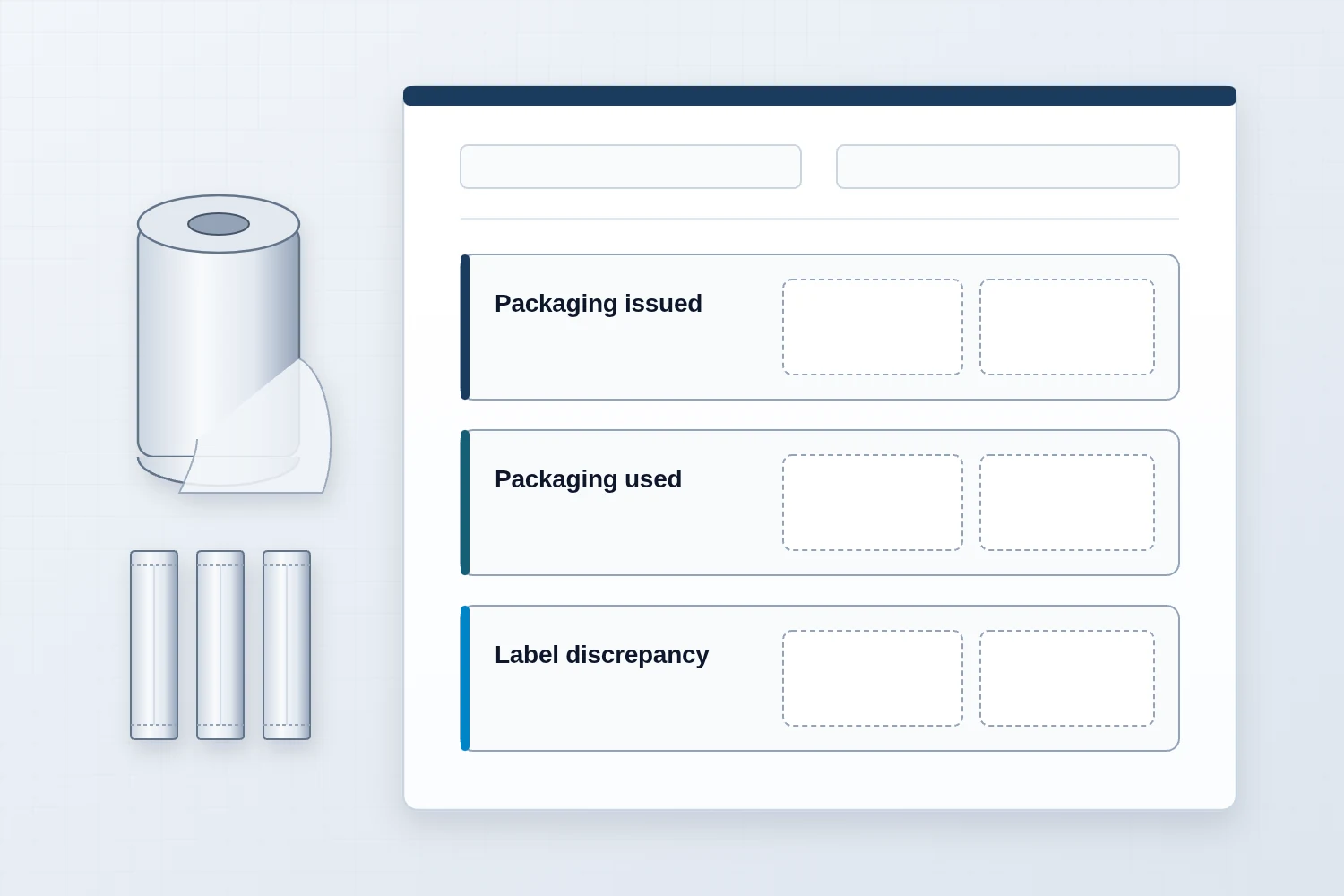
- Multi-lane rollstock math on manual lines: convert master-roll meter readings or net core weights into total stick impressions (web length / cut pitch x active lanes) and bag startup, registration, and splice strips by batch.
- Hardware scope for the 100% examination waiver (21 CFR 111.410(d) / 211.125(c)): specify one camera channel or wide-field lane array reading every lane's barcode/lot print prior to cutting, interlocked with positive per-lane reject confirmation.
- PLC recipe-locked inline coding (21 CFR 211.122): load lot and expiry strings from a supervisor-approved HMI recipe across all printheads simultaneously to prevent single-lane typographical mixups.
Allergen Changeovers, Packaging Room Air, and Pre-Use Line Clearance
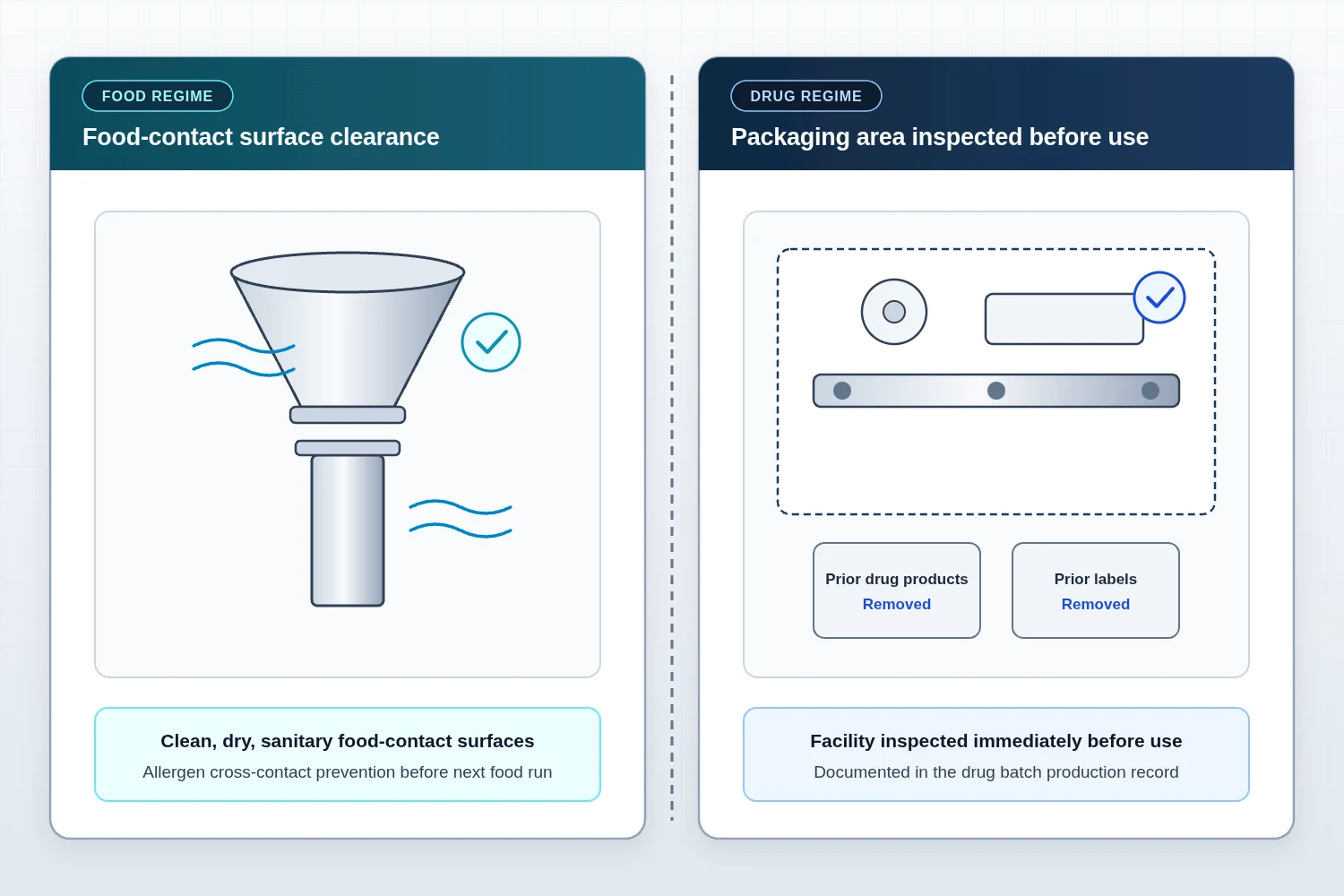
When a line switches between flavors or active ingredients, equipment cleanability and moisture control dictate real changeover downtime. Under 21 CFR Part 117 (117.3, 117.40, 117.80, and 117.135), food-contact hoppers, augers, pumps, and forming assemblies must be constructed and maintained to prevent allergen cross-contact, disassembled as needed for thorough cleaning, supplied with treated compressed air or nitrogen that introduces no unlawful indirect additives, and backed by written allergen and sanitation preventive controls. US food stick pack labels and segregation plans cover nine major food allergens: the eight listed in the Food Allergen Labeling and Consumer Protection Act of 2004 (milk, eggs, fish, Crustacean shellfish, tree nuts, peanuts, wheat, and soybeans) plus sesame added effective January 1, 2023 under the FASTER Act, with food sources declared in ingredient names, parentheticals, or a Contains statement (advisory 'may contain' phrases never replace GMP controls). Because 21 CFR 117.35 requires low-moisture food-contact surfaces to start clean, dry, and sanitary, and to be sanitized and thoroughly dried whenever wet-cleaned, powder stick pack operators often buy dedicated spare auger screws and forming sets for dairy, soy, peanut, or sesame SKUs rather than risking trapped wash water caking inside narrow dosing tubes.
Facility air handling and pre-run line inspections also split along regulatory regimes rather than imposing a universal pharmaceutical cleanroom on every buyer. Drug packaging under 21 CFR 211.42, 211.46, and 211.130 requires defined or physically/spatially separated areas, appropriate temperature, humidity, air-filtration, and dust-recirculation controls, plus a documented inspection of the packaging and labeling facility immediately before use confirming all prior drug products and unsuitable labels have been cleared. High-efficiency particulate air (HEPA) filtration under positive pressure and aseptic room disinfection in 211.42 apply specifically to aseptic processing as appropriate, not across every non-sterile oral powder suite. Dietary supplement packaging under 21 CFR 111.415 requires equipment cleaning and sanitizing, physical or spatial separation to prevent mixups, and protection against airborne contamination, typically solved on multi-lane powder fillers with negative-pressure dust extraction shrouds around dosing nozzles and cross-seal jaws.
Related reading: Nitrogen Flushing for Stick Packs: Residual Oxygen Control; Powder Stick Pack Machine: Auger Dosing; Probiotic Powder Stick Pack Machine: Auger Dosing & Nitrogen Flushing
- Dry-cleanout design on powder stick pack machines (21 CFR 117.35): specify quick-clamp split hoppers, tool-free servo auger removal, and dry vacuum/alcohol wipe protocols so flavor switches finish in minutes without moisture bridging.
- Local dust capture over room-wide overbuilding (21 CFR 111.415 / 211.46): negative-pressure extraction ports at the forming-tube mouth keep fine nutraceutical dust out of adjacent lanes and prevent powder contamination in end seals.
- Pre-use clearance walkdown (21 CFR 211.130): inspect unwinder splice tables, slitter blade guards, reject bins, and discharge conveyors immediately before use so leftover sticks or trim from the prior lot cannot mix into the new batch.
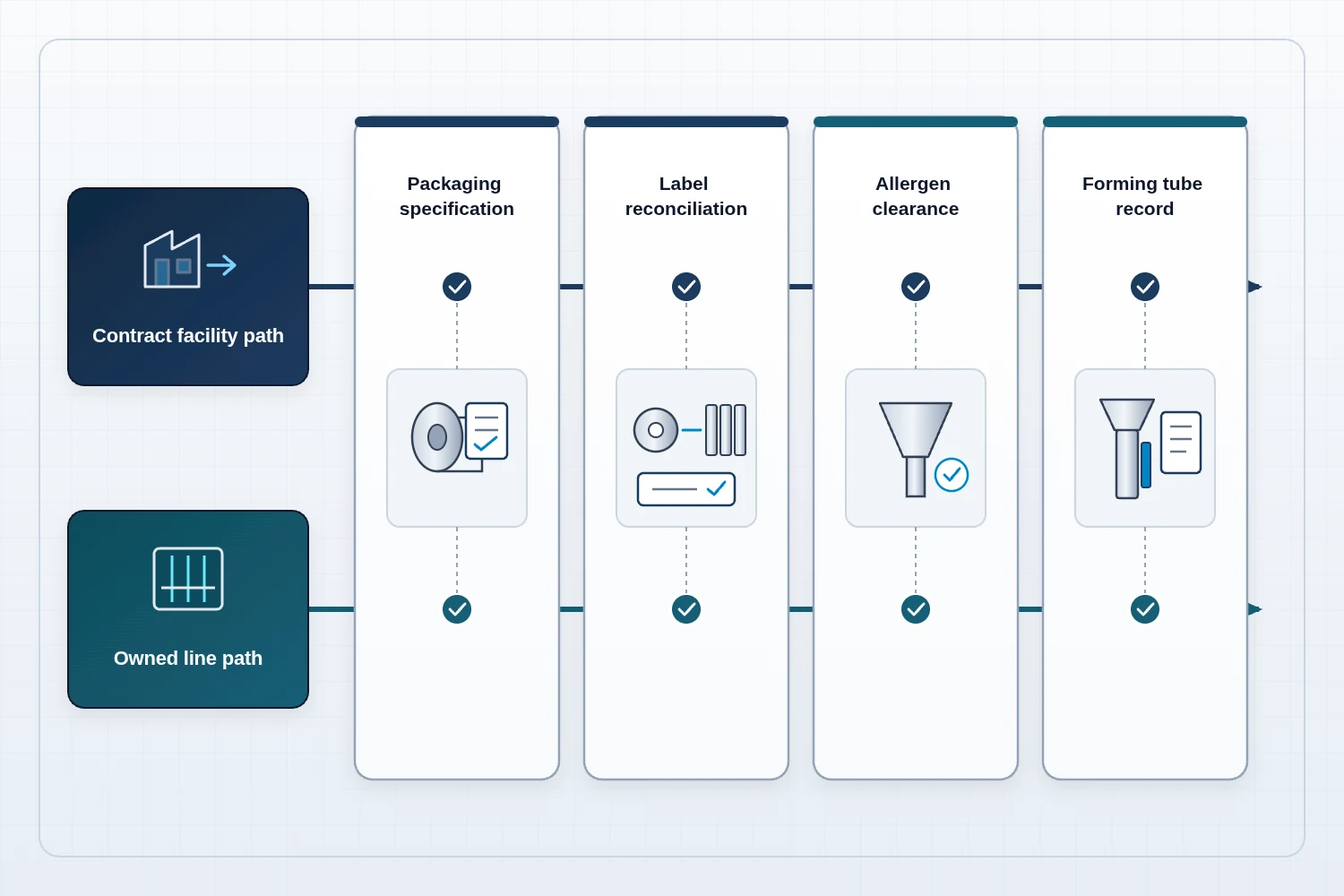
Forming-Tube Engineering and the Co-Packer-to-In-House Handover Checklist
Moving a proven SKU from a co-packer onto an owned multi-lane stick pack machine requires matching web-forming geometry so your existing printed rollstock runs without re-engraving cylinders. On a multi-lane stick pack machine, a wide master reel unwinds under closed-loop tension past the registration photo-eye and passes through rotary slitting blades that divide the web into one narrow strip per active lane. Each strip folds over a precision forming collar around a hollow vertical forming tube, where a vertical heat-seal bar bonds the overlapping edges into a longitudinal fin seal or lap seal before the lane's servo auger, piston pump, or volumetric cup dispenses product down the bore and horizontal jaws close and cut the pack. Because the forming tube fixes finished stick width (such as the 15 to 30 mm width range on our four-lane powder reference configuration), your new machine's slit pitch, seam allowance, eye-mark offset, and unwind direction must match the co-packer's approved dieline.
Keep statutory batch-record rules distinct from company engineering qualification when assembling your handover file. For dietary supplements, 21 CFR 111.260 requires batch production records to identify the specific equipment and processing lines used on the batch alongside maintenance, cleaning, and sanitizing dates and times; Part 111 does not impose a separate statutory 'forming-tube qualification' rule. Dimensional sign-off on forming collars, forming tube clearances, and jaw serrations comes from your internal engineering specification and Factory Acceptance Test (FAT) protocol. In pharmaceutical manufacturing, FDA's drug quality-agreement guidance specifies that the agreement assign equipment qualification, maintenance, and change control over major manufacturing equipment and container-closure systems, while ICH Q10 technology transfer governs the structured transfer of product, tooling, and process parameters between a contract facility and an in-house packaging suite.
To cut over from co-packing without a stockout, ship production rollstock and representative bulk blend for a pre-delivery sample trial and FAT on your new machine while maintaining buffer inventory at the co-packer. Verify lane-by-lane fill weights, seal burst or leak integrity, barcode legibility, and splice recovery under recorded run speeds before signing off shipment, then verify the six handover records below prior to releasing your first in-house commercial lot.
Related reading: Stick Pack Machine Buying Guides; How a Stick Pack Machine Works; Fin Seal vs Lap Seal on Stick Packs: Film Width, Seal Layers & Dust Tolerance; Stick Pack Machine FAT Checklist; Stick Pack Machine Sample Testing
Scroll horizontally to see all columns. Keyboard: focus the table and use the arrow keys.
| Handover item | Regulatory or engineering basis | Verification before cutting over to an owned line |
|---|---|---|
| Dieline, slitting pitch, and forming-tube drawing | Internal engineering & FAT spec; Drug equipment and container-closure controls (FDA Quality Agreements guidance) | Confirm slit-strip width, fin- vs. lap-seal seam allowance, unwind chart, registration eye-mark position, and forming-tube diameter against live printed film. |
| Approved contact-packaging and label specs | Dietary supplement (21 CFR 111.70); Drug (21 CFR 211.122); Food (21 CFR 117.80) | Transfer signed laminate barrier/food-contact specifications, approved artwork proofs, and drug container-closure change-control files. |
| Incoming rollstock sampling and supplier release | Dietary supplement (21 CFR 111.75); Drug (21 CFR 211.122) | Establish visual examination plus supplier COA/guarantee checks for supplements, or quarantine sampling, lab testing, and QC release procedures for drugs. |
| Multi-lane label reconciliation or 100% vision waiver | Dietary supplement (21 CFR 111.260, 111.410(d)); Drug (21 CFR 211.125(c), 211.134) | Set master-roll impression math and variance limits, or challenge-test 100-percent electronic barcode/OCR inspection with per-lane reject verification. |
| Sanitation, allergen, and pre-use clearance SOPs | Food (21 CFR 117.35, 117.135; FALCPA & FASTER Act sesame); Supplement (21 CFR 111.415); Drug (21 CFR 211.130) | Validate dry vs. wet contact-part teardown, allergen holding and 9-allergen label checks, and documented pre-use area clearance checklists. |
| Equipment/line identity log and site technology transfer | Supplement equipment/line ID log (21 CFR 111.260); Drug equipment qualification & transfer (FDA Quality Agreements, ICH Q10); internal IQ/OQ | Assign unique machine and lane IDs plus cleaning/maintenance logs in batch records (111.260), complete engineering forming-tube/IQ/OQ checks, and transfer dosing/sealing recipes. |
Discuss this configuration
Discuss on WhatsAppSources
Further reading: 21 CFR 111.70: Establishing Specifications for Dietary Supplements, Labels, and Packaging (eCFR); 21 CFR 111.75: Determining Whether Dietary Supplement Specifications Are Met (eCFR); 21 CFR 111.260: Required Batch Production Record Elements Including Equipment and Line Identity (eCFR); 21 CFR 111.410: Packaging and Labeling Operations and Label Reconciliation for Dietary Supplements (eCFR); 21 CFR 211.122: Drug Materials Examination and Usage Criteria (eCFR); 21 CFR 211.125: Drug Labeling Issuance and Reconciliation (eCFR); 21 CFR 211.130: Drug Packaging and Labeling Operations and Pre-Use Inspection (eCFR); 21 CFR 117.35: Food Sanitary Operations and Low-Moisture Surface Cleaning (eCFR); 21 CFR 117.40: Cleanable Food Equipment and Utensils Design and Maintenance (eCFR); 21 CFR 117.135: Written Food Preventive Controls for Allergens and Sanitation (eCFR); FDA Guidance for Industry: Contract Manufacturing Arrangements for Drugs: Quality Agreements; Contract Manufacturing Arrangements for Drugs: Quality Agreements PDF (FDA, November 2016); FDA Food Allergies: FALCPA Eight Major Allergens and FASTER Act Sesame Requirements
- ICH Q10 Pharmaceutical Quality System Guideline: Section 2.7 (Management of Outsourced Activities and Purchased Materials) and Section 3.1 (Technology Transfer)
Common Questions
At what annual volume does an in-house stick pack machine beat a co-packer?
Most brands hit a 12 to 18-month payback once volume reaches roughly 300,000 to 500,000+ sticks per year across SKUs sharing one stick width, or earlier when running four or more flavors penalized by per-SKU co-packer minimums. Published US powder co-packer tolling rates run ~$0.55 to $0.73 per stick on 5,000 to 7,500-stick pilot batches and ~$0.22 to $0.43 per stick across 25,000 to 100,000-stick runs, whereas direct in-house conversion typically costs ~$0.03 to $0.08 per stick.
Does outsourcing stick pack filling to a co-packer transfer cGMP compliance off the brand?
No. Under 21 CFR 111.1, a dietary supplement manufacturer remains subject to Part 111 when another firm packages or labels its product. For drugs under 21 CFR 211.22 and FDA's quality-agreement guidance, a quality agreement cannot delegate statutory CGMP responsibilities and the owner's quality unit retains legal authority over final batch release. Food brands remain bound by 21 CFR Part 117 preventive and sanitation controls.
Can pre-printed rollstock from our co-packer run on a new in-house stick pack machine?
Yes, if the new machine's slitter width, forming-tube diameter, fin-seal or lap-seal seam allowance, registration mark coordinates, and unwind direction match the existing dieline. Send two or three production film rolls and product sample for a factory trial and FAT before cutting over inventory.
When is manual rollstock label reconciliation waived on a multi-lane stick pack line?
Both dietary supplement rules (21 CFR 111.410(d)) and drug rules (21 CFR 211.125(c) with 211.122(g)(2)) waive label reconciliation for cut or rolled labels when electronic or electromechanical equipment performs a 100-percent examination for correct labeling during or after finishing, such as lane-indexed barcode or OCR vision sensors interlocked with per-lane reject devices.
Which major food allergens govern changeover and labeling on US food stick packs?
US food stick packs must control and declare nine major food allergens: milk, eggs, fish, Crustacean shellfish, tree nuts, peanuts, wheat, and soybeans under FALCPA (2004), plus sesame added effective January 1, 2023 under the FASTER Act. Labels must name the food source (including tree nut type and fish or Crustacean shellfish species), and low-moisture powder contact surfaces must start clean, dry, and sanitary under 21 CFR 117.35.
Does 21 CFR 111.260 require formal forming-tube qualification on dietary supplement lines?
No. Section 111.260 requires the batch production record to log the identity of the equipment and processing lines used on the batch plus maintenance, cleaning, and sanitizing dates and times. Forming-collar and forming-tube dimensional qualification is an internal engineering and IQ/OQ control (and for pharmaceuticals, governed by quality-agreement equipment qualification and ICH Q10 technology transfer).