
What Is a Volumetric Cup Filler and Where Does It Fit on Stick Pack Lines?
A volumetric cup filler is a dry-dosing mechanism that meters particulate solids by fixed cavity volume rather than by weight or fill level. In the USDA FSIS Thermal Processing of Shelf-Stable Products Glossary, a volumetric filler is defined specifically as a filler machine that fills by a volume of product rather than by weight or level and may also be called a pocket filler.
On packaging lines, volumetric cup systems dispense dry, free-flowing materials such as sugar crystals, granulated drink mixes, beans, rice, seeds, and uniform small candies without mechanical product degradation. Because no rotating screw compresses the material inside a narrow barrel, fragile agglomerates and crisp crystals preserve their original particle shape and surface finish.
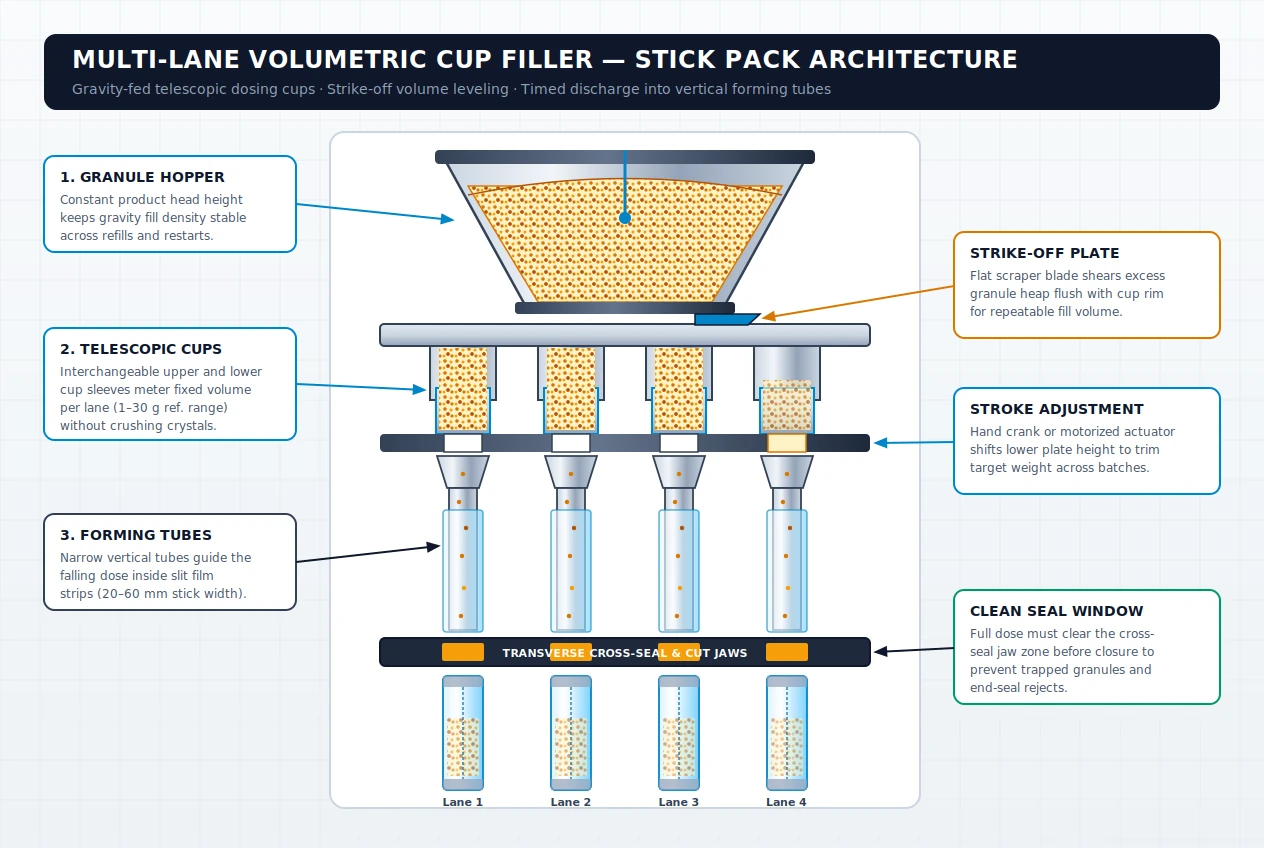
On a multi-lane granule stick pack line, volumetric cups sit directly above the vertical forming station and feed each lane's narrow forming tube in phase with film pull and sealing. In the four-lane granule reference configuration, volumetric cup or vibratory dosing delivers about 1–30 g per stick at roughly 30–50 packs per minute per lane, reaching about 120–200 packs per minute across four lanes.
Finished pack geometry also follows product bulk volume rather than serving mass alone. In the granule reference layout, back-seal stick packs run about 20–60 mm wide per lane and four-side-seal sachets run about 30–80 mm wide, both roughly 50–180 mm long, on a film reel up to about 420 mm wide. On single-head rotary vertical form-fill-seal (VFFS) baggers, rotary volumetric cup fillers typically operate across 30–120 packages per minute depending on cup size and product flow.
Related reading: Granule Stick Pack Machine: Drink Mixes; How a Stick Pack Machine Works
How Does a Volumetric Cup Filler Work on a Stick Pack Machine?
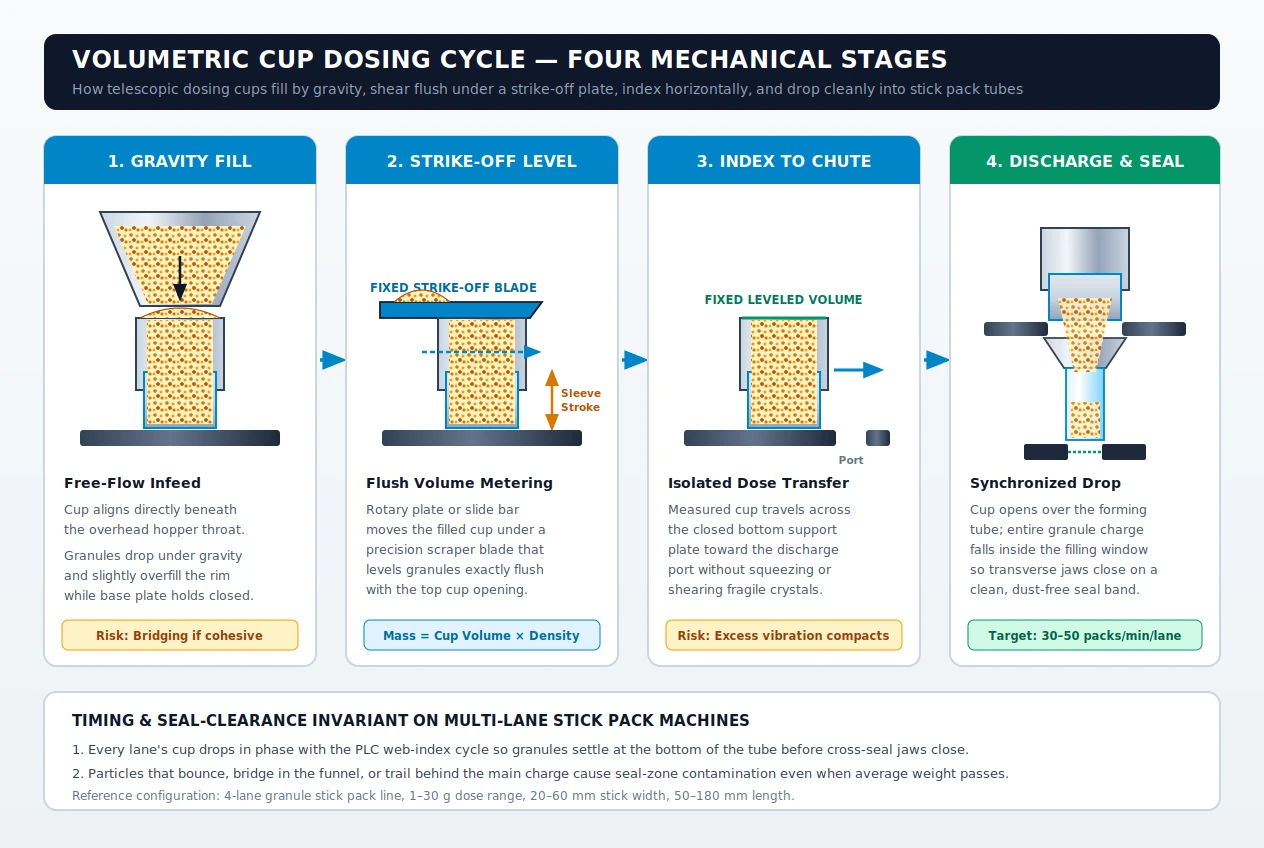
A volumetric cup filler works on a stick pack machine through a four-step mechanical sequence: gravity fills a telescopic cup under an overhead hopper, a flat strike-off plate shears excess heap flush with the cup rim, the filled cup indexes horizontally across a closed base plate, and the bottom opens over the forming tube so the measured charge drops cleanly before the cross-seal jaws close.
Depending on lane architecture, multi-lane stick pack fillers execute this stroke either with a rotating turret plate or with a reciprocating linear slide plate carrying one telescopic cup per lane. In both layouts, an upper cup sleeve fits over a lower adjustable sleeve so the enclosed cylindrical cavity holds a repeatable volumetric charge on every machine cycle.
Synchronization with the vertical stick pack stations is critical for seal integrity. After the film unwind, photo-eye registration sensor, slitting blades, and forming collar wrap each strip into a narrow vertical tube, the dosing cup must discharge inside the designated filling interval so every granule settles into the lower pouch body before the transverse sealing jaws close. Particles that bounce off the funnel wall, hang in the discharge chute, or trail behind the main dose can get trapped inside the end seal and produce rejected packs even when average fill weight looks right.
Maintaining a consistent granule level in the supply hopper is equally important to steady volumetric dosing. Because gravity drives particles into each cup during the fill window, large swings in hopper head height or abrupt batch refills alter how tightly granules pack into the cavity before the strike-off plate passes across the top rim.
Scroll horizontally to see all columns. Keyboard: focus the table and use the arrow keys.
| Dosing Stage | Mechanical Action | Primary Failure Mode | Operator Verification Check |
|---|---|---|---|
| 1. Gravity fill | Telescopic cup aligns beneath the hopper throat while the bottom support plate remains closed | Cohesive bridging, arching, or uneven hopper head pressure causes partial cavity fills | Compare lane net weights immediately after a hopper refill and at low hopper level |
| 2. Strike-off leveling | Cup slides beneath a flat scraper plate that shears excess granule heap flush with the top rim | Worn scraper edge or clumped particles leave uneven top surfaces or crush fragile granules | Inspect strike-off plate clearance and verify particles remain intact after leveling |
| 3. Transfer and indexing | Leveled cup moves horizontally across the closed support plate toward the discharge port | Excess machine vibration settles particles tighter or separates coarse and fine fractions | Check for fine dust seepage beneath the carrier plate and verify blend uniformity |
| 4. Timed discharge and seal | Cup clears the base plate over the forming tube and drops the dose before cross-seal jaws close | Bouncing granules or late-arriving fines land inside the transverse heat-seal band | Inspect end seals and cut edges on consecutive packs from every active lane |
What Is the Volumetric Filling Method and Why Does Bulk Density Matter?
The volumetric filling method meters a fixed volume of product rather than weighing each dose, yet packaged dry food sold in stick packs must declare net contents by weight under 21 CFR 101.7(a) and pass gravimetric inspection under NIST Handbook 133 Chapter 2. Because delivered mass equals cup volume multiplied by actual bulk density, any shift in bulk density converts directly into a fill-weight shift.
Under 21 CFR 101.7(q), the net quantity declaration must state package contents accurately, allowing only reasonable variations from moisture exchange during distribution or unavoidable deviations in good manufacturing practice, and variations must not be unreasonably large. For retail cartons holding multiple stick packs, 21 CFR 101.7(s) additionally requires stating the number of individual units, the quantity of each individual unit, and the total quantity of contents in parentheses. Under NIST Handbook 133 Chapter 1, the average net quantity of contents across a production lot must at least equal the declared label weight.
Bulk density—also known as apparent density—is the mass of particulate solids divided by the total bulk volume, which includes particle volume, inter-particle void spaces, and internal pore volume. Crucially, bulk density is an extrinsic material property rather than a fixed constant: disturbing or vibrating a poured powder causes particles to settle closer together and increases bulk density. That is why packaging engineers measure both freely settled (poured) bulk density and tapped bulk density before sizing dosing cups.
ASTM D6393/D6393M-21 establishes standardized apparatus and test procedures for characterizing bulk solids through eight measurements and two calculations for Carr Indices including Loose Bulk Density, Packed Bulk Density, Compressibility, Angle of Repose, Cohesion, Uniformity, Angle of Spatula, and Dispersibility—for free-flowing and moderately cohesive materials up to 2.0 mm in particle size that pour through a 6.0 to 8.0 mm funnel outlet when aerated. In a free-flowing granule, loose and tapped bulk density sit close together so the Carr Compressibility Index stays below 15% and the Hausner Ratio remains near 1.00–1.18. When interparticle friction rises, loose and tapped density diverge, pushing the Carr Index above 25% and the Hausner Ratio above 1.25–1.4, signaling poor flowability. Because Hausner Ratio measurements vary with test methodology and grain size and shape strongly influence angle of repose, always test actual production lots under repeatable laboratory conditions.
Scroll horizontally to see all columns. Keyboard: focus the table and use the arrow keys.
| Flowability Grade | Carr Compressibility Index (%) | Hausner Ratio | Volumetric Cup Dosing Fit |
|---|---|---|---|
| Excellent | 10 or less | 1.00–1.11 | Strong volumetric cup fit (pairs with 25–30 degree angle of repose) |
| Good | 11–15 | 1.12–1.18 | Reliable volumetric cup fit when hopper level and moisture stay controlled |
| Fair | 16–20 | 1.19–1.25 | Transitional zone; run sample trials checking refill and pause weight stability |
| Passable | 21–25 | 1.26–1.34 | High risk of density drift in gravity cups; compare against auger or vibratory dosing |
| Poor | 26–31 | 1.35–1.45 | Unsuitable for gravity cups; specify servo auger filler with hopper agitation |
| Very poor to very, very poor | 32–37 and above 38 | 1.46–1.59 and above 1.60 | Cohesive powder regime; requires agitated servo auger and positive cutoff tooling |
Volumetric Cup Filler vs. Auger Filler: Which Fits Your Granule or Powder?
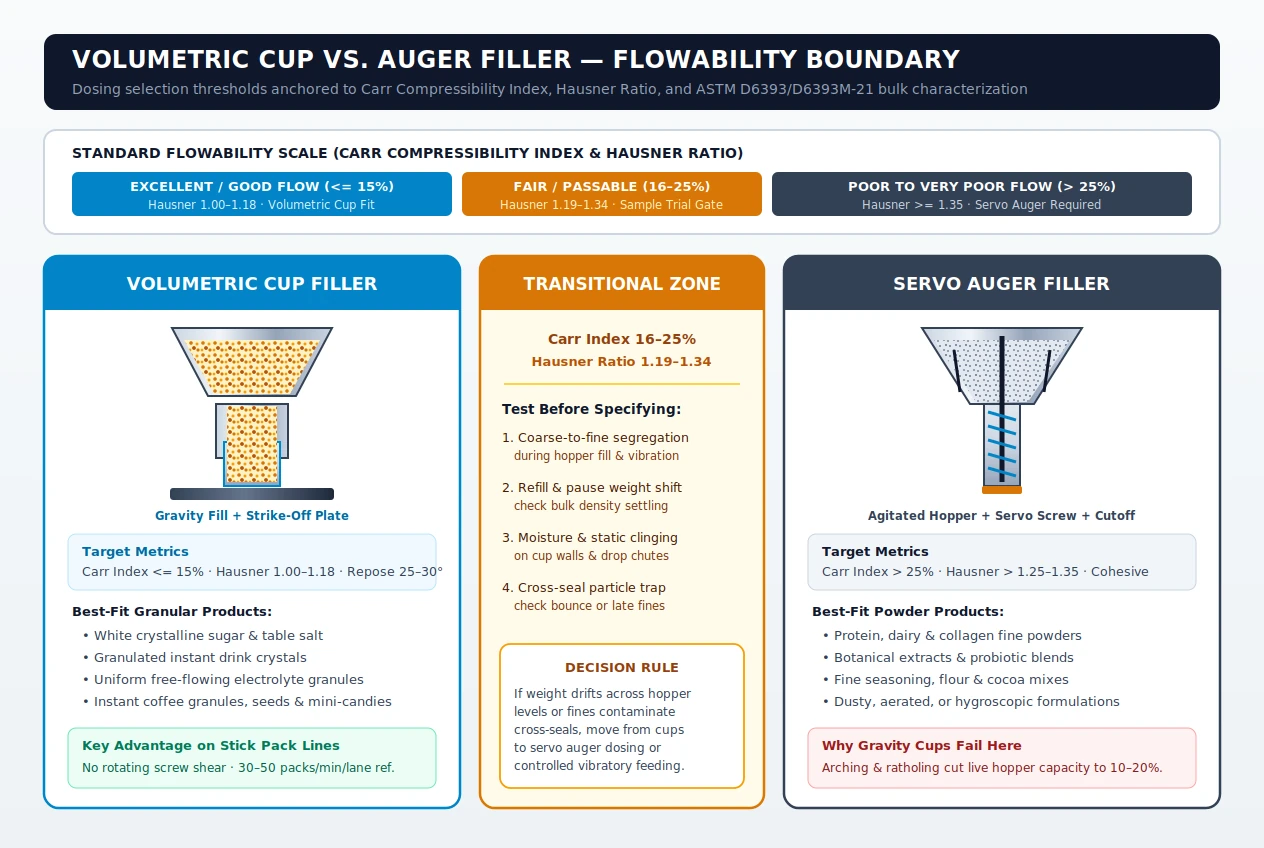
Choose a volumetric cup filler when your stick pack product is a free-flowing, low-compressibility granule (Carr Index 15% or lower, Hausner Ratio 1.00–1.18) with consistent bulk density and intact crystal shape; choose a servo auger filler when your formulation is a cohesive, dusty, or high-compressibility powder (Carr Index above 25%, Hausner Ratio above 1.25–1.34) that bridges or ratholes in a gravity hopper.
The mechanical dividing line lies in how each head moves product out of the hopper and shuts off flow. A volumetric cup filler relies purely on gravity to fill an open pocket and a flat strike-off blade to level the volume, keeping mechanical stress near zero so fragile granules and coated crystals stay whole. By contrast, cohesive dairy, protein, and botanical powders arch across gravity outlets or form stagnant ratholes that can reduce live hopper capacity to as low as 10–20%. Servo auger fillers solve that failure mode with counter-rotating slow agitation, self-feeding screw flights, and positive cutoff hardware such as drip washers or spinner plates.
Throughput and pack geometry reference ranges also differ between the two stick pack routes. In the four-lane reference builds, granule stick pack machines using volumetric cups or vibratory feeders run roughly 30–50 packs per minute per lane (about 120–200 packs per minute across four lanes) across 1–30 g portions and 20–60 mm stick widths, whereas four-lane powder stick pack machines with independent servo augers run about 30–40 cycles per lane per minute (roughly 120–160 sticks per minute) across 15–30 mm stick widths and 50–180 mm lengths.
For transitional beverage mixes and seasoning blends in the Fair (16–20%) to Passable (21–25%) Compressibility Index range, neither datasheet claims nor product names settle the choice. Two blends carrying the same serving weight can occupy substantially different volumes or behave differently once vibration and humidity enter the hopper, so evaluating the actual sample across cup and auger setups before freezing the line specification prevents chronic reject rates.
Related reading: Auger Filler for Stick Packs: Screw Pitch, Agitator Sync & Shutoff; How to Choose a Stick Pack Machine
Scroll horizontally to see all columns. Keyboard: focus the table and use the arrow keys.
| Evaluation Factor | Volumetric Cup Filler | Servo Auger Filler |
|---|---|---|
| Target flowability regime | Excellent to Good flow (Carr Index 15% or lower, Hausner Ratio 1.00–1.18) | Fair to Very poor flow (Carr Index above 25%, Hausner Ratio above 1.25–1.34, cohesive or dusty) |
| Metering principle | Fixed cylindrical cavity leveled flush by a strike-off plate; gravity filled | Positive displacement by servo-controlled auger screw revolutions with hopper agitator |
| Particle preservation | Gentle gravity transfer without screw shear or crystal crushing | Mechanical flight transport can abrade fragile coated crystals or coarse granules |
| Hopper bridging resistance | Low; relies on free flow and steady hopper head height | High; counter-rotating agitator breaks arches and prevents 10–20% live-capacity ratholing |
| 4-lane stick pack reference speed | About 30–50 packs/min per lane (120–200 packs/min total, 1–30 g range) | About 30–40 cycles/min per lane (120–160 sticks/min total) |
| Reference stick width and length | Back-seal stick 20–60 mm wide (sachet 30–80 mm), 50–180 mm long | Back-seal stick 15–30 mm wide, 50–180 mm long |
Discuss this configuration
Discuss on WhatsAppWhich Dry Products Run Cleanly on a Volumetric Cup Filling Machine?
Dry products that run cleanly on a volumetric cup filling machine share four traits: uniform particle size, stable bulk density, free-flowing discharge without clinging, and low fine-dust content. White crystalline sugar, granulated instant drink mixes, uniform electrolyte granules, table salt, seeds, and small candies fit volumetric cup dosing well, whereas sticky, hygroscopic, or fine cohesive powders trigger bridging, weight drift, and contaminated cross-seals.
Four physical variables decide whether a granular formulation stays stable in production: particle size distribution, bulk density, flowability, and the balance between coarse and fine fractions. Granulated drink mixes, sugar-like crystals, and blended solid beverages differ sharply across all four traits. Even when a blend pours cleanly out of a sample bag, transfer conveyors and hopper vibration can cause coarse crystals and fine flavor or vitamin fractions to segregate before reaching the dosing plate.
Moisture pickup and compaction introduce a second failure mode during shifts and line stops. Hygroscopic electrolyte salts or fruit-acid drink blends absorb ambient humidity inside an open hopper, increasing interparticle friction until granules cling to cup walls, form lumps, or stop dropping cleanly through narrow stick pack chutes.
Finally, seal-zone cleanliness often sets the practical speed ceiling before the dosing plate itself runs out of mechanical capacity. If light fines separate from a granular mix or dense crystals rebound off the bottom of the stick pack into the transverse jaw path, cross-seals fail leak inspection even though every pack meets its target net weight. Pairing clean granule screening with a representative sample trial reveals bounce, static cling, and segregation before tooling is cut.
Related reading: Sugar Stick Packing Machine; Electrolyte Stick Pack Machines
Scroll horizontally to see all columns. Keyboard: focus the table and use the arrow keys.
| Dry Product Group | Typical Physical Behavior | Volumetric Cup Fit | Primary Risk and Engineering Control |
|---|---|---|---|
| White crystalline sugar and table salt | Uniform grain size, low compressibility, minimal fine dust | High fit | Crystal bounce at high drop speed; tune discharge timing and chute clearance |
| Granulated drink mixes and instant coffee granules | Free-flowing agglomerates sensitive to screw crushing | High fit | Fragile granule breakage during transfer; avoid harsh agitation and verify bulk density stability |
| Blended electrolyte and solid-beverage mixes | Mixed coarse crystals plus finer acid, mineral, or flavor fractions | Conditional fit (sample trial) | Coarse-to-fine segregation and moisture clinging; map transfer path and test across refills |
| Cohesive protein, dairy, and botanical powders | High compressibility, dusty fines, strong interparticle friction | Poor fit (use servo auger) | Hopper bridging, ratholing, dose drift, and powder trapped in transverse cross-seals |
How Do Operators Adjust, Calibrate, and Clean Telescopic Dosing Cups?
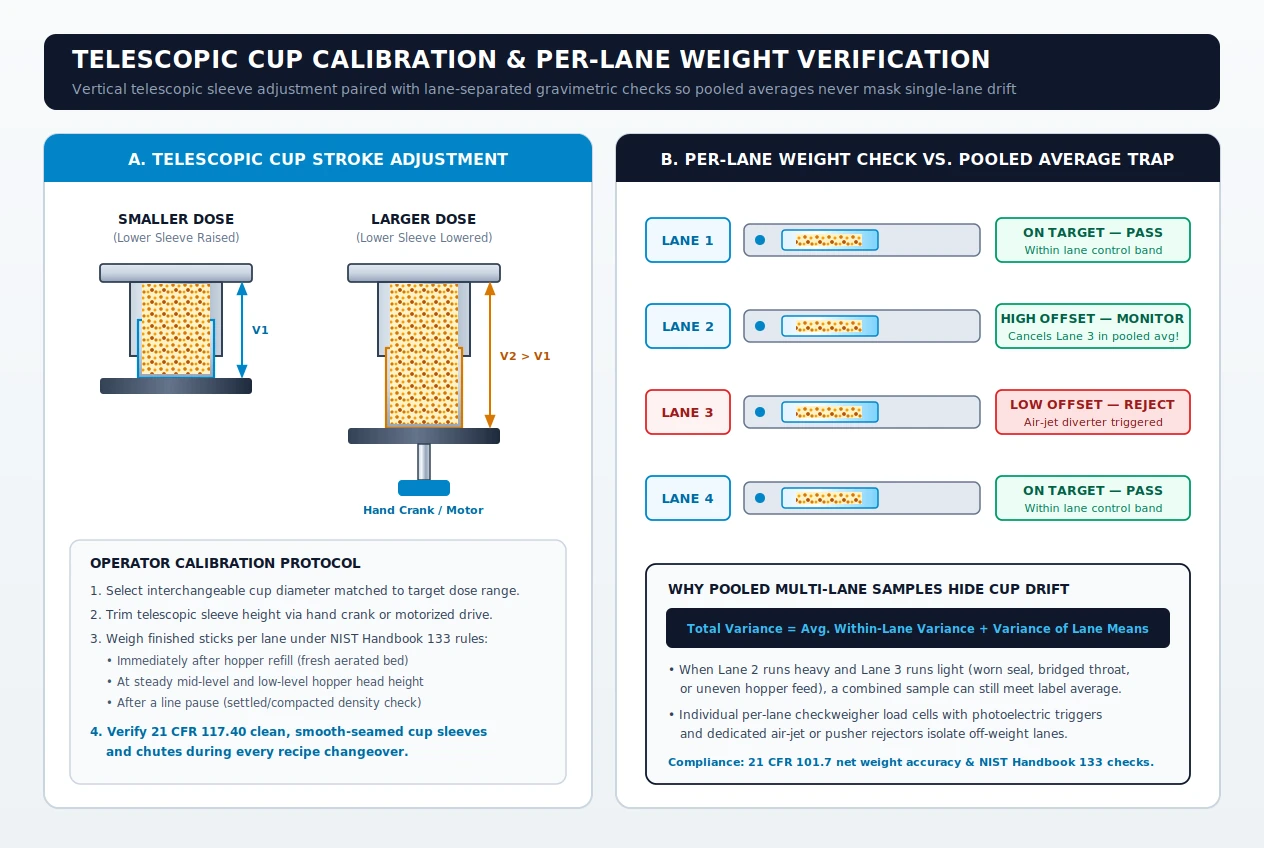
Operators adjust fill volume on a volumetric cup filler by raising or lowering the lower telescoping cup sleeves via a hand crank or motorized actuator for fine weight trims, or by swapping interchangeable cup sets within minutes for larger dose changes, then calibrating net weight individually on every lane across hopper refills, mid-run levels, and line pauses while maintaining smooth-seamed stainless contact parts under 21 CFR 117.40.
Because a volumetric cup controls volume rather than mass, gravimetric verification is mandatory whenever a new raw material lot arrives or ambient humidity shifts. Do not rely on a single pooled sample drawn from all lanes combined. In multi-lane packaging with equal sample counts per lane, total weight variance equals the average within-lane variance plus the variance of the lane means. A combined average can appear compliant while one lane doses heavy and another doses light due to uneven hopper feed, a worn cup seal, or slight sleeve offset.
To catch single-lane offsets automatically at production speed, multi-lane inline checkweighers route each stick pack lane over its own weigh cell with photoelectric triggers and dedicated per-lane reject hardware—air jets for light, fast stick packs and pushers or drop flaps for heavier formats. During manual startup and factory acceptance checks, keep test sticks labeled separately by lane and compare weights immediately after a hopper refill, across high and low hopper levels, and right after a pause so bulk-density settling is measured directly.
Sanitary design and recipe changeover procedures directly protect both weight accuracy and food safety. Under 21 CFR 117.40, equipment used in packing or holding food must be designed to be adequately cleanable, protect against allergen cross-contact, avoid adulteration from lubricants or metal fragments, and use corrosion-resistant, nontoxic food-contact surfaces. Specifically, 21 CFR 117.40(b) requires seams on food-contact surfaces to be smoothly bonded or maintained to minimize particle buildup. On reference stick pack builds constructed with SUS304 stainless steel frames and SUS304 or 316L product-contact parts, document full cleaning access to hoppers, telescoping cup sleeves, strike-off plates, chutes, and pockets where stray granules collect before switching recipes.
Related reading: Inline Checkweigher for Multi-Lane Stick Packs: Per-Lane Reject & Feedback; Stick Pack Machine Sample Testing
Sources
Regulatory definitions, food-packing equipment sanitation rules, net-contents testing procedures, and bulk-solids characterization standards referenced in this guide:
Further reading: USDA FSIS — Thermal Processing of Shelf-Stable Products (TPSP) Glossary (Volumetric Filler / Pocket Filler definition); U.S. eCFR — 21 CFR 101.7 Declaration of Net Quantity of Contents; U.S. eCFR — 21 CFR 117.40 Equipment and Utensils (CGMP for Human Food); NIST — Handbook 133 (2026 Current Edition), Checking the Net Contents of Packaged Goods; ASTM International — ASTM D6393/D6393M-21 Standard Test Method for Bulk Solids Characterization by Carr Indices; Wikipedia — Bulk density (freely settled vs. tapped density definition); Wikipedia — Carr index (powder compressibility thresholds); Wikipedia — Hausner ratio (flowability index definition and limits); Wikipedia — Angle of repose (granular flow and hopper design reference)
Common Questions
What is the difference between a volumetric cup filler and a pocket filler?
They describe the same dosing principle. The USDA FSIS TPSP Glossary defines a volumetric filler as a filler machine that fills by a volume of product rather than by weight or level and explicitly notes that it may also be referred to as a pocket filler.
Why does bulk density drift cause fill-weight errors on a volumetric cup filler?
A volumetric cup meters a fixed cavity volume, whereas packaged dry food must declare net contents by weight under 21 CFR 101.7(a) and meet NIST Handbook 133 gravimetric lot rules. Because bulk density is an extrinsic property that rises when vibration or handling compacts particles, any bulk-density shift changes stick weight directly.
What Carr Index and Hausner Ratio indicate a good fit for volumetric cup dosing?
Free-flowing granules with a Carr Compressibility Index of 15% or lower (10% or less Excellent, 11–15% Good) and a Hausner Ratio of 1.00–1.18 run best in gravity-fed volumetric cups. Above a Carr Index of 25% or Hausner Ratio above 1.25–1.34, cohesive flow requires a servo auger filler with hopper agitation.
Can a volumetric cup filler pack fine protein or botanical powder stick packs?
Usually not cleanly. Cohesive dairy, protein, and botanical powders tend to bridge or rathole above gravity cup outlets—potentially cutting live hopper capacity to 10–20%—and release airborne dust that contaminates transverse end seals. Independent servo auger fillers with counter-rotating agitators and positive cutoff tooling fit those powders far better.
How do operators adjust dose weight on a telescopic volumetric cup filler?
For fine weight adjustments across bulk-density shifts, operators raise or lower the telescoping cup sleeves using a hand crank or motorized actuator. For major serving-size changes, interchangeable cup sets can be swapped in minutes, followed by lane-by-lane gravimetric verification after hopper refills and pauses.