
What Does Oxygen Transmission Rate Measure in Packaging Films?
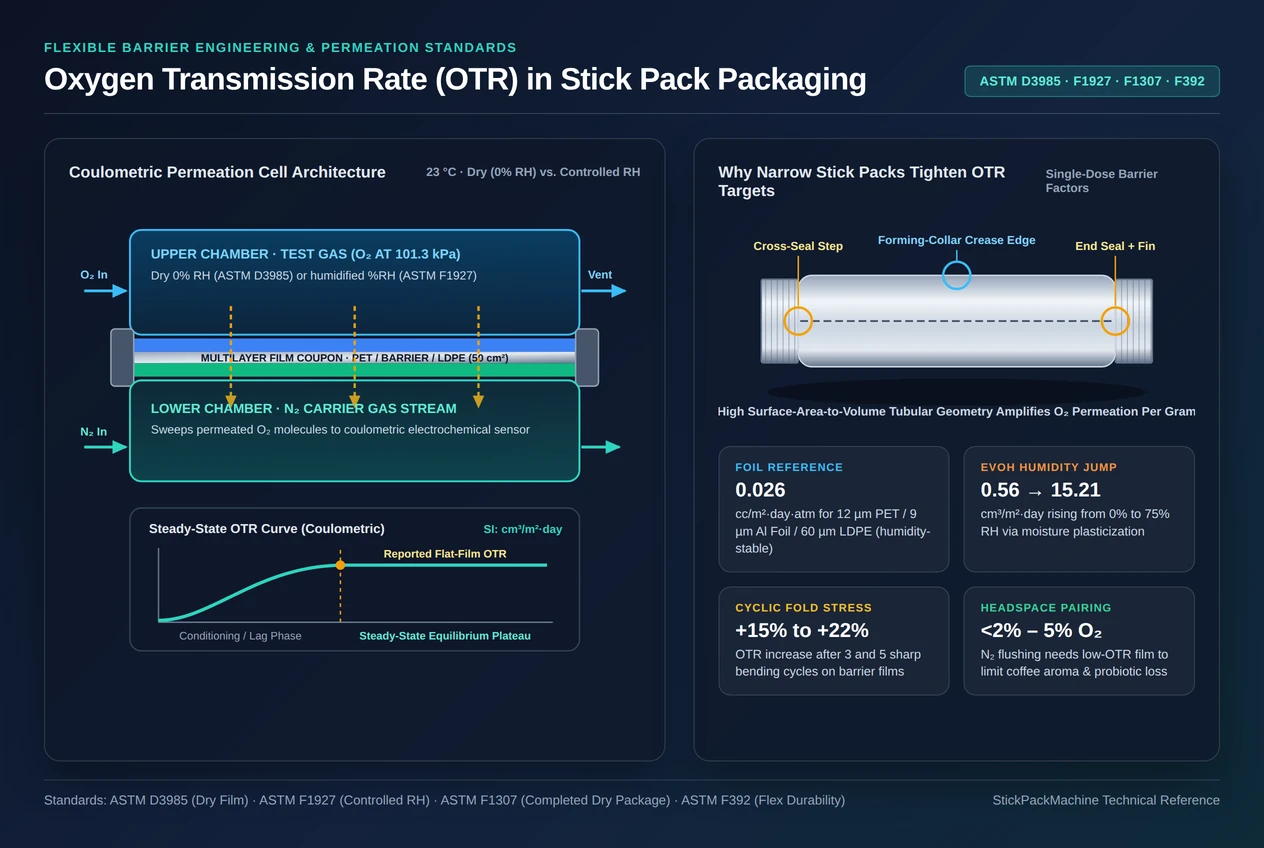
Oxygen transmission rate (OTR) in flexible packaging measures the steady-state rate at which oxygen gas diffuses through a plastic film, sheeting, laminate, coextrusion, or coated substrate under controlled temperature, humidity, and pressure. Under ASTM D3985-17 and ASTM F1927-20, coulometric sensors quantify this steady-state flux across nonporous barrier materials used for oxygen-sensitive foods and pharmaceuticals.
Engineers reviewing film datasheets should distinguish three related terms defined in ASTM D3985 Section 1.1: oxygen gas transmission rate (OTR) is the measured transmission rate for a specific structure at its actual thickness, permeance adjusts for partial pressure difference without normalizing thickness, and the oxygen permeability coefficient normalizes for thickness only in homogeneous single-polymer materials. Multilayer stick pack laminates combine dissimilar polymers and metallic or oxide coatings, so comparing whole-structure OTR rather than a single-layer permeability coefficient keeps supplier evaluations consistent.
Both ASTM D3985 Section 5.1 and ASTM F1927 Section 5.1 caution that OTR is an important determinant of barrier protection but not the sole determinant, meaning additional experience-based package testing is required to correlate flat-film readings with real shelf life. Selecting compatible stick pack film layers alongside web handling, seal initiation temperature, and roll structure keeps permeation targets aligned with high-speed forming on multi-lane equipment.
Because coulometric interlaboratory measurements align closely with NIST manometric reference values under ASTM D3985 Section 5.2 (alongside Test Method D1434), ASTM D3985 and ASTM F1927 serve as formal referee methods whenever buyer and film converter agree in advance on sampling procedures, standardization, test conditions, and acceptance criteria.
Related reading: Stick Pack Film & Machine Compatibility
How Do OTR, WVTR, and Humidity Interact in Barrier Laminates?
Oxygen transmission rate (OTR) and water vapor transmission rate (WVTR) work together because OTR governs oxidative rancidity, aroma loss, and probiotic oxygen stress while WVTR governs moisture pickup, powder caking, and water activity—and both affect microbial growth. In hydrophilic polymers such as ethylene vinyl alcohol (EVOH), ambient humidity also directly degrades oxygen barrier performance through water vapor plasticization.
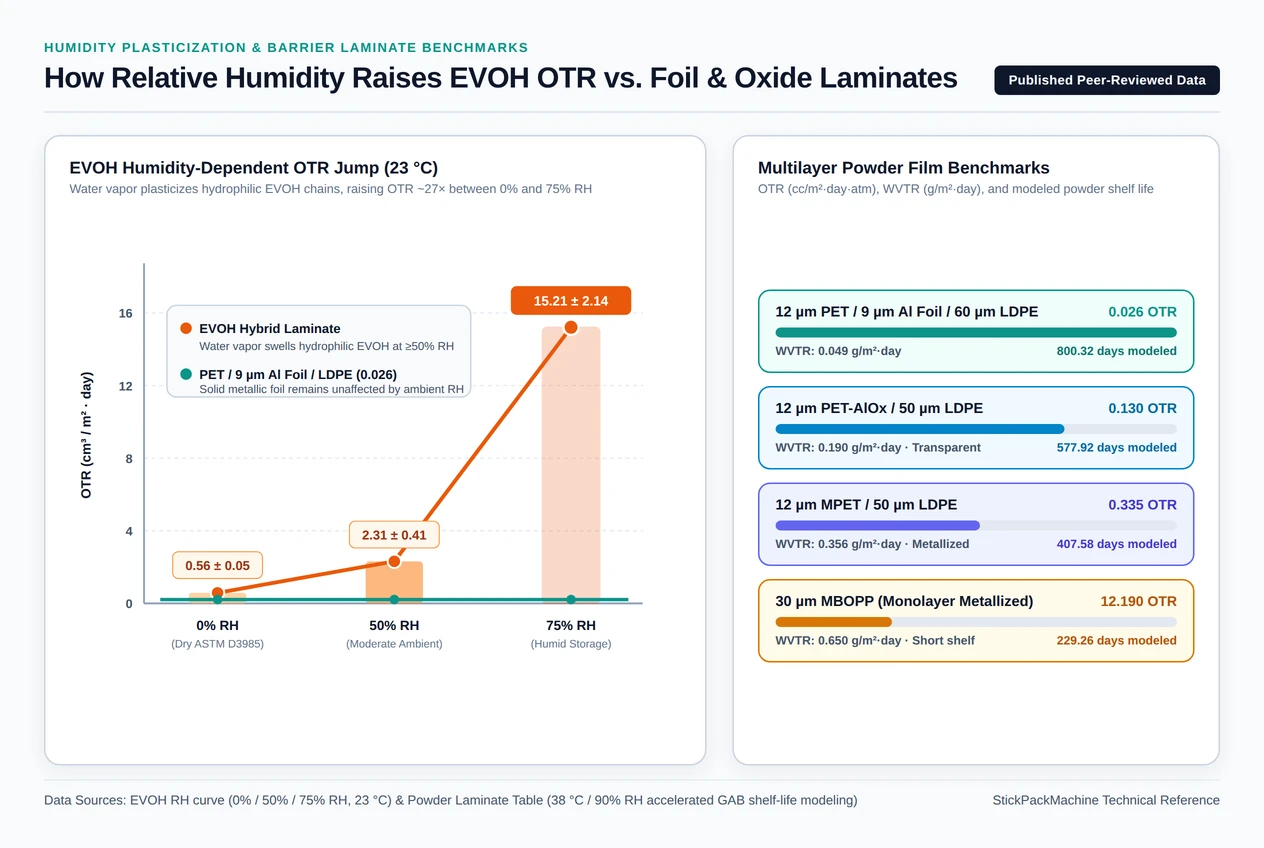
Controlled-humidity testing at 23 °C demonstrates that moisture sensitivity clearly: an EVOH hybrid laminate measured 0.56 ± 0.05 cm³/m²/day OTR at 0% RH, jumping to 2.31 ± 0.41 cm³/m²/day at 50% RH and 15.21 ± 2.14 cm³/m²/day at 75% RH, while a conventional non-EVOH trilaminate stayed near 35.38 to 36.84 cm³/m²/day. Although a continuous 50 µm LDPE sealant held WVTR steady at 1.22 ± 0.08 g/m²/day under 38 °C and 90% RH (versus 4.85 ± 0.3 g/m²/day for the trilaminate), external humidity still plasticized EVOH, confining unshielded structures to dry internal environments below 25% RH unless moisture-barrier plies protect the core.
Solid aluminum foil eliminates that humidity penalty. NASA Johnson Space Center testing confirms glass and aluminum provide the best food-packaging barriers: a PET/Polyethylene/Aluminum/Ionomer quadlaminate (Technipaq) held OTR and WVTR below 0.0003 g/100 in²/day at 100% RH, whereas transparent Nylon/EVOH/Nylon/EVA/LLDPE (Combitherm) measured 5.405 OTR and 0.352 WVTR, and AlOx-coated PET (Tolas) measured below 0.0030 OTR and below 0.0003 WVTR. In 180-day accelerated powder storage at 38 °C and 90% RH, 12 µm PET / 9 µm aluminum foil / 60 µm LDPE delivered 0.026 cc/m²·day·atm OTR, 0.049 g/m²·day WVTR, and 800.32 days modeled shelf life (intact aluminum-polyethylene laminates generally stay below 0.1), ahead of 12 µm AlOx-PET / 50 µm LDPE (0.130 OTR, 0.190 WVTR, 577.92 days), 12 µm MPET / 50 µm LDPE (0.335 OTR, 0.356 WVTR, 407.58 days), and 30 µm MBOPP (12.190 OTR, 0.650 WVTR, 229.26 days).
Over those 180 days, powder moisture rose from 2.11% to 3.13% in PET/Al-foil/LDPE, 4.73% in AlOx-PET/LDPE, 5.59% in MPET/LDPE, and 5.70% in MBOPP. Metallizing 25 µm BOPP (uncoated OTR 2000–2500 cc/m²·day·atm; WVTR 4–6 g/m²·day) cuts OTR by 98.7% and WVTR by 75%, yet MBOPP fits only 6–8 months, AlOx-PET and MPET fit 1–1.5 years, and foil remains the multi-year benchmark.
Scroll horizontally to see all columns. Keyboard: focus the table and use the arrow keys.
| Barrier Laminate Structure | Flat-Film OTR | WVTR & Humidity Behavior | Storage Role & Defect Risk |
|---|---|---|---|
| 12 µm PET / 9 µm Al Foil / 60 µm LDPE | 0.026 cc/m²·day·atm | 0.049 g/m²·day; metallic foil unaffected by ambient RH | 800.32 days modeled powder shelf life; barrier loss stems mainly from flex cracks or seal-edge damage |
| 12 µm PET-AlOx / 50 µm LDPE | 0.130 cc/m²·day·atm | 0.190 g/m²·day; transparent, non-metallic oxide layer | 577.92 days modeled (~1–1.5 years); amorphous oxide is brittle and prone to lamination, heat-seal, or wrinkle micro-cracks |
| 12 µm MPET / 50 µm LDPE | 0.335 cc/m²·day·atm | 0.356 g/m²·day; moisture can widen metal-polymer discontinuities | 407.58 days modeled (~1–1.5 years); vacuum-deposition pinholes and interfacial delamination elevate permeation under folds |
| 30 µm MBOPP (Monolayer Metallized) | 12.190 cc/m²·day·atm | 0.650 g/m²·day (versus 4–6 g/m²·day on uncoated 25 µm BOPP) | 229.26 days modeled (6–8 months); lower oxygen barrier unsuitable for highly oxygen-sensitive single-dose powders |
| EVOH Hybrid Laminate (50 µm LDPE Sealant) | 0.56 (0% RH) → 2.31 (50% RH) → 15.21 cm³/m²/day (75% RH) | 1.22 g/m²/day at 38 °C / 90% RH; hydrophilic EVOH plasticizes at elevated RH | Strong dry-climate oxygen barrier for internal RH below 25%; requires moisture-barrier protection in humid distribution |
What Units and ASTM Standards Appear on Film OTR Datasheets?
Supplier OTR datasheets report steady-state oxygen transmission in SI units such as cm³/m²·day (or cc/m²·day·atm) measured on flat coupons under ASTM D3985 at 23 °C and 0% RH, or under ASTM F1927 at a specified temperature and controlled %RH. Reading the number without checking the standard designation, test temperature, relative humidity, and unit system frequently causes apples-to-oranges film comparisons.
ASTM D3985 Section 1.3 and ASTM F1307 Section 1.2 both regard SI units as standard, whereas U.S. legacy reports and aerospace studies sometimes report transmission per 100 in² per day (such as grams/100 in²/day in NASA's 100% RH comparison). ASTM F392/F392M Section 1.2 warns explicitly that SI and inch-pound values are regarded separately as standard because they are not exact equivalents, so engineering teams must keep one unit system independent across specifications and acceptance logs without mixing values.
Matching the ASTM standard to the exact barrier question closes the main gaps in datasheet review. ASTM D3985-17 screens dry flat films (commonly using 50 cm² circular coupons conditioned for 24 h), ASTM F1927-20 exposes humidity-sensitive structures such as EVOH to controlled %RH during coulometric detection, ASTM F1249-20 measures WVTR using a modulated infrared sensor on films and foils up to 3 mm (0.1 in.) thick (tested at 38 °C and 90% RH in peer-reviewed studies, with Note 1 warning that inverse-thickness and direct partial-pressure scaling may not always apply), and ASTM F392/F392M-21 conditions laminates on a 30.70 mm (1.20 in.) Gelbo shaft before gas or moisture permeation re-testing.
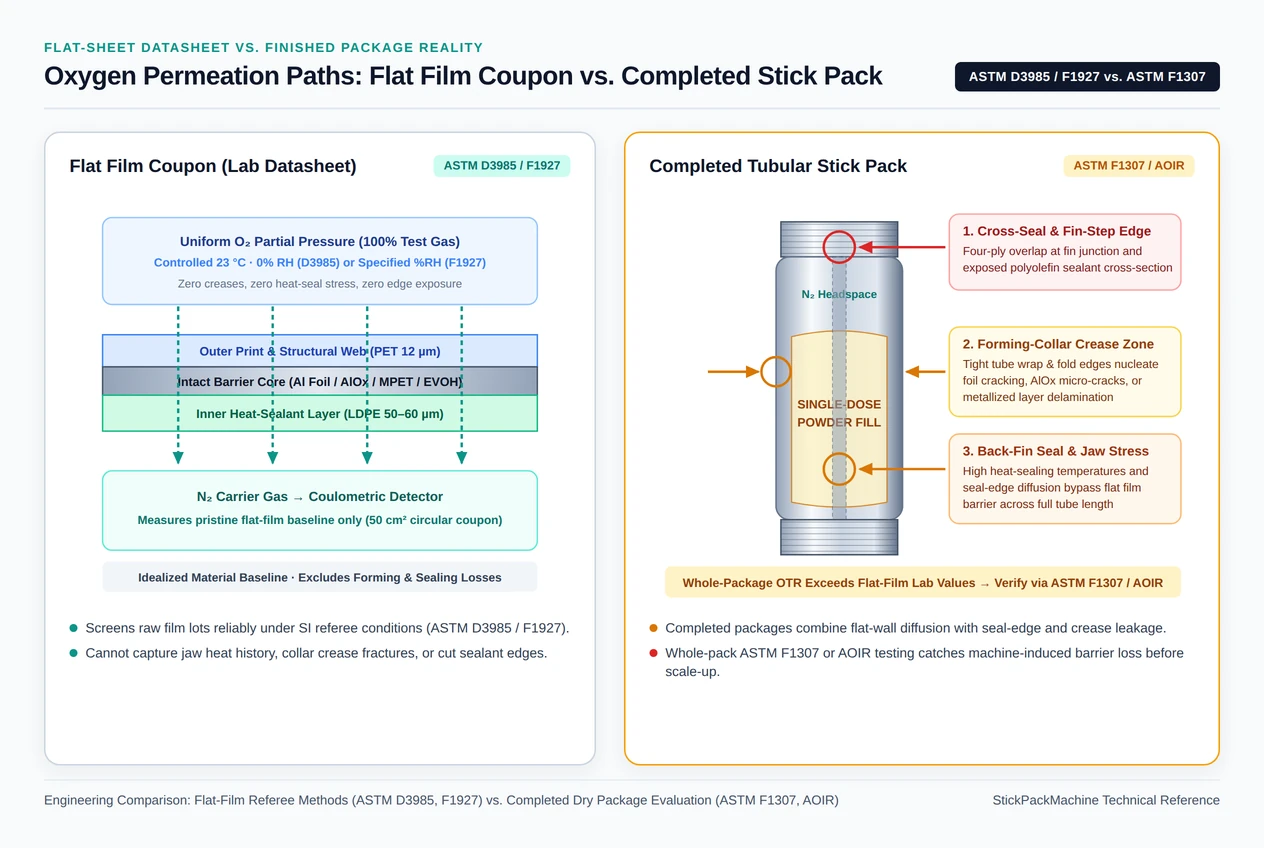
When qualifying completed stick packs rather than flat rollstock, whole-package standards provide direct finished-pack verification. ASTM F1307-20 uses a coulometric sensor to measure steady-state oxygen transmission directly into completed packages that enclose a dry environment, complemented by alternative flat-film methods such as ASTM F2622 (various sensors) and ASTM F3136 (dynamic accumulation) and whole-package techniques such as the Ambient Oxygen Ingress Rate (AOIR) method.
Scroll horizontally to see all columns. Keyboard: focus the table and use the arrow keys.
| ASTM or Package Method | Specimen & Sensor Basis | Climate & Unit Discipline | Role in Stick Pack Qualification |
|---|---|---|---|
| ASTM D3985-17 | Flat film, laminate, or coated web; coulometric sensor (50 cm² typical) | Dry gas (0% RH, 23 °C); SI units regarded as standard | Incoming flat-rollstock referee baseline; aligned with NIST manometric reference |
| ASTM F1927-20 | Flat barrier film or laminate; coulometric detector | Controlled temperature and specified %RH; SI units standard | Mandatory for EVOH or moisture-sensitive barrier webs used in humid climates |
| ASTM F1307-20 | Completed intact packages enclosing a dry environment; coulometric sensor | Controlled test conditions on finished pack; SI units standard | Captures flat wall plus heat seals, back fin, and forming-collar crease effects |
| ASTM F1249-20 | Single or multilayer films and foils up to 3 mm (0.1 in.); modulated IR sensor | Commonly 38 °C and 90% RH; Note 1 cautions against simple thickness extrapolation | Quantifies moisture barrier preventing powder caking, water activity rise, and EVOH plasticization |
| ASTM F392/F392M-21 | Flexible barrier sheet flexed on 30.70 mm (1.20 in.) Gelbo shaft | Levels A–C for pinholes; D and E before OTR/WVTR; keep SI and inch-pound separate | Simulates forming-shoulder folding and handling damage before permeation testing |
| ASTM F2622 / F3136 / AOIR | Alternative flat-film sensors (F2622), dynamic accumulation (F3136), or whole-pack AOIR | Configured per agreed buyer-seller referee test protocol | Provides alternate sensor options or ambient-air whole-pouch oxygen ingress tracking |
Discuss this configuration
Discuss on WhatsAppHow Do Heat Seals and Folds Raise Finished Stick-Pack OTR?
Completed flexible packages involve heat seals, creases, joints, and closures that frequently reduce the effective oxygen barrier well below flat-sheet film values. On a multi-lane stick pack machine, wrapping narrow slit strips around forming tubes, folding a longitudinal back fin, and crimping top and bottom transverse jaws introduces localized mechanical and thermal stresses absent from pristine 50 cm² flat test coupons.
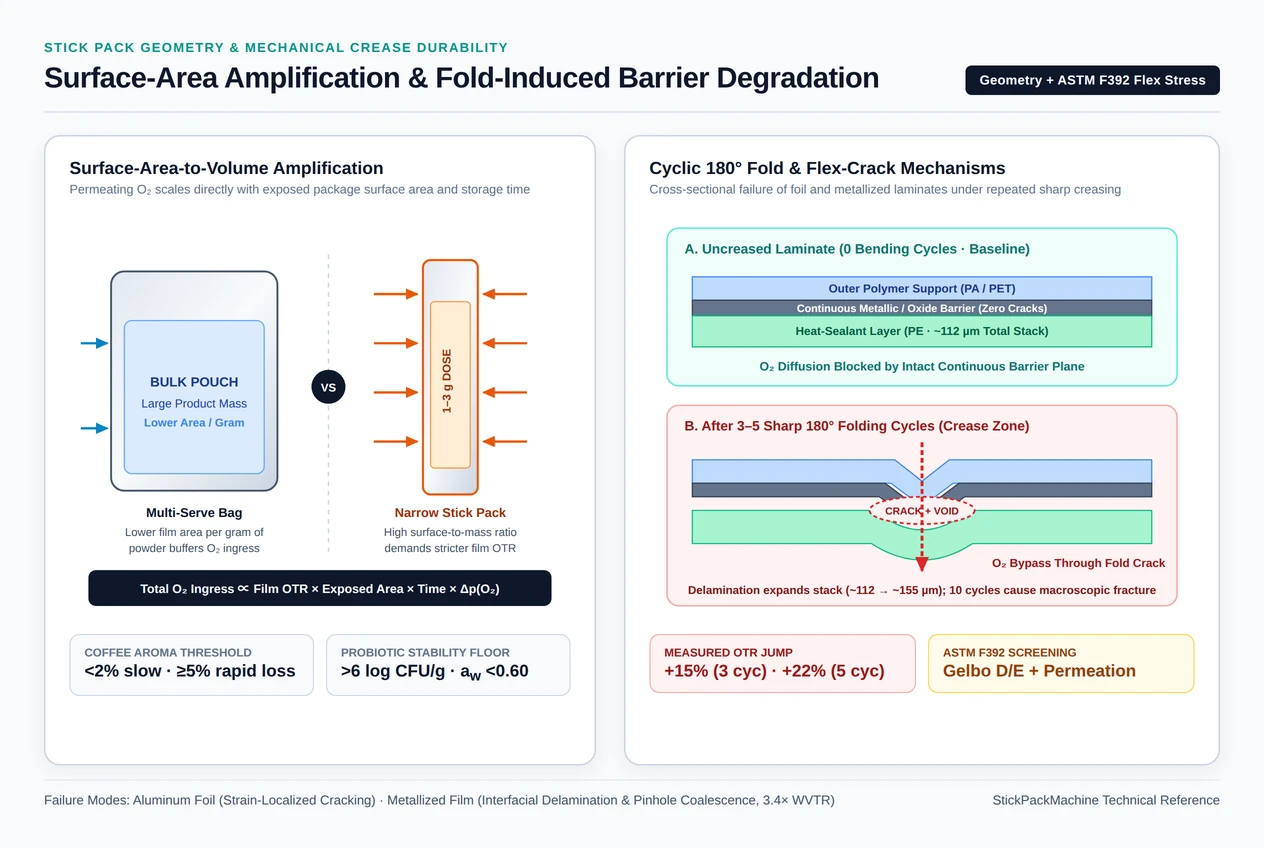
Published cyclic bending research on multilayer barrier membranes demonstrates how quickly sharp folding degrades gas barriers. Across both laminated aluminum foil structures (15 µm PA / 14 µm PET / 15 µm aluminum foil / 50 µm PE) and nanometallized PET films (30–100 nm aluminum coatings), cyclic 180° edge folding raised OTR by 15% after three bending cycles and by 22% after five cycles, while ten cycles caused macroscopic membrane fractures and total barrier failure. Cross-sectional microscopy revealed two distinct failure mechanisms: confined aluminum foil layers fail through strain-localized cracking due to limited ductility when sandwiched between stiffer polymer plies, whereas metallized films degrade through interfacial delamination at metal-polymer boundaries—expanding total laminate thickness from roughly 112 µm to 155 µm, causing pinhole coalescence, and driving a 3.4-fold WVTR jump from 20 mg to 68 mg after five cycles (compared with stable 19.5 mg to 20 mg on aluminum foil).
Thermal sealing history and vacuum-wrinkle stresses add a second layer of barrier loss, especially on transparent ceramic coatings and thin vacuum-metallized webs. NASA comparative packaging research specifically evaluates barrier degradation from high heat-sealing temperatures and fold stress cracking caused by vacuum wrinkles on AlOx-coated PET (Tolas), and multilayer powder studies confirm that amorphous aluminum oxide coatings are brittle enough to develop micro-cracks during lamination or heat sealing. In metallized films, incomplete island coalescence during vacuum deposition also leaves residual pinholes and grain-boundary voids that act as rapid diffusion paths, which high ambient humidity can widen through polymer relaxation.
Controlling the gap between flat-film OTR and completed-pack OTR requires linking film specification to machine sealing and mechanical QC. Conditioning candidate films under ASTM F392 levels D and E followed by supplementary permeation testing (referencing Guide F2097 and Practice E171) screens flex-crack risk before ordering printed reels. On the production line, evaluating fin seal vs lap seal step geometry, running nondestructive vacuum decay leak tests for micro-channels, and checking jaw uniformity with burst test packaging keep seal-edge defects from masking film barrier performance.
Related reading: Fin Seal vs Lap Seal on Stick Packs: Film Width, Seal Layers & Dust Tolerance; Vacuum Decay Leak Test: Principle & Stick Pack QC; Burst Test Packaging: Internal Pressure & Stick Seal QC
How Do You Size Allowable OTR for Single-Dose Stick Packs?
Allowable OTR for a single-dose stick pack depends directly on exposed film surface area, storage time, temperature, and product oxygen tolerance. Because permeating gas volume scales proportionally with surface area and time, narrow single-serve formats—such as 1 g probiotic doses in 2 × 3 cm, 90 µm foil pouches—expose far more barrier area per gram of fill than bulk bags.
That high surface-area-to-mass ratio compresses allowable film OTR whenever product oxidation or cell-death endpoints are tight. In roasted ground coffee studies, key volatile aroma compound 2-furfurylthiol declines rapidly when headspace oxygen reaches 5% or higher, whereas holding oxygen near 2% slows aroma loss, and international quality standards cap moisture at 5.0% at packaging. Across 180-day storage tests comparing 25 °C and 40 °C, capsules held at 40 °C accumulated higher headspace oxygen than packs stored at 25 °C, proving that warm distribution zones tighten the required barrier margin.
Live probiotic powders face equally strict coupled oxygen, moisture, and temperature boundaries. Probiotic instant coffee research on Lactiplantibacillus plantarum Dad-13 shows that stable samples kept viable cell counts above 6 log CFU/g with water activity below 0.60 to preserve shelf stability. Even inside 90 µm aluminum foil pouches, storage temperature shifted estimated vacuum-packaged shelf life from 726 days (2 years) at 4 °C down to 95 days (3 months) at 30 °C, while any imperfect seal or mechanical damage permitting air exchange directly reduced cell viability. Dry herbal infusion accelerated aging at 35 °C and 75% RH for 90 days (modeling roughly 12 months ambient storage using a Q10 = 2 approximation) similarly required holding headspace oxygen below a 5% sensory rejection ceiling (reaching 0.8 ± 0.2% in an EVOH hybrid versus 3.2 ± 0.5% in a conventional trilaminate).
Rather than picking a film from an unverified flat-sheet estimate, teams sizing probiotic powder stick packs or instant coffee stick packs should combine four inputs: package surface area relative to dose mass, worst-case distribution temperature and relative humidity, verified product oxygen and water-activity endpoints, and finished-pack verification via ASTM F1307 or AOIR plus accelerated storage validation.
Related reading: Probiotic Powder Stick Pack Machine: Auger Dosing & Nitrogen Flushing; Instant Coffee Stick Packs: Dosing, Moisture & Nitrogen
Scroll horizontally to see all columns. Keyboard: focus the table and use the arrow keys.
| Stick Pack Design Factor | Governing Permeation Driver | Qualification Action Before Scale-Up |
|---|---|---|
| Exposed Film Area vs. Fill Mass | Gas permeation volume scales directly with package surface area and storage time | Calculate total wall area per serving (for example 1 g doses in small pouches) before setting maximum flat-film OTR |
| Distribution Temperature & Climate RH | Permeation increases at elevated temperatures (40 °C vs. 25 °C; 30 °C vs. 4 °C) and humid RH plasticizes EVOH | Specify ASTM F1927 controlled-RH OTR for non-foil laminates and match accelerated aging climate to target markets |
| Product Oxidative & Aroma Ceiling | Coffee 2-furfurylthiol drops rapidly at ≥5% O₂ (slowed near 2% O₂); herbal sensory ceiling near 5% O₂ | Pair low-OTR laminate (<1.0 to <1.5) with headspace O₂ tracking over accelerated storage intervals |
| Probiotic Viability & Moisture Floor | Live probiotic powders require above 6 log CFU/g and water activity below 0.60; roasted coffee caps moisture at 5.0% | Couple ASTM F1249 WVTR screening with foil or low-WVTR oxide laminates and seal-integrity checks |
| Forming Collar & Seal Conversion Loss | Sharp folds raise OTR 15%–22% (3–5 cycles) and heat-seal steps bypass flat-wall barrier | Run ASTM F392 Gelbo D/E pre-flexing and verify finished stick packs via ASTM F1307 or AOIR |
Why Must Low-OTR Films Accompany Nitrogen Flushing on Stick Packs?
Nitrogen flushing displaces ambient air during sealing, but holding low headspace oxygen across shelf life requires pairing modified atmosphere packaging with a hermetically sealed, low-OTR laminate. Residual oxygen trapped in powder void spaces and occluded air limits gas flushing alone, while steady-state diffusion through the film continuously adds oxygen during storage.
Moderate polymer barriers illustrate how quickly permeation undermines a flushed headspace. A 10 µm PVdC coating on 60 µm PET—described as a high oxygen barrier polymer—still exhibits a combined OTR of 12–18 cc O₂/m²/24 h at 25 °C, permitting ongoing steady-state oxygen ingress that gradually erodes an initially low residual oxygen level across multi-month shelf life.
By contrast, single-serve coffee shelf-life studies packaged under a 100% nitrogen protective atmosphere show what properly matched barrier films achieve. Using either a 12 µm PET / 8 µm aluminum foil / 60 µm PE standard film (OTR < 1.0, 99 g/m²) or an alternative 12 µm PET / 12 µm MPET / 55 µm PE film (OTR < 1.5, 90 g/m²), individual coffee pods rose gently from roughly 0.4% headspace O₂ at 30 days to 1.4–1.8% after 180 days—remaining well below the 5% rapid aroma-degradation threshold—while larger-area capsule multipacks climbed from 1.7% to 1.9–3% over 180 days. Similarly, probiotic instant coffee packed in 90 µm aluminum foil achieved longer shelf life under vacuum sealing than nonvacuum sealing at both 4 °C (726 days) and 30 °C (95 days), confirming that starting with low residual oxygen and sealing it inside an ultra-low-OTR foil barrier act synergistically.
Production teams should therefore engineer gas flushing and film selection as a single closed system rather than independent purchases. Use dedicated nitrogen flushing for stick packs guidance to tune lance depth and residual oxygen at seal closure, and verify the actual product, barrier reel, and machine forming collar together during factory sample testing before approving commercial rollstock.
Related reading: Nitrogen Flushing for Stick Packs: Residual Oxygen Control; Stick Pack Machine Sample Testing
Sources
International permeation testing standards, NASA packaging studies, peer-reviewed multilayer barrier research, and technical reference documentation cited in this guide:
Further reading: ASTM International — ASTM D3985-17 Standard Test Method for Oxygen Gas Transmission Rate Through Plastic Film and Sheeting Using a Coulometric Sensor; ASTM International — ASTM F1927-20 Standard Test Method for Determination of Oxygen Gas Transmission Rate, Permeability and Permeance at Controlled Relative Humidity Through Barrier Materials Using a Coulometric Detector; ASTM International — ASTM F1307-20 Standard Test Method for Oxygen Transmission Rate Through Dry Packages Using a Coulometric Sensor; ASTM International — ASTM F1249-20 Standard Test Method for Water Vapor Transmission Rate Through Plastic Film and Sheeting Using a Modulated Infrared Sensor; ASTM International — ASTM F392/F392M-21 Standard Practice for Conditioning Flexible Barrier Materials for Flex Durability; NASA Advanced Food Technology Johnson Space Center — Perchonok & Antonini, Comparative Packaging Study; NIH PubMed Central — Sustainable Alternatives in Multilayer Packaging: Storage Stability of Pudding Powder Under Accelerated Storage Conditions; NIH PubMed Central — Redesigning Flexible Food Packaging for the Circular Economy: A Comparative Assessment of Hybrid Paper-Based Solutions; NIH PubMed Central — The Lipidic and Volatile Components of Coffee Pods and Capsules Packaged in an Alternative Multilayer Film; NIH PubMed Central — Degradation Mechanisms in Metallized Barrier Films for Vacuum Insulation Panels Subjected to Flanging-Induced Stress; NIH PubMed Central — Study of Viability, Storage Stability, and Shelf Life of Probiotic Instant Coffee in Aluminium Foil Packaging; NIH PubMed Central — Oxygen Absorbers in Food Preservation: A Review of Modified Atmosphere and Low-OTR Barrier Packaging; Oxygen transmission rate — Overview of ASTM Film, Whole-Package, and AOIR Test Methods
Common Questions
What is the difference between OTR, oxygen permeance, and oxygen permeability coefficient?
Under ASTM D3985 Section 1.1, OTR is the steady-state rate of oxygen transmission through a film or laminate at its actual thickness, permeance normalizes for oxygen partial pressure without normalizing thickness, and oxygen permeability coefficient normalizes for thickness only in homogeneous single-layer materials.
Why does an EVOH laminate datasheet tested under ASTM D3985 understate humid-climate oxygen ingress?
ASTM D3985 tests flat films dry at 0% RH, whereas hydrophilic EVOH absorbs moisture at elevated humidity and plasticizes. Peer-reviewed controlled-humidity measurements showed an EVOH hybrid laminate climbing from 0.56 cm³/m²/day at 0% RH to 2.31 cm³/m²/day at 50% RH and 15.21 cm³/m²/day at 75% RH, making ASTM F1927 controlled-RH testing essential.
Which ASTM standard measures oxygen transmission rate on a completed stick pack rather than flat rollstock?
ASTM F1307-20 uses a coulometric sensor to measure steady-state oxygen transmission directly into completed packages that enclose a dry environment in normal use, capturing heat seals, back fins, and forming creases that flat-film methods omit. The Ambient Oxygen Ingress Rate (AOIR) method is an additional whole-package option.
How do aluminum foil, AlOx-coated PET, and metallized PET compare for single-dose powder stick packs?
In multilayer powder testing, 12 µm PET / 9 µm Al foil / 60 µm LDPE achieved the tightest barrier (0.026 cc/m²·day·atm OTR, 0.049 g/m²·day WVTR, 800.32 days modeled storage), followed by transparent 12 µm PET-AlOx / 50 µm LDPE (0.130 OTR, 577.92 days) and 12 µm MPET / 50 µm LDPE (0.335 OTR, 407.58 days), while monolayer 30 µm MBOPP measured 12.190 OTR (229.26 days).
How can engineers screen stick pack barrier films for forming-collar fold cracking before buying printed reels?
Condition flat candidate laminates using ASTM F392/F392M-21 Gelbo flexing (levels D and E) and run supplementary gas or water vapor permeation tests before and after flexing. Cyclic 180° folding studies have shown 15% to 22% OTR increases after 3 to 5 bending cycles plus interfacial delamination in metallized webs.
Can nitrogen flushing compensate for a moderate-barrier stick pack film on coffee or probiotics?
No. Nitrogen flushing reduces initial oxygen at sealing, but residual void-space oxygen and continuous permeation through the film drive headspace oxygen upward over time. Roasted coffee loses key aroma rapidly at 5% O₂ or higher and probiotics require above 6 log CFU/g with water activity below 0.60, so inert gas flushing should be paired with a low-OTR laminate and verified seals.