
What Is Burst Test Packaging and How Does Internal Air Inflation Locate Weak Seals?
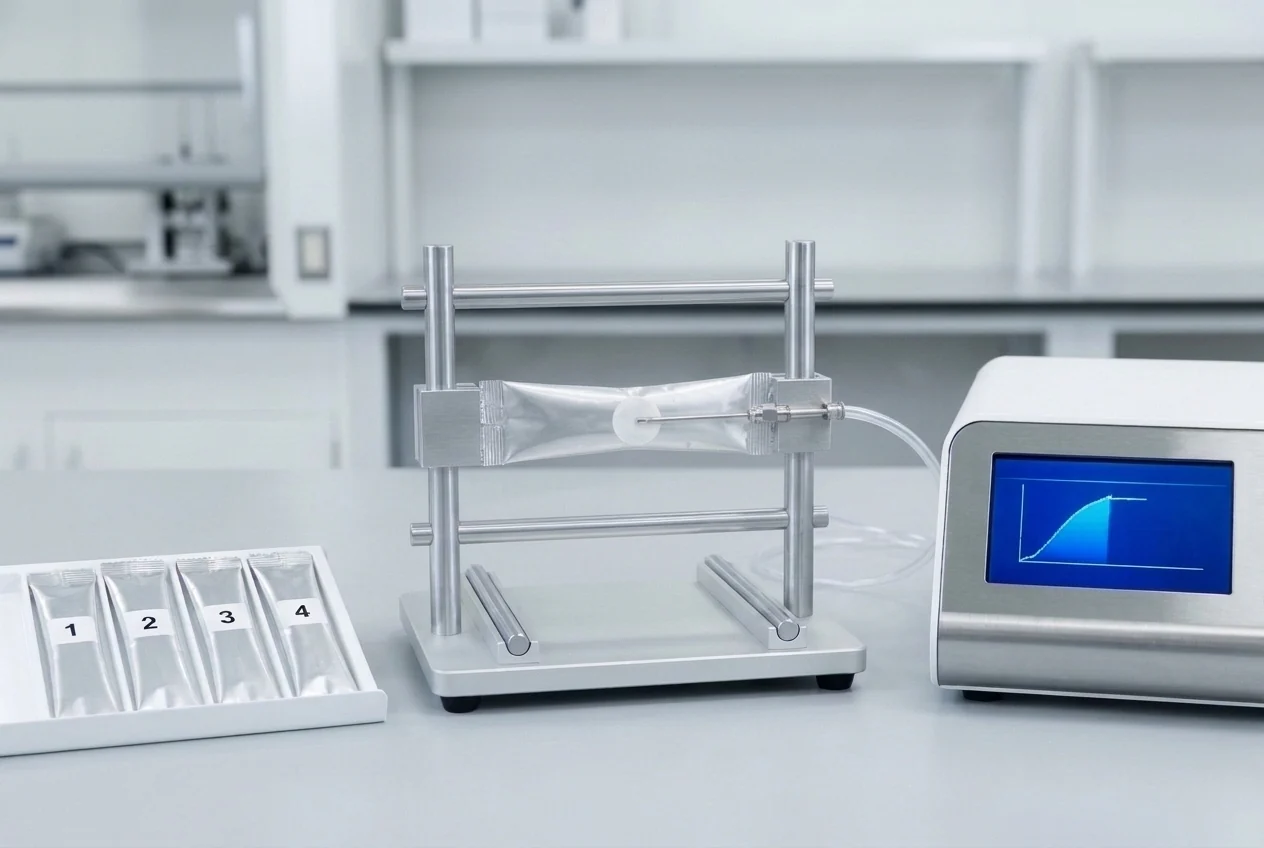
Burst test packaging is a rapid destructive test method that injects controlled air into a sealed flexible package until the weakest seal or substrate area opens. Under ASTM F1140 and ASTM F2054, internal pressurization evaluates how flexible pouches and stick packs resist pressure differentials encountered during sterilization, shipping, and multi-lane production.
Because pressurized air acts outward against the entire enclosed boundary at once, internal pressurization screens the whole perimeter rather than a single cut strip. On a tubular stick pack, that pressure loads the longitudinal back seam, both transverse cross seals, and the thicker transition step where the folded back fin passes through the top and bottom sealing jaws.
Choosing between fin seal vs lap seal construction directly changes how peel and shear loads develop during internal inflation. In a fin seal, the inner sealant faces fuse together and peel apart under internal pressure, whereas a lap seal bonds the inner sealant to an outer compatible layer in shear. Reviewing stick pack film laminate layers alongside seam geometry before setting burst targets keeps film tearing separate from incomplete heat-seal fusion.
Internal pressurization tests are frequently used during manufacturing and across the package life cycle because each cycle finishes quickly and reveals where failure initiates. However, burst testing measures mechanical failure resistance rather than micro-leak tightness: a seal that reaches high burst pressure can still harbor a narrow channel leak running like a tunnel through the two sealed layers, allowing microbes to enter a sterile product.
Related reading: Fin Seal vs Lap Seal on Stick Packs: Film Width, Seal Layers & Dust Tolerance; Stick Pack Film & Machine Compatibility
How Does ASTM F1140 Unrestrained Burst Testing Compare With Creep-to-Failure Hold Testing?
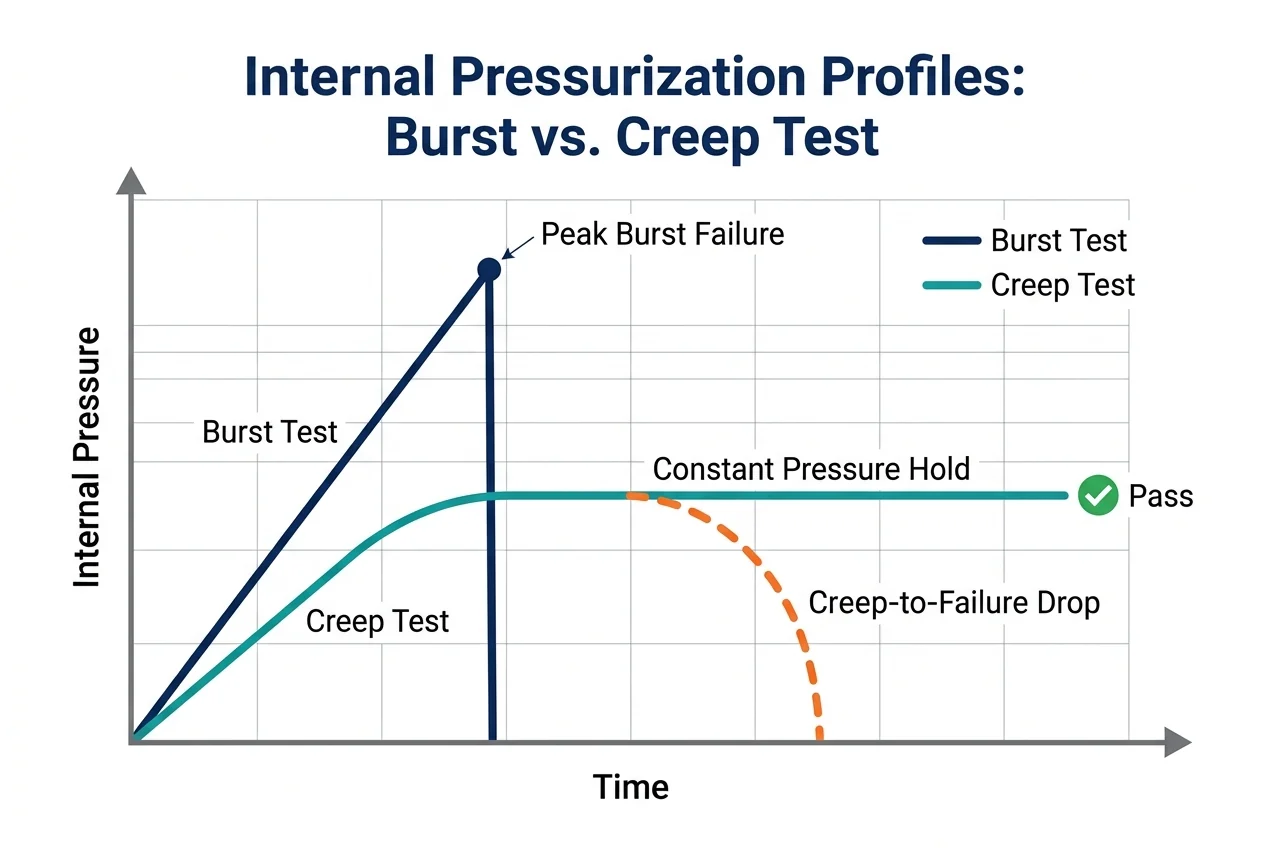
ASTM F1140/F1140M defines two distinct internal-pressurization modes for unrestrained flexible packages: the burst test increasingly pressurizes the package until it fails, whereas the creep test maintains a specified internal pressure for a specified hold time or until the package fails. Both methods rapidly evaluate package failure tendencies under sterilization and transportation pressure differentials.
A burst ramp establishes peak failure pressure and highlights immediate weak spots along heat seals, making it practical for quick line start-up checks and sealing-jaw adjustments. A creep hold applies sustained sub-burst pressure to detect slow seal peeling or viscoelastic yielding that a rapid ramp can overshoot before adhesive separation propagates across the full seal width.
Quality engineers should not treat ASTM F1140 burst readings as interchangeable with mechanical tensile peel results. ASTM F1140 Section 5.4 states that internal pressurization methods do not necessarily provide correlation with actual package seal strength as measured using ASTM F88, which pulls apart a cut material strip containing the seal and records both separation force and specimen failure mode.
When recording ASTM F1140 results across lab and plant teams, unit discipline also matters. ASTM F1140 Section 1.4 states that SI units and inch-pound units are regarded separately as standard because values in each system are not exact equivalents; teams must use one measurement system independently without combining values across test reports.
Scroll horizontally to see all columns. Keyboard: focus the table and use the arrow keys.
| Test Method & Standard | Loading Mechanism | Primary Defect Exposed | Destructive & Key Boundary |
|---|---|---|---|
| Unrestrained Burst (ASTM F1140) | Increasing internal air pressure until package fails | General pressurization failure tendency; stress peaks at center bulge | Destructive; may not reliably locate weakest perimeter seal and does not necessarily correlate with ASTM F88 |
| Constant-Pressure Creep (ASTM F1140) | Sustained specified internal pressure for a set time or until failure | Time-dependent seal creep and progressive peel failure under hold load | Destructive; requires fixed hold pressure, air flow rate, and test position for repeatability |
| Restrained-Plate Burst (ASTM F2054) | Increasing internal air pressure while enclosed between parallel plates | Minimum perimeter seal burst strength with more uniform seal loading | Destructive; does not measure seal uniformity, overall integrity, or areas contacting the plates |
| Seal Peel Strength (ASTM F88) | Mechanical tensile separation of a cut test strip across the seal | Local strip separation force and visual specimen failure mode | Destructive; tests only the cut strip segment rather than full perimeter weak points |
| Internal Pressurization Bubble (ASTM F2096) | Controlled internal air pressure submerged to observe bubble streams | Gross substrate holes and seal channels down to 250 µm (0.010 in.) at 81% probability | Destructive because it requires package entry to supply internal air pressure |
| Dye Penetration (ASTM F3039 / F1929) | Capillary or pressure-assisted dye migration across seal edges | Edge seal channel leaks of 50 µm or larger in nonporous packages (ASTM F3039) or porous packs (ASTM F1929) | Destructive; complements burst testing where micro-channels threaten sterile barriers |
Why Do Narrow Tubular Stick Packs Benefit From ASTM F2054 Restraining Plates?
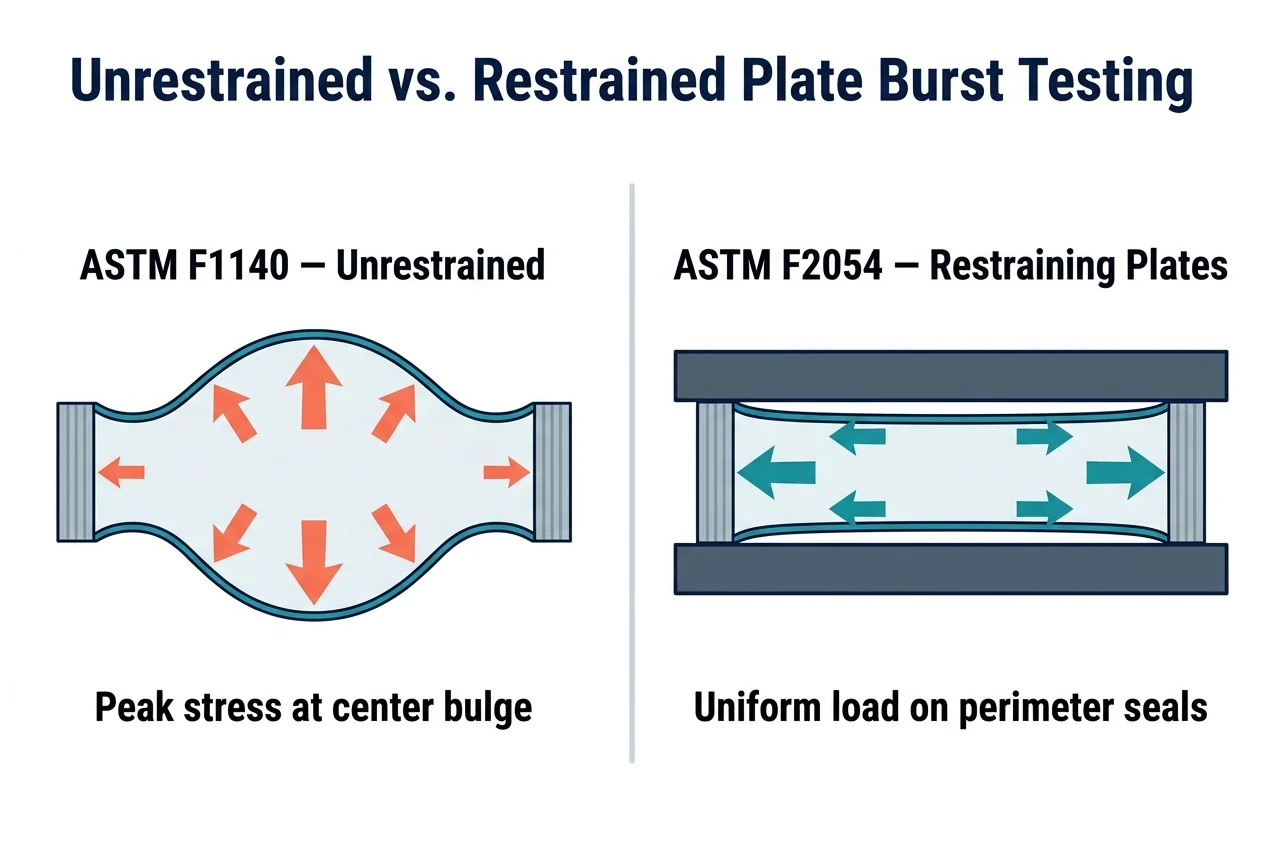
Narrow tubular stick packs benefit from ASTM F2054 restraining plates because unrestrained inflation under ASTM F1140 does not distribute stress uniformly across all seal areas. Without plates, stress peaks at the middle of the package where the flexible film inflates to its maximum diameter, which can burst the center wall or longitudinal seam before fully loading weaker cross seals.
ASTM F2054/F2054M encloses the flexible package between rigid parallel restraining plates during internal air pressurization. Maintaining dimensional stability restricts excessive center ballooning and redirects pressurization stresses more uniformly along the perimeter seals, giving quality teams a higher probability of locating the true weakest area of the seal and measuring minimum perimeter seal burst strength.
Engineering teams should account for the explicit scope limits of ASTM F2054. Section 1.4 notes that the method applies to flexible packages with perimeter seals and is particularly intended for peelable seal features, while Section 5.1 emphasizes that restrained burst testing cannot measure seal uniformity, overall package integrity, or the burst strength of package surfaces touching the restraining plates.
Film porosity and fixture safety also require verification before routine shop-floor use. Under ASTM F2054 Section 1.4.1, porous barrier materials can fail to reach burst pressure if air escapes faster than the tester volume flow supplies it. In addition, Section 1.6 advises particular caution whenever teams design and fabricate custom restraining plate fixtures, because fixture rigidity and plate spacing directly affect both operator safety and repeatable seal loading.
Related reading: Vacuum Decay Leak Test: Principle & Stick Pack QC
Discuss this configuration
Discuss on WhatsAppHow Does Flexible Pouch Burst Testing Differ From Mullen Corrugated Board Burst Strength?
Flexible pouch burst testing and Mullen corrugated board burst strength test completely different packaging structures and failure mechanisms. ASTM F1140 and ASTM F2054 inject air inside a sealed flexible pouch or stick pack to measure heat-seal failure resistance, whereas the Mullen Burst Test measures the hydraulic force required to puncture through a flat sheet of corrugated fiberboard.
According to the Virginia Tech Center for Packaging and Unit Load Design, the Mullen Burst Test is a widely required corrugated material property test referenced under ISO 2759 and TAPPI T810, with Model A testers rated up to 1,000 psi maximum pressure. Corrugated bursting strength reflects paper liner thickness, flute narrowness, and adhesive glue layers rather than polymer heat-seal integrity.
Confusing Mullen board burst ratings with flexible internal-pressurization burst specifications is a common RFQ and acceptance-protocol mistake. Specifying ISO 2759 or TAPPI T810 for primary stick pack film or asking a flexible pouch burst tester to qualify shipping cartons yields unusable data and delays factory acceptance sign-off.
Packaging buyers should split primary and secondary test plans cleanly: specify ASTM F1140 or ASTM F2054 (paired with ASTM F88 peel strength and leak integrity checks) for sealed stick packs, and keep Mullen corrugated burst or shipping-case compression specs confined to outer display cartons and master shippers.
Scroll horizontally to see all columns. Keyboard: focus the table and use the arrow keys.
| Comparison Dimension | Flexible Pouch Internal Pressurization | Mullen Corrugated Board Burst Test |
|---|---|---|
| Governing Standards | ASTM F1140/F1140M (unrestrained) and ASTM F2054/F2054M (restraining plates) | ISO 2759 and TAPPI T810 |
| Packaging Level Tested | Primary sealed flexible pouches, stick packs, and sterile barrier bags | Secondary corrugated fiberboard sheets and shipping cartons |
| Physical Failure Mechanism | Internal air pressurization opens the weakest heat seal or flexible wall | Diaphragm force punctures through corrugated paper liner and fluted board |
| Primary Strength Drivers | Heat-seal fusion, seal geometry (fin vs. lap), stick pack film structure, and jaw alignment | Paper liner layer thickness, flute narrowness, and adhesive glue layers |
| Representative Equipment Scope | Pneumatic package burst/creep tester with optional rigid restraining plates | Model A Mullen Burst Tester rated to 1,000 psi maximum pressure |
What Procedure Controls and Per-Lane Validation Steps Make Burst Testing Repeatable?
Repeatable burst testing starts with locking every mechanical and pneumatic variable between test runs. Both ASTM F1140 Section 5.3 and ASTM F2054 Section 5.3 warn that correlating results across different testers requires exact equivalence in package size, material, seal type and configuration, air flow rate, pressure-drop sensing sensitivity, and test article position, plus restraining plate rigidity and plate spacing for F2054.
Because internal pressurization tests on closed stick packs require piercing the film wall to supply internal air pressure, consistent air-entry preparation prevents artificial film-tear failures away from the seals. Operators apply a reinforcing patch or adhesive septum over a flat film zone away from heat seals, insert the inflation probe cleanly without nicking the opposite wall, position the stick pack consistently between the plates, and keep the air ramp rate and pressure-drop trigger locked to the validated recipe.
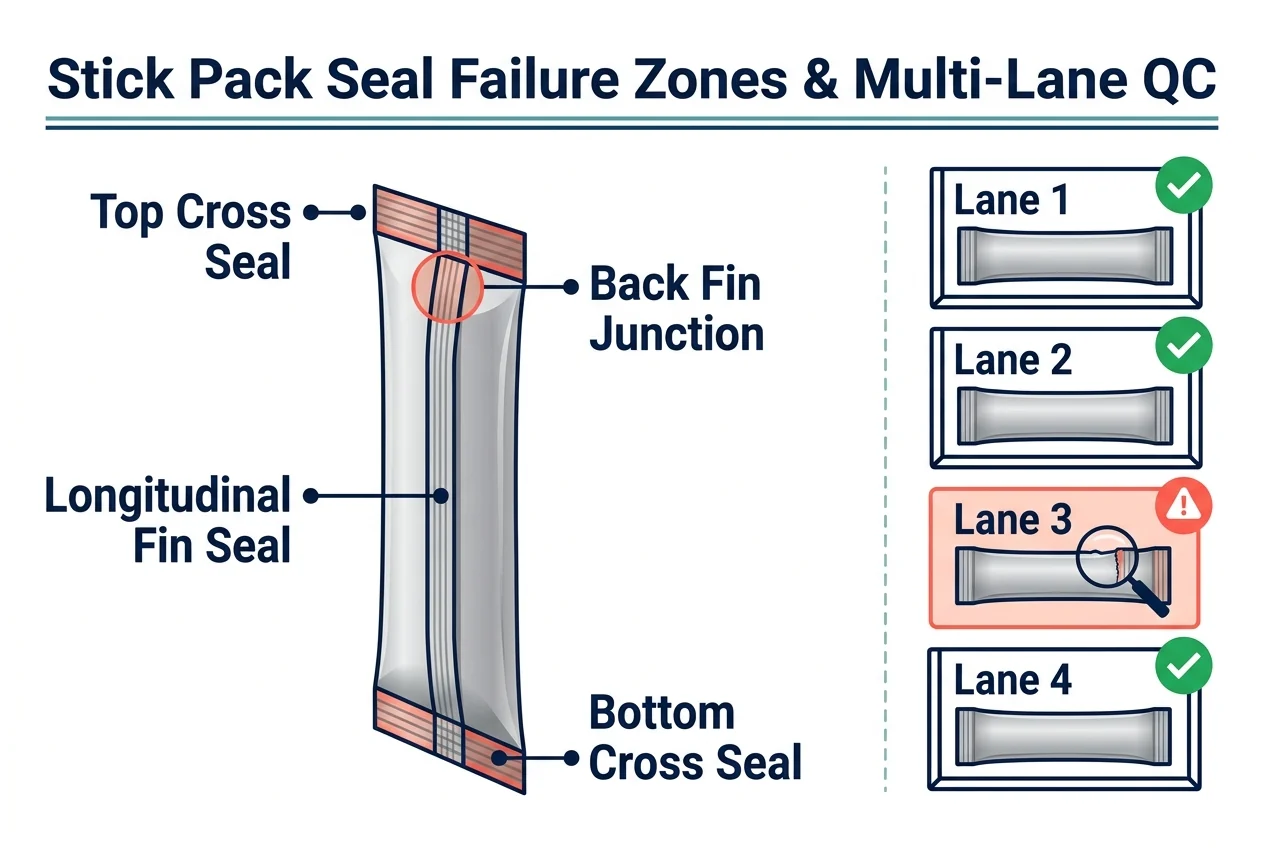
On multi-lane stick pack machines, burst pressure alone is incomplete unless every sample is logged by lane number and exact failure location. Recording whether rupture occurred at the top cross seal, bottom cross seal, longitudinal back fin, or the back-fin-to-cross-seal junction separates an all-lane temperature or dwell shift from a single-lane jaw pressure imbalance, worn crimper tooth, or misaligned forming tube.
For sterile medical devices and regulated pharmaceutical lines, regulatory frameworks tie burst testing directly to documented process validation and complementary integrity checks. The U.S. FDA CDRH recognizes ASTM F1140 (FR Recognition Number 14-402, List 034), ASTM F2054 (FR Recognition Number 14-403, List 034), and ASTM F88 (FR Recognition Number 14-596, List 061) as complete consensus standards alongside ISO 11607-1, ISO 11607-2, and ISO/TS 16775 for forming, sealing, and assembly validation. In drug packaging, 21 CFR 211.130 requires written procedures, pre-use material examination, and batch production record documentation, while microbial ingress studies show defects larger than 15 µm can breach flexible pouch sterility—confirming why regulated lines pair burst strength with dedicated leak detection.
Related reading: Stick Pack Machine Problems and Solutions: Multi-Lane Troubleshooting, Seal Leaks & Dose Drift; Stick Pack Machine FAT Checklist; Stick Pack Machine Sample Testing
Scroll horizontally to see all columns. Keyboard: focus the table and use the arrow keys.
| QC Record Field | What Operators Must Control or Log | Diagnostic Value on Multi-Lane Stick Lines |
|---|---|---|
| Lane Number & Sample Sequence | Tag every tested stick pack with its exact forming lane and sampling timestamp | Distinguishes single-lane jaw wear or film tracking drift from shared all-lane heater or air-pressure changes |
| Test Mode & Unit System | Record ASTM F1140 unrestrained, ASTM F2054 restrained, or creep hold using SI or inch-pound units independently | Prevents mixing incompatible test outputs or combining non-equivalent unit systems across shift logs |
| Tester & Fixture Parameters | Lock air flow rate, pressure-drop sensitivity, test article position, restraining plate rigidity, and plate gap | Preserves machine-to-machine correlation between factory acceptance lab testers and plant QC benches |
| Exact Failure Location | Classify rupture at top cross seal, bottom cross seal, longitudinal fin seal, back fin junction, or film body | Pinpoints whether corrective action belongs on vertical fin sealers, horizontal crimping jaws, or film laminate specs |
| Complementary Integrity Pairing | Pair destructive burst records with ASTM F88 peel mode checks and dedicated leak testing methods | Covers seal uniformity and micro-channel leaks down to the 15 µm critical microbial barrier threshold that burst tests cannot detect |
Sources
Standards bodies, regulatory consensus records, university corrugated testing documentation, and peer-reviewed flexible packaging integrity studies referenced in this guide:
Further reading: ASTM International — ASTM F1140/F1140M-13(2020)e1 Standard Test Methods for Internal Pressurization Failure Resistance of Unrestrained Packages; ASTM International — ASTM F2054/F2054M-13(2020) Standard Test Method for Burst Testing of Flexible Package Seals Using Internal Air Pressurization Within Restraining Plates; U.S. FDA CDRH Recognized Consensus Standards — ASTM F1140/F1140M-13 (Reapproved 2020)e1 (FR Recognition Number 14-402); U.S. FDA CDRH Recognized Consensus Standards — ASTM F2054/F2054M-13 (Reapproved 2020) (FR Recognition Number 14-403); U.S. FDA CDRH Recognized Consensus Standards — ASTM F88/F88M-23 Standard Test Method for Seal Strength of Flexible Barrier Materials (FR Recognition Number 14-596); Virginia Tech Center for Packaging and Unit Load Design — Bursting Strength Testing (Mullen Burst Test, ISO 2759 / TAPPI T810); NIH PubMed Central — Moghimi & Park (2017), Leakage assessment of flexible pouches using dye penetration test with correlation to modeled bacterial aerosol challenge test; ASTM International — ASTM F2096 Standard Test Method for Detecting Gross Leaks in Packaging by Internal Pressurization (Bubble Test); U.S. eCFR — 21 CFR 211.130 Packaging and labeling operations
Common Questions
What is a burst test in flexible packaging quality control?
Under ASTM F1140 and ASTM F2054, a flexible packaging burst test increasingly pressurizes a sealed pouch or stick pack with internal air until the weakest seal or material area fails, rapidly evaluating failure resistance under pressure differentials from sterilization, distribution, and manufacturing.
What is the difference between a burst test and a creep test under ASTM F1140?
ASTM F1140 Section 1.2 defines the burst test as increasingly pressurizing a package until it fails, whereas Section 1.3 defines the creep test as maintaining a specified internal pressure for a specified time or until the package fails.
Why use ASTM F2054 restraining plates instead of unrestrained ASTM F1140 burst testing?
Under unrestrained ASTM F1140 inflation, stress is highest at the middle of the pouch where it expands to maximum diameter and may miss the weakest seal area. Placing the package between parallel restraining plates under ASTM F2054 maintains dimensional stability and distributes stress more uniformly along perimeter seals.
Can burst test pressure replace ASTM F88 tensile peel testing or micro-leak detection?
No. Both ASTM F1140 and ASTM F2054 state that internal pressurization results do not necessarily correlate with ASTM F88 strip peel strength, and ASTM F2054 explicitly notes that restrained burst testing cannot evaluate seal uniformity or overall package integrity, so lines pair burst testing with leak detection and peel mode inspection.
How is flexible pouch burst testing different from a Mullen burst test?
Flexible pouch burst testing (ASTM F1140 and ASTM F2054) inflates a sealed package with internal air to test heat-seal failure resistance. A Mullen burst test (ISO 2759 and TAPPI T810) measures the force required to puncture corrugated board based on paper liner thickness, flute geometry, and glue layers.
Why should multi-lane stick pack lines record both lane number and rupture location during burst testing?
Logging each sample by lane number and failure zone—top cross seal, bottom cross seal, longitudinal fin seal, or back fin junction—lets engineers distinguish a single-lane jaw alignment or wear fault from an all-lane temperature, dwell, or film-lot shift.