
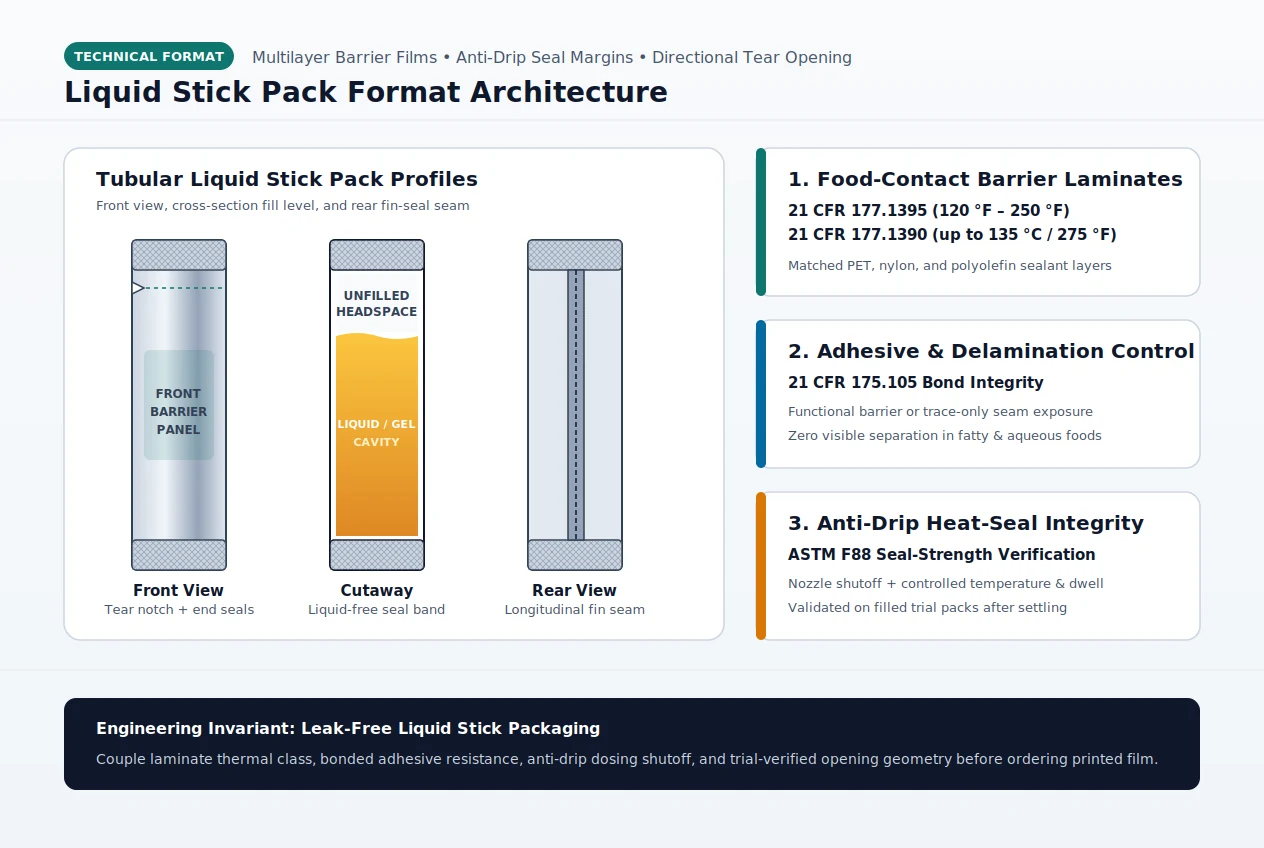
How Do Narrow Tubular Liquid Stick Packs Differ From Flat Four-Side-Seal Sachets?
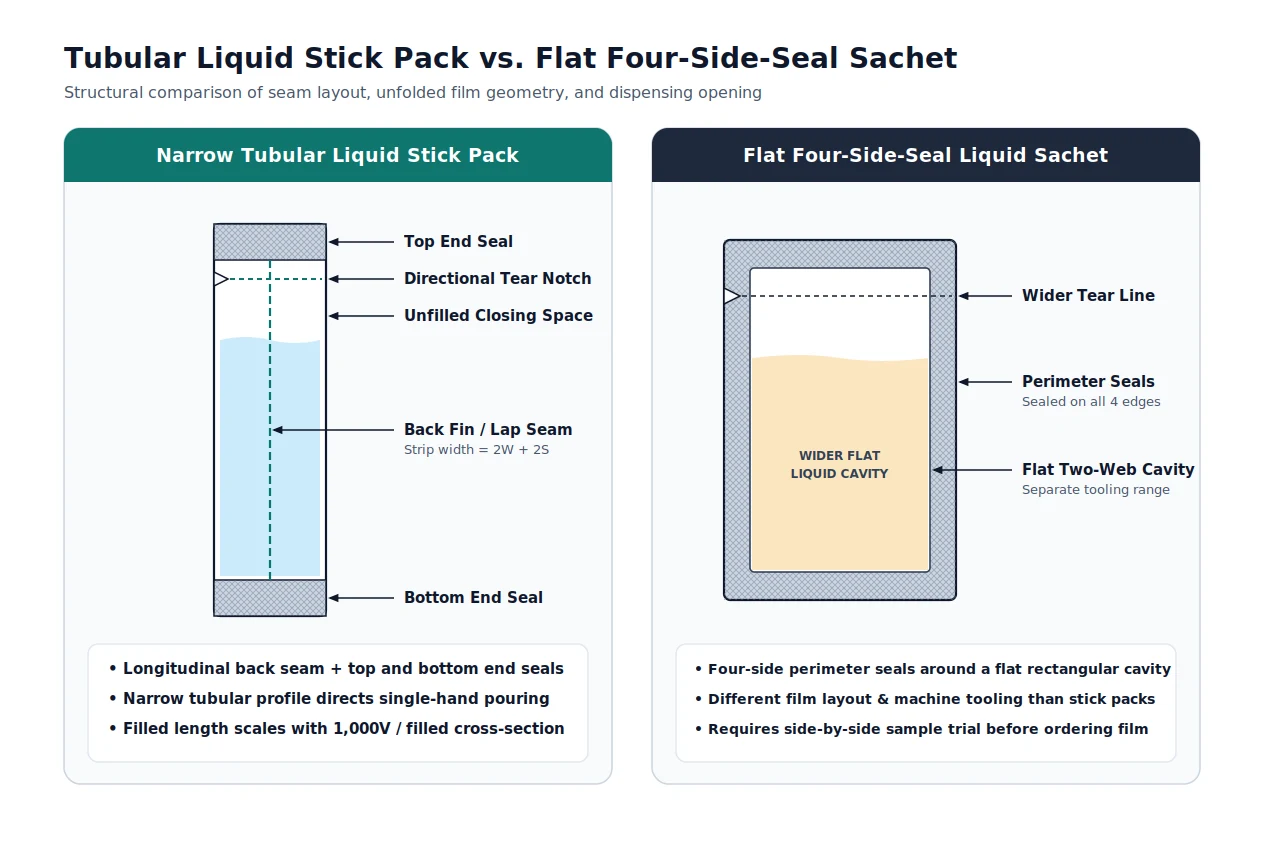
Narrow tubular liquid stick packs differ structurally from flat four-side-seal sachets in format geometry, film layout, perimeter sealing structure, and dispensing ergonomics, wrapping a single slit strip into a slim tube closed by a longitudinal back seam and top and bottom end seals rather than sealing all four flat edges.
For a fin-seal drawing that defines cavity lay-flat width W and fin material S at each edge, the unfolded strip width equals 2W + 2S, whereas a flat four-side-seal sachet uses a separate two-face perimeter seal layout and tooling range. That narrow tubular shape concentrates pouring through a compact top opening for single-hand use across beverages, syrups, and gels.
Because stick packs and flat sachets differ in film layout, seal layout, opening behavior, and machine parts, packaging teams should compare both formats in a side-by-side trial before ordering printed rollstock.
Related reading: Stick Pack vs Sachet: Which Format to Use; Stick Pack Sizes & Dimensions Guide
Scroll horizontally to see all columns. Keyboard: focus the table and use the arrow keys.
| Structural Attribute | Narrow Tubular Liquid Stick Pack | Flat Four-Side-Seal Liquid Sachet |
|---|---|---|
| Seam and perimeter layout | Longitudinal back fin or lap seam combined with top and bottom transverse end seals | Four-side perimeter heat seals enclosing a flat rectangular liquid cavity |
| Unfolded film layout | Single slit strip wrapped into a tube; fin-seal strip width equals 2W + 2S for cavity width W and fin allowance S | Separate flat film layout and perimeter sealing structure requiring distinct tooling |
| Dispensing and opening ergonomics | Narrow tubular profile channels liquid through a compact top tear opening for controlled single-hand pouring | Wider flat cavity and broader tear edge suited to larger flat-pouch layouts |
| Format approval step | Verify filled length, end-seal bands, unfilled closing space, and tear opening on filled trial samples | Compare directly against stick samples in a side-by-side trial before ordering production film |
What Pouch Proportions and Tear-Opening Features Prevent Messy Spurting?
Controlling messy spurting in liquid stick packs requires sizing required filled length (in mm) as 1,000V / A_filled (with dose volume V in mL and average filled cross-section A_filled in mm²), adding explicit end-seal widths and unfilled closing space to the finished length, and validating the tear-notch and cutting profile on filled product samples so the pouch opens cleanly without trapping liquid.
Cutting tooling options for stick packs include zig-zag edges, round-corner profiles, tear notches, and perforations. Even when a tear notch is positioned accurately on the drawing, the resulting opening can still feel inconvenient or leave excess retained product behind depending on liquid viscosity and wet-hand handling.
Rather than forcing a liquid dose into the smallest external rectangle a sample can be pushed into by hand, inspect trial packs immediately after filling and after settling to confirm there is no excessive bulging, product trapped near the seal, difficult opening, or incomplete emptying.
Related reading: Stick Pack Sizes & Dimensions Guide; Honey Stick Pack Machine
Which Multilayer Food-Contact Barrier Films Resist Delamination From Acids, Oils, and Syrups?
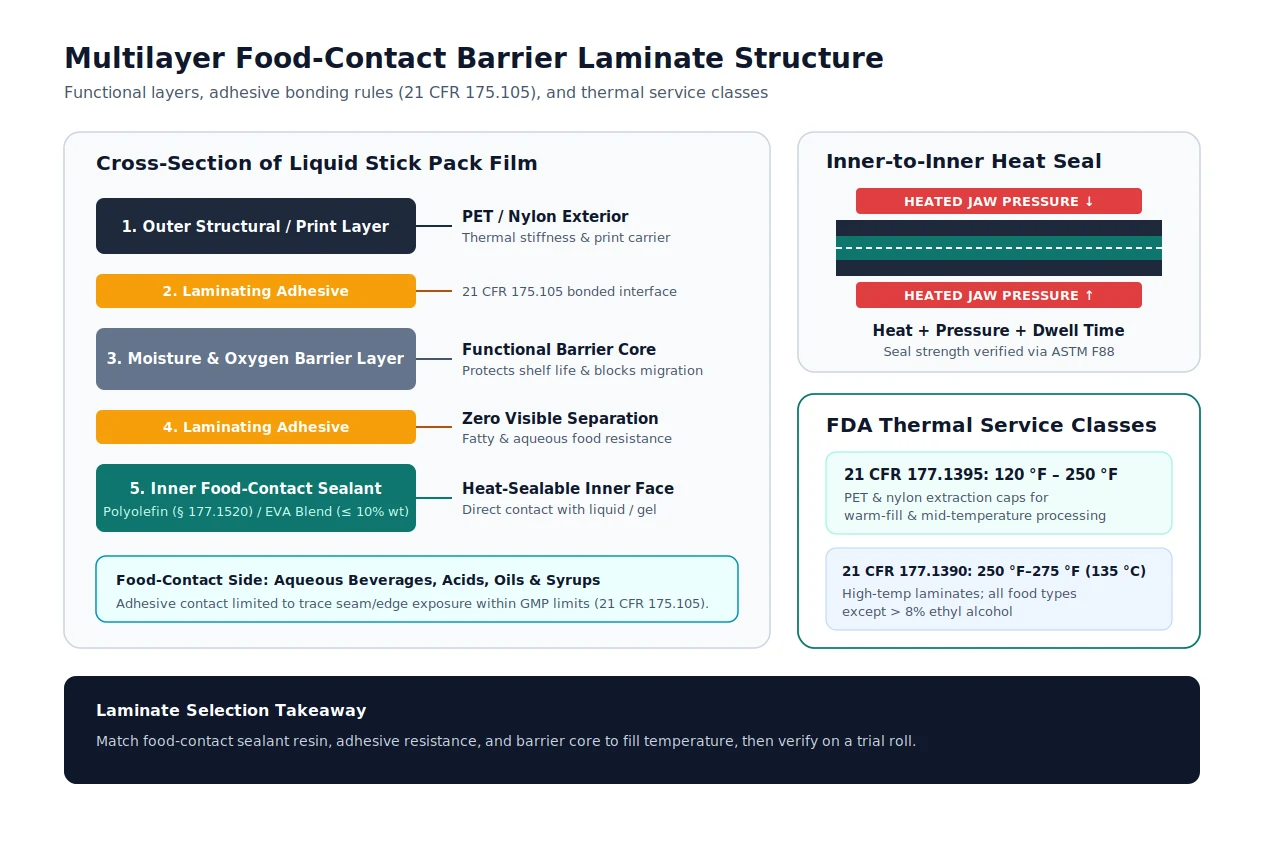
Multilayer liquid stick pack films resist delamination and migration by matching FDA-regulated food-contact layers to the actual processing temperature, using 21 CFR 177.1395 for 120 °F to 250 °F conditions or 21 CFR 177.1390 up to 135 °C (275 °F), paired with food-packaging adhesives that remain firmly bonded without visible separation in fatty and aqueous foods.
Under 21 CFR 177.1395, mid-temperature laminates are layered structures optionally bonded with adhesives that may be laminated, extruded, coextruded, or fused, and the food-contact layer does not function as a migration barrier from non-food-contact layers. Laminate structures using polyethylene terephthalate as the food-contact layer complying with 21 CFR 177.1630 under conditions C through G of 21 CFR 176.170(c) must not yield m-phenylenedioxy-O,O′-diethyl isophthalate or cyclic bis(ethylene isophthalate) in excess of 7.8 micrograms/square decimeter (0.5 microgram/square inch) of food-contact surface when extracted with 8 percent ethanol at 150 °F for 2 hours.
Nylon laminate structures under 21 CFR 177.1395 carry distinct aqueous extraction caps: nylon laminate structures for nonalcoholic foods up to 100 °C (212 °F) must yield no more than 0.15 milligram of epsilon-caprolactam and 0.04 milligram of omega-laurolactam per square inch after 5 hours in water at 100 °C (212 °F); laminate structures for nonalcoholic foods up to 82.2 °C (180 °F) must stay at or below 0.15 milligram of epsilon-caprolactam per square inch after 5 hours at 82.2 °C (180 °F); and nylon 6/69 laminates must keep aqueous extract nitrogen at or below 15 micrograms per square centimeter (100 micrograms per square inch) after 8 hours at 100 °C (212 °F).
For high-temperature processing at 250 °F and above, up to 135 °C (275 °F), 21 CFR 177.1390 permits packaging all food types except products containing more than 8 percent ethyl alcohol. Authorized food-contact layers include polyolefin resins complying with item 2.2 or 3.2 of 21 CFR 177.1520(c), blends of those base polymers with up to 10 percent by weight of ethylene and vinyl acetate copolymer under 21 CFR 177.1350, and polyethylene phthalate resins complying with 21 CFR 177.1630(e)(4)(i) and (ii). Across all liquid structures, food-packaging adhesives must be separated from food by a functional barrier or limited to trace seam and edge exposures within good manufacturing practice limits with zero visible separation.
Related reading: Stick Pack Film & Machine Compatibility
Scroll horizontally to see all columns. Keyboard: focus the table and use the arrow keys.
| FDA Regulation | Temperature & Food Scope | Permitted Layer or Adhesive Rule | Extraction or Bond Threshold |
|---|---|---|---|
| 21 CFR 177.1395 (PET laminate) | 120 °F to 250 °F; conditions C through G of 21 CFR 176.170(c) | Polyethylene terephthalate food-contact layer complying with 21 CFR 177.1630 | At most 7.8 micrograms/square decimeter (0.5 microgram/square inch) of m-phenylenedioxy-O,O′-diethyl isophthalate or cyclic bis(ethylene isophthalate) in 8 percent ethanol at 150 °F for 2 hours |
| 21 CFR 177.1395 (Nylon laminates) | Nonalcoholic foods up to 100 °C (212 °F), or up to 82.2 °C (180 °F) for lower-temp grades | Nylon laminate structures with authorized food-contact materials | At most 0.15 milligram epsilon-caprolactam/in² (and 0.04 milligram omega-laurolactam/in² at 100 °C / 212 °F) in 5-hour water extraction |
| 21 CFR 177.1395 (Nylon 6/69) | Nonalcoholic aqueous service up to 100 °C (212 °F) | Laminate structures containing nylon 6/69 resins | Aqueous extract nitrogen at or below 15 micrograms per square centimeter (100 micrograms per square inch) after 8 hours at 100 °C (212 °F) |
| 21 CFR 177.1390 (High-temp laminate) | 250 °F and above, up to 135 °C (275 °F); excludes foods over 8 percent ethyl alcohol | 21 CFR 177.1520(c) item 2.2 or 3.2 polyolefin, blend with up to 10 percent EVA (21 CFR 177.1350), or 21 CFR 177.1630(e)(4)(i)-(ii) PET | Safe for food contact across covered food types within the 135 °C (275 °F) ceiling |
| Food-packaging adhesives | Fatty and aqueous food packaging under normal conditions of use | Separated by a functional barrier or limited to trace seam and laminate edge exposure within GMP limits | Seams and laminates must remain firmly bonded without visible separation |
How Do Gel and Oral-Liquid Stick Packs Control Seal Cleanliness and Heat-Seal Integrity?
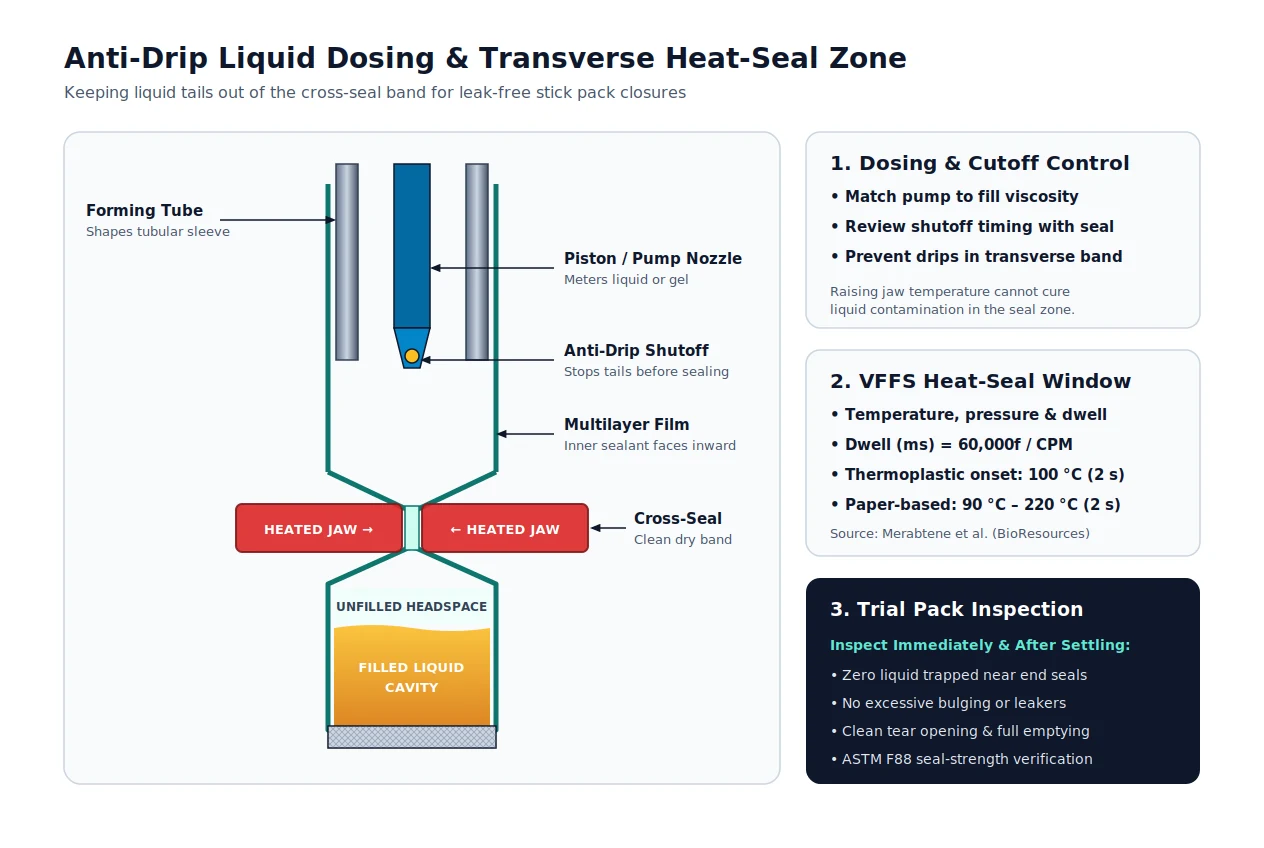
Gel and oral-liquid stick packs maintain leak-free closures by pairing anti-drip nozzle shutoff that keeps liquid out of the transverse seal band with controlled vertical form-fill-seal heat, pressure, and dwell time on the inner sealant layer, then verifying finished seal strength using the ASTM F88 test method.
Product shelf-life depends directly on both sealing integrity and the barrier properties of the flexible packaging material. Industrial machines close flexible materials by applying heat and pressure toward the inner layer of the film, where heat-seal performance depends on sealing temperature, pressure, and dwell time. For a constant cam contact fraction f, estimated dwell in milliseconds equals 60,000f divided by cycles per minute.
In published industrial vertical form-fill-seal evaluation at a 2 s dwell time, the first observable seal formed at 90 °C for paper-based material and 100 °C for thermoplastic film, while the paper-based flexible material showed a wider sealing window up to 220 °C before thermal degradation began. On liquid lines, however, liquid left by a nozzle near the sealing area interferes with closure, and raising jaw temperature does not cure product contamination; liquid shutoff and nozzle timing must be reviewed alongside sealing conditions.
Related reading: Liquid Stick Pack Machine for Gels; Energy Gel Stick Pack Machine
What Viscosity and Settling Checks Govern How Gels and Supplement Liquids Fill Narrow Tubes?
Filling isotonic gels, honey, and supplement liquids into narrow tubular stick packs depends on product viscosity and flow characteristics at the filling temperature, matched to piston or pump dosing with anti-drip nozzle control and verified through immediate and post-settling inspection of filled trial packs.
Because piston or pump dosing systems meter liquids and gels into a slim vertical sleeve, stringing or dripping at cutoff can leave liquid inside the transverse heat-seal zone. The inner sealant layer must work with the selected sealing arrangement, with temperature, pressure, and contact time established on the actual film and product rather than copied from a different SKU.
During sample evaluation, inspect trial packs both immediately after filling and after settling to catch product trapped near the seal, excessive bulging, difficult opening, or incomplete emptying, and agree with the supplier on which adjustments belong to the package geometry versus the filler.
Related reading: Liquid Stick Pack Machine for Gels; Energy Gel Stick Pack Machine; Honey Stick Pack Machine
Scroll horizontally to see all columns. Keyboard: focus the table and use the arrow keys.
| Verification Check | What to Measure or Observe | Failure Mode Prevented |
|---|---|---|
| Viscosity and flow at fill temperature | Flow behavior, particle passage, and cutoff cleanliness through piston or pump dosing nozzles | Nozzle stringing or dripping that contaminates the transverse heat-seal band |
| Heat-seal process window | Sealing temperature, jaw pressure, and dwell time (60,000f divided by cycles per minute for constant cam contact fraction f) | Weak cold seals or thermally degraded film outside the validated sealing window |
| Seal-strength verification | Mechanical peel evaluation of finished seals per ASTM F88 on filled trial samples | Unverified seal strength that fails during shipping or retail handling |
| Immediate and post-settling pack check | Product trapped near the seal, excessive bulging, tear-notch opening ease, and retained product after emptying | Leakers, messy spurting on opening, and excessive gel or syrup left inside the pouch |
When Should Brands Validate Films and Contract Packaging Before Investing in Dedicated Equipment?
Brands should validate liquid stick pack films on a physical machine trial with the exact candidate roll grade and product sample before committing to printed production rolls or dedicated multi-lane equipment, and treat shelf-life qualification as a separate requirement from runnability testing.
Film approval comes from a physical machine trial—not a supplier data sheet alone—evaluating forming, registration, sealing, and cutting across every active lane while keeping the approved roll identification with the trial record. Whenever a new film supplier or resin grade is proposed later, repeat the affected trial checks before ordering printed reels.
Just as importantly, a passed machine runnability trial is not proof of shelf life. Packaging teams must pair runnability sign-off with separate packaging-performance evidence tied to the exact film grade and intended distribution conditions before scaling into dedicated multi-lane liquid packaging lines.
Related reading: Stick Pack Machine Sample Testing; Stick Pack Manufacturing: Co-Packing vs In-House Lines; Liquid Stick Pack Machine for Gels
Discuss this configuration
Discuss on WhatsAppSources
Federal food-contact laminate and adhesive regulations and peer-reviewed vertical form-fill-seal heat-sealing research cited in this guide:
Further reading: eCFR — 21 CFR § 177.1395 Laminate structures for use at temperatures between 120 °F and 250 °F; eCFR — 21 CFR § 177.1390 Laminate structures for use at temperatures of 250 °F and above; eCFR — 21 CFR § 175.105 Food-packaging adhesives; NC State BioResources — Merabtene et al. (2022), Heat Sealing Evaluation and Runnability Issues in a VFFS Machine
Common Questions
How does a liquid stick pack differ from a four-side-seal liquid sachet?
A narrow tubular liquid stick pack wraps a single film strip into a slim tube closed by a longitudinal back seam and top and bottom end seals (with fin-seal strip width equal to 2W + 2S), whereas a flat four-side-seal sachet seals all four perimeter edges around a wider cavity and uses different film layout and machine tooling.
Which FDA regulations govern multilayer food-contact laminates for liquid stick packs?
FDA 21 CFR 177.1395 governs food-contact laminate structures used between 120 °F and 250 °F, while 21 CFR 177.1390 covers high-temperature laminates at 250 °F and above up to 135 °C (275 °F) for all food types except those containing more than 8 percent ethyl alcohol. Food-packaging adhesives must be separated from food by a functional barrier or stay within trace seam limits without visible separation.
What inner sealant resins are permitted in high-temperature liquid stick pack laminates?
Under 21 CFR 177.1390, permitted food-contact layers include polyolefin resins complying with item 2.2 or 3.2 of 21 CFR 177.1520(c), blends of those base polymers with no more than 10 percent by weight of ethylene and vinyl acetate copolymer under 21 CFR 177.1350, and polyethylene phthalate resins complying with 21 CFR 177.1630(e)(4)(i) and (ii).
Can raising heat-seal jaw temperature fix liquid contamination in the transverse seal zone?
No. Liquid left by a nozzle near the sealing area interferes with closure, and raising the temperature does not cure product contamination. Liquid shutoff, anti-drip nozzle control, and nozzle timing must be reviewed alongside sealing temperature, pressure, and dwell time.
Does a passed machine runnability trial prove shelf life for a liquid stick pack?
No. Film approval requires a physical machine trial with the exact candidate roll grade and product sample, but a passed runnability trial is not proof of shelf life. Separate packaging-performance evidence tied to the exact film grade and intended distribution conditions is required.