
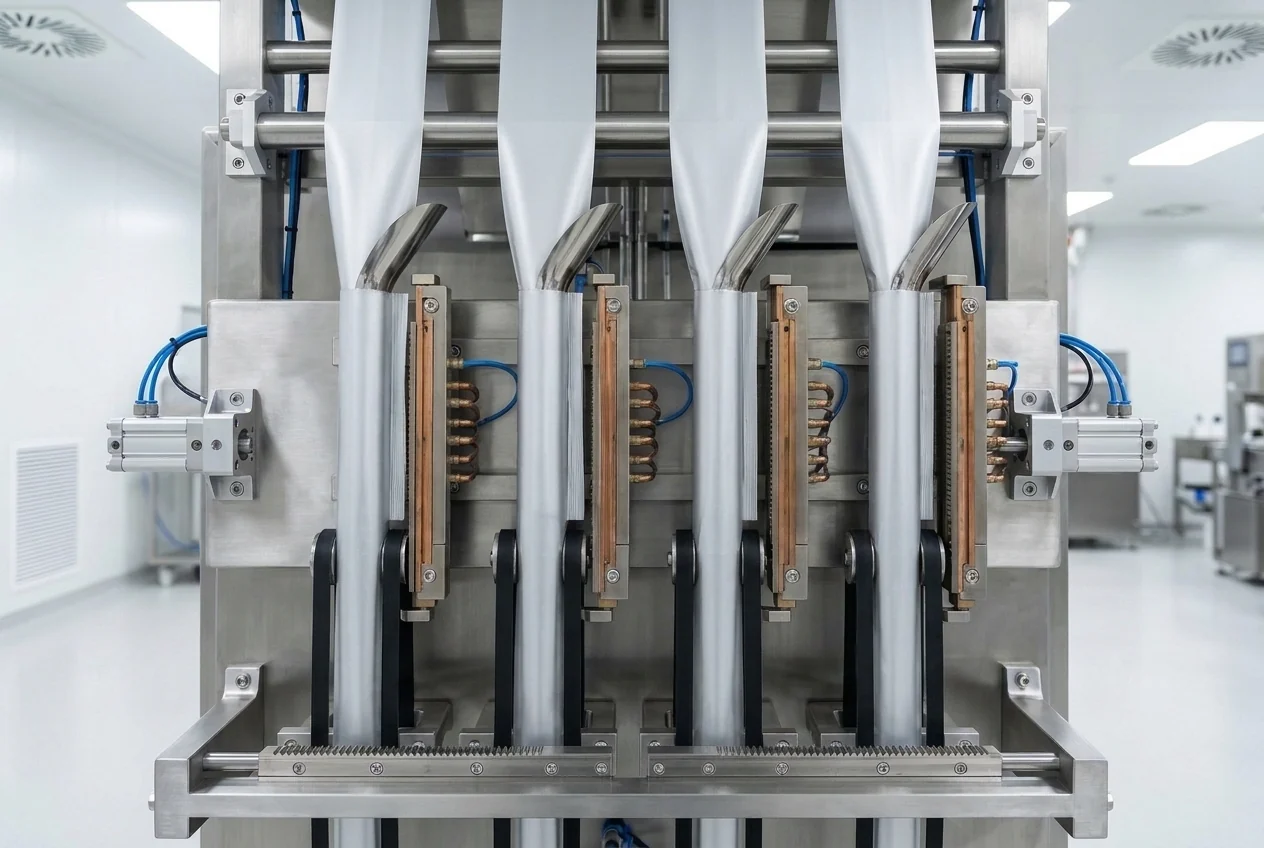
How Does an Offset Forming Collar Position a Side-Edge Fin Seal?
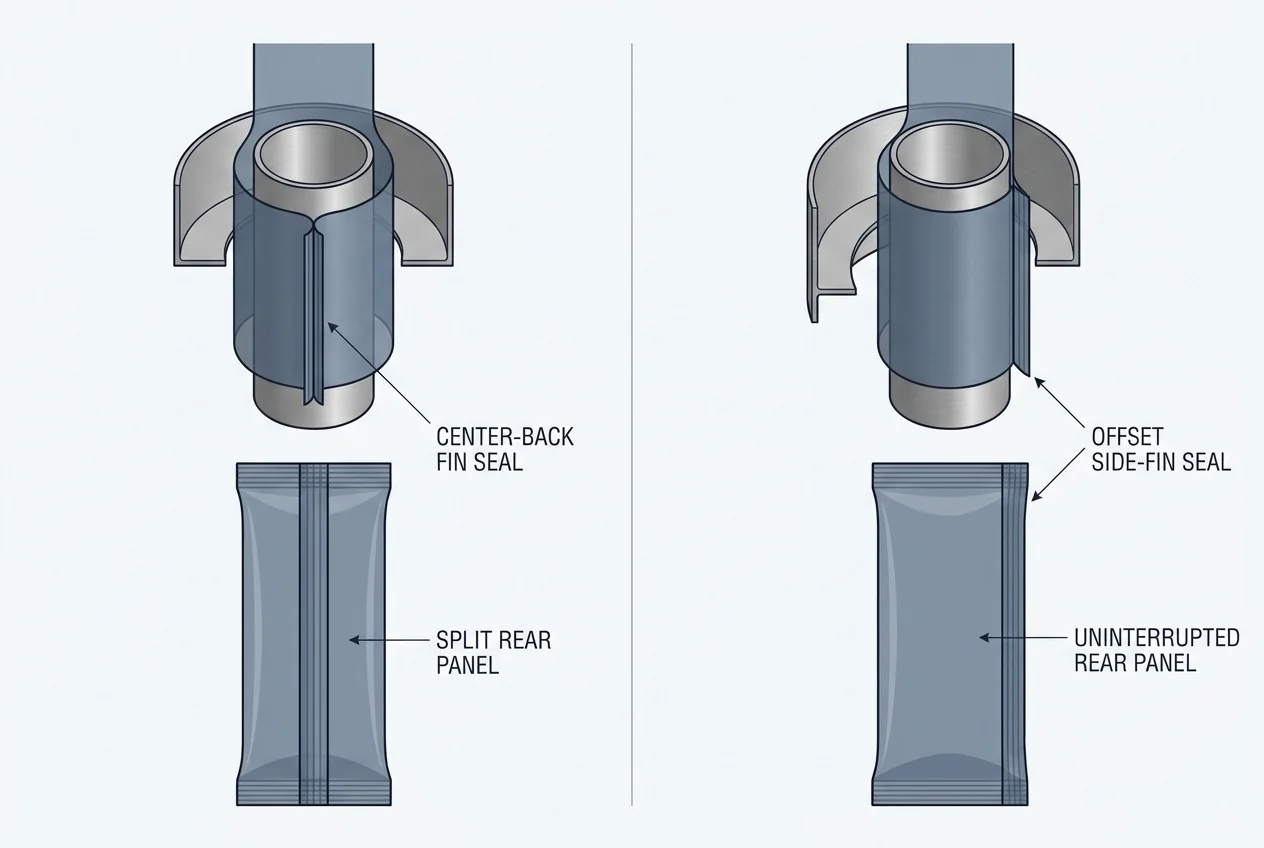
An offset forming collar guides each slit film strip asymmetrically around the hollow vertical forming tube so the two outer web edges meet at one lateral crease rather than down the middle of the rear panel, bonding the inner sealant surface to itself and folding the fin flap flat.
Standard center-back fin-seal tooling wraps the slit strip symmetrically so the folded fin bisects the rear face of the pouch. Shifting the folding locus on an asymmetric shoulder moves that same inner-to-inner fin bond to the lateral margin without changing finished flat stick width, which stays fixed by the forming tube—spanning 15–30 mm widths and 50–180 mm lengths in the four-lane powder reference configuration. Changing finished stick width or switching seam geometry requires installing a dedicated forming set.
Keeping a fin seal rather than switching to a lap seal matters whenever the laminate has a non-heat-sealable outer print layer. Because a fin seal joins the two inner sealant faces together, multi-layer barrier structures run without special outer heat-seal coatings, though both folded fin edges consume wider unfolded film strip allowance than a flat-overlapped lap seal.
Related reading: Fin Seal vs Lap Seal on Stick Packs: Film Width, Seal Layers & Dust Tolerance; Multi-Lane Stick Packaging Machines Compared
Further reading: Vertical form-fill-seal tube and fin-sealer geometry (Wikipedia)
Scroll horizontally to see all columns. Keyboard: focus the table and use the arrow keys.
| Longitudinal Seal Architecture | Forming Collar & Sealant Contact | Rear Panel Usability | Longitudinal Sealer Alignment |
|---|---|---|---|
| Center-back fin seal | Symmetric collar folds both web edges inward so inner sealant bonds to inner sealant; uses wider unfolded strip width than lap seal | Folded fin flap lies down the rear panel and splits back-panel artwork into two narrow halves | Vertical heat-sealing bar clamps against the center-back seam line of the forming tube |
| Offset side-fin seal | Asymmetric collar wraps slit web off-center so inner sealant bonds to inner sealant at one lateral margin; compatible with non-heat-sealable outer print layers | Folded fin moves to the side edge, leaving both front and rear panels continuous for text and barcodes | Vertical heat-sealing bar mounts on an offset lateral bracket aligned with the side edge of the forming tube |
| Lap seal | Asymmetric overlap guides one edge flat over the opposite edge so inner sealant bonds to a heat-sealable outer film surface with narrower strip width | Flat overlap avoids a protruding folded flap, though seam overlap still requires artwork clearance | Vertical heat-sealing bar presses the flat two-ply overlap directly against the forming tube backing surface |
How Is Vertical Heat-Sealing Bar Alignment Adjusted on Side-Fin Tubes?
Vertical heat-sealing bar alignment on a side-fin stick pack sealer repositions the heated bar carrier to the lateral seam edge of each forming tube, clamping the two inward-folded film margins squarely so matched sealing temperature, dwell time, and bar pressure fuse the inner sealant layers into an airtight seam.
On a vertical form-fill-seal packaging machine, transport belts pull the formed tube downward past the vertical sealing bar toward the horizontal cross-sealing jaws, which form the top seal of the filled pouch and the bottom seal of the next pouch simultaneously. Heat-seal integrity across both seams depends on how sealing temperature, dwell time, and jaw or bar pressure interact across the molten inner sealant layer before cooling.
Moving the folded fin from the center of the tube to the lateral edge also changes how the seam enters the horizontal cross-sealing nip. Operators align pull-belt grip and horizontal jaw faces so the folded side-fin transition flattens cleanly at one end of the cross seal without pinching or leaking, before the cross-cutting knife separates sticks with a straight, zig-zag, or round-corner cut and an optional tear notch or perforated chain.
Related reading: How a Stick Pack Machine Works
Further reading: Merabtene et al. (2022) VFFS heat-sealing window and dwell parameters
Why Does Moving the Fin Flap Free Up Regulatory Label Space?
Moving the folded fin flap to the side edge frees continuous rear-panel label space because federal food labeling rules under 21 CFR 101.2 classify folded flaps as unusable label space and state that required information-panel copy shall appear prominently and conspicuously at one-sixteenth inch minimum height without intervening material.
Under 21 CFR 101.2, the information panel on packaged food is defined as the part of the label immediately contiguous and to the right of the principal display panel—or immediately contiguous and to the right of any alternate principal display panel—and when an adjacent area is too small or unusable because of folded flaps, the next contiguous panel to the right may serve as the information panel.
On slim stick packs spanning 15–30 mm finished width in the four-lane powder reference configuration, a center-back fin flap interrupts the rear panel and restricts uninterrupted typography and barcode quiet zones. Shifting the fin seam to the lateral edge preserves one full-width rear panel while keeping barcodes, required text, date-code areas, and safe zones clear of longitudinal seam folds and heat-seal margins on the approved dieline.
Related reading: Stick Pack Artwork & Dieline Design
Further reading: 21 CFR 101.2(a) & (c) folded-flap and information-panel rules (eCFR)
Can Multi-Lane Powder and Liquid Lines Share Side-Fin Forming Sets?
Multi-lane stick pack frames tie finished stick width and longitudinal seam position directly to the installed forming collar and forming tube set, while dosing systems stay separated by product state—servo augers for dry powders, pumps with shut-off nozzles for liquids and gels, and volumetric cups or vibratory feeders for granules.
Multi-lane stick pack packaging machines slit one wide film reel into parallel strips so every lane forms, fills, and seals one narrow stick tube per cycle. Because finished stick width and seam fold path are hardware-locked to the forming tube, collar, rotary slitter spacing, and vertical sealer bracket, changing stick width or converting between center-back and side-fin geometry requires swapping the complete forming set across all lanes.
Even when two SKUs share identical 15–30 mm finished stick widths and 50–180 mm lengths, powder and liquid products do not share dosing heads on the same run. The four-lane powder reference configuration drives an independent servo auger per lane for about 1–20 g per stick—with doses around 30 g needing alternate tooling and a material trial—whereas liquid and gel machines pair each lane with dedicated liquid pumps and shut-off nozzles.
Related reading: Multi-Lane Stick Packaging Machines Compared; Powder Stick Pack Machine: Auger Dosing; Liquid Stick Pack Machine for Gels
What Web-Tracking and Friction Issues Affect Recyclable Side-Fin Films?
Folding recyclable, paper-based, or mono-material webs over an asymmetric side-fin collar changes thermal and mechanical behavior during vertical form-fill-seal production, amplifying forming-shoulder wrinkling, web buckling, forming-tube sliding friction, and pouch airtightness sensitivity when lane-slitting positions, eye-mark registration, or web tension remain set for symmetric center-back folding.
Conventional multi-layer stick pack laminates balance outer print stiffness, middle oxygen or moisture barrier layers, and an inner sealant layer engineered for clean bonding. In published industrial vertical form-fill-seal runnability testing by Merabtene et al., thermoplastic reference film sealed from 100 °C at a 2 s dwell time and shrank above 140 °C, whereas coated paper-based webs sealed up to 220 °C before browning while exhibiting web buckling from shear misalignment, wrinkling over narrow shoulder fillets, and frictional heat buildup inside the forming tube.
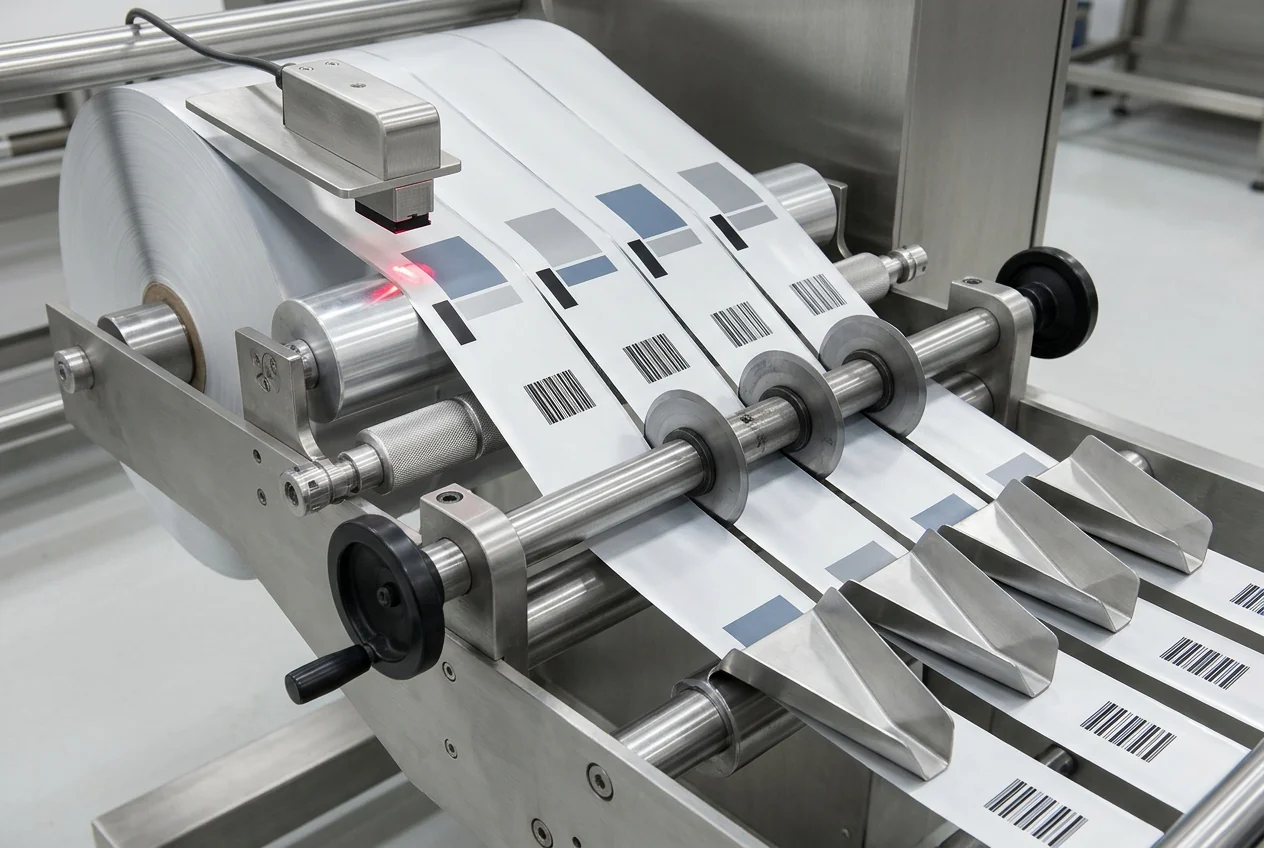
Because multi-lane parent reel width equals the unfolded strip width per lane multiplied by lane count plus web edge allowance, asymmetric side-fin folding demands exact lane-slitting offsets and repeat pitches across the web. Aligning rotary slitter knives, web tension control, and optical eye-mark registration sensors with the approved asymmetric dieline prevents edge wander and fin-width drift.
Related reading: Stick Pack Film & Machine Compatibility; Stick Pack Artwork & Dieline Design
Further reading: Merabtene et al. (2022) VFFS forming-shoulder wrinkling and tube friction
How Do Powder Dosing Tubes Clear the Offset Longitudinal Seal Bar?
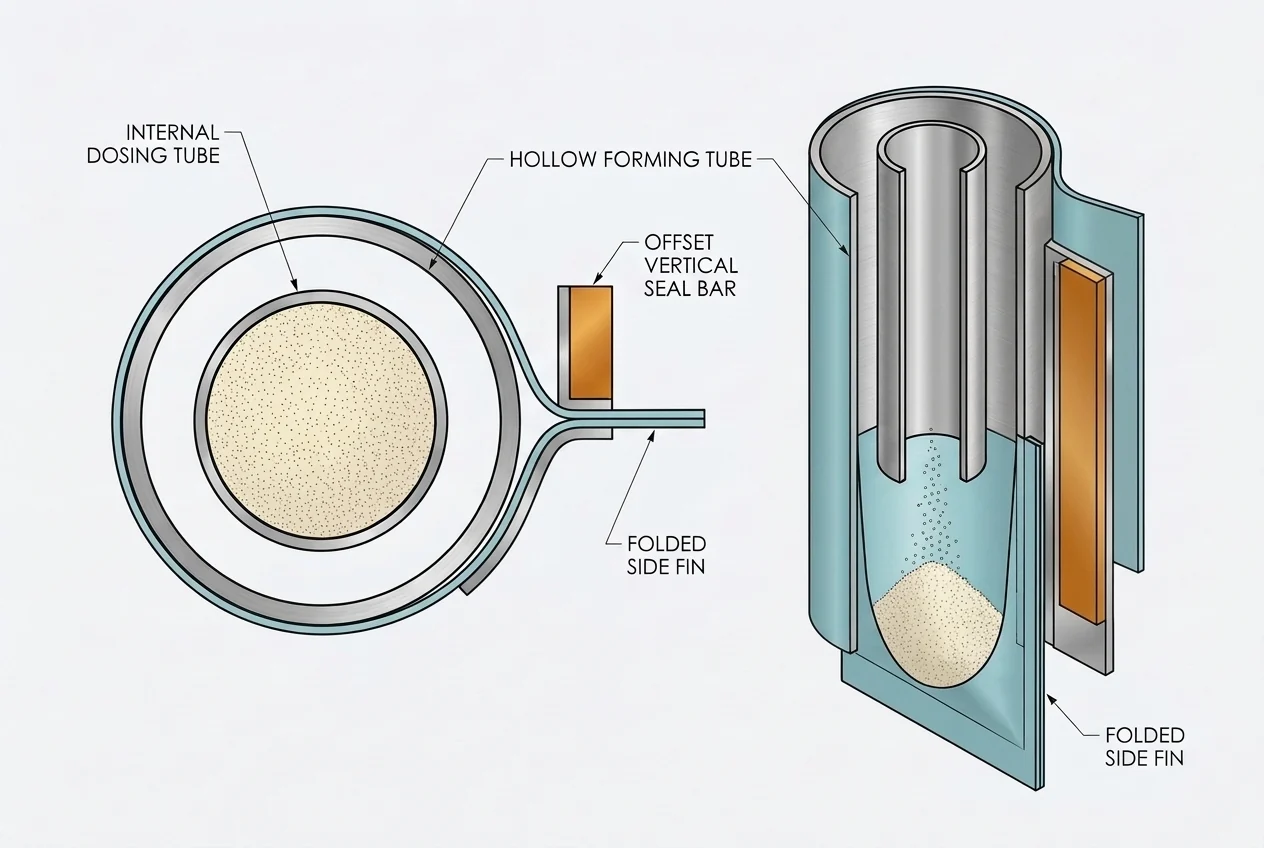
Food supplement powder stick pack machines maintain mechanical and thermal clearance between product dosing and the offset longitudinal seal bar by routing each lane's auger downspout concentrically down the hollow interior of the forming tube while the film wraps and seals along the exterior lateral wall.
During each vertical form-fill-seal cycle, flat slit film wraps around the outside of the hollow forming tube and the offset vertical heat-sealing bar clamps the meeting inner sealant edges against the outer lateral support before product discharges through the internal bore into the bottom-sealed pouch cavity. Because the forming tube wall separates the internal powder stream from the external vertical bar, relocating the fin seam from center-back to the side edge leaves internal dosing clearance unchanged across 15–30 mm reference stick widths.
In multi-lane supplement powder production, each lane's independent servo auger matches dose volume and powder flow to the available cycle time before horizontal cross sealing, while liquid stick pack machines extend dedicated shut-off nozzles into the bore to keep residue off the seal zone. Pairing clean internal discharge with an inner sealant layer engineered to seal through fine powder dust protects both longitudinal and horizontal seal tightness.
Related reading: Powder Stick Pack Machine: Auger Dosing
Which Forming Set and Film Web Parameters Should Buyers Confirm?
Before ordering printed rollstock or locking a multi-lane side-fin forming set, packaging teams verify finished stick width and length, unfolded fin-seal strip width, parent reel slitting pitch, eye-mark sensor coordinates, rear-panel seam clearances, film coefficient of friction, and product dosing trials on one approved specification record.
Because lane count, finished stick width, and film reel width are fixed together on multi-lane equipment, shifting from a center-back fin seal to an offset side-fin seal changes where the slit edges fold relative to front and rear artwork panels without altering the unfolded strip width consumed by the fin. Confirming both film runnability and product bulk volume in a pre-purchase trial prevents mismatch between printed cylinders and forming collars.
Related reading: Stick Pack Machine Buying Guides; Multi-Lane Stick Packaging Machines Compared; Fin Seal vs Lap Seal on Stick Packs: Film Width, Seal Layers & Dust Tolerance; Stick Pack Artwork & Dieline Design; Stick Pack Film & Machine Compatibility
Scroll horizontally to see all columns. Keyboard: focus the table and use the arrow keys.
| Parameter to Confirm | Center-Back vs. Offset Side-Fin Impact | Specification Input for Drawing & Trial |
|---|---|---|
| Finished stick width and length | Finished width is fixed by the forming tube on both styles; switching width or moving the fin to the side edge requires a dedicated forming set | Specify flat finished width (15–30 mm four-lane powder reference) and stick length (50–180 mm reference) on the pack drawing |
| Unfolded strip width and parent reel width | Both fin-seal styles fold two inner sealant edges together and need wider unfolded strip allowance than a lap seal | Confirm unfolded strip width per lane multiplied by lane count plus web edge allowance on the approved web-layout drawing |
| Lane slitting pitch and eye-mark registration | Offset side-fin folding shifts panel centerlines relative to the slit edges, requiring matched rotary slitter and eye-mark sensor positions | Align lane slit lines, repeat pitch, eye-mark track, and tear-notch coordinates on the multi-lane dieline before print release |
| Rear information panel and barcode safe zones | Offset side fin removes the folded flap from the rear panel so 21 CFR 101.2 copy and barcodes sit on an uninterrupted surface | Keep mandatory text (minimum one-sixteenth inch height unless exempt), date codes, and barcode quiet zones clear of lateral seam folds |
| Laminate stiffness, COF, and heat-seal window | Asymmetric shoulder folding increases sensitivity to coefficient of friction, wrinkling, and narrower recyclable or paper-web seal windows | Provide barrier laminate structure, inner sealant grade, and trial reels to verify sealing temperature, dwell time, and bar pressure |
| Product dosing route and bore clearance | Internal dosing tubes run inside the hollow forming tube bore while the vertical sealer clamps the offset lateral fin outside | Test production powder (about 1–20 g reference; around 30 g needs alternate tooling and trial) or liquid shut-off nozzles across all lanes |
Discuss this configuration
Discuss on WhatsAppSources
Federal food-labeling rules, vertical form-fill-seal heat-sealing and web-runnability research, and forming-station references cited in this guide:
Further reading: eCFR — 21 CFR § 101.2 Information panel of package form food; NC State BioResources — Merabtene et al. (2022), Heat-Sealing & VFFS Runnability of Flexible Packaging; Wikipedia — Vertical form fill sealing machine
Common Questions
What is the difference between a side fin stick pack packaging machine and a center-back fin seal machine?
Both machines fold the two film edges inward to bond inner sealant to inner sealant, which allows multi-layer laminates with non-heat-sealable outer print layers to seal cleanly. A center-back machine places that folded fin down the middle of the rear panel, whereas a side fin stick pack packaging machine uses an asymmetric forming collar and offset vertical heat-sealing bar to position the folded fin along one lateral edge so both front and rear panels stay uninterrupted.
Why does 21 CFR 101.2 favor an offset side-fin seal on narrow food and supplement stick packs?
Under 21 CFR 101.2, folded flaps are classified as unusable label space, and mandatory information-panel statements shall appear prominently and conspicuously with no intervening material and at a minimum type height of one-sixteenth inch unless an exemption applies. Moving the folded fin flap off the rear panel onto the side edge frees continuous rear-panel width for required statements and scannable barcodes on narrow 15–30 mm sticks.
Does switching from a center-back fin seal to a side-fin seal reduce film reel width like a lap seal?
No. An offset side-fin seal still folds two inner sealant margins together and consumes wider unfolded strip allowance per lane than a flat-overlapped lap seal. Parent reel width on a multi-lane machine remains equal to the unfolded strip width per lane multiplied by lane count plus web edge allowance.
Can an existing multi-lane stick pack machine convert to side-fin sealing without changing the forming set?
No. Finished stick pack width and longitudinal seam position are fixed by the forming collar, hollow forming tube, rotary slitter spacing, and vertical heat-sealing bar bracket, so converting between center-back and offset side-fin geometry—or changing stick width—requires installing a dedicated forming set across all lanes.
Why do recyclable or paper-based films wrinkle more easily on asymmetric side-fin forming shoulders?
Transitioning from conventional multi-layer laminates to recyclable, paper-based, or mono-material webs alters film stiffness, surface roughness, thermal sealing windows, and coefficient of friction. If lane-slitting offsets, web tension, or eye-mark registration sensors are not aligned to the asymmetric fold path, uneven drag across the forming shoulder triggers wrinkling, web buckling, and loss of pouch airtightness.